
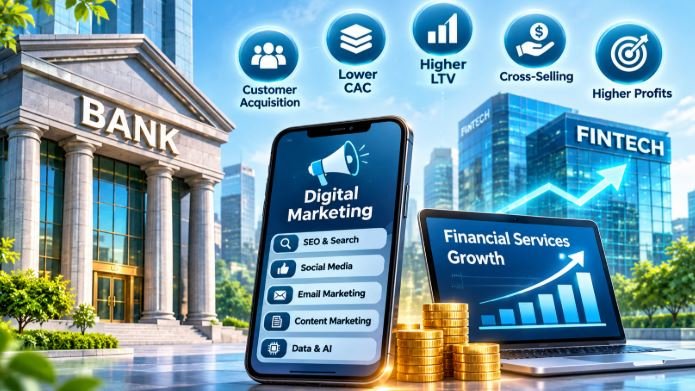
The financial services industry is undergoing a major transformation as customers increasingly turn to digital platforms to compare financial products, manage money, apply for loans and make investment decisions. For banks, fintech startups, insurance providers and other financial companies, digital marketing has become much more than a promotional activity. It is now a strategic business tool for attracting customers, building trust, improving customer retention and increasing profitability.
Traditional marketing methods alone are no longer sufficient to reach digitally connected consumers. Financial institutions are investing in search engine optimisation (SEO), paid advertising, social media, email campaigns, data analytics and personalised customer experiences to connect with people at the right moment.
The real business value lies in turning online engagement into measurable financial outcomes. When digital marketing is supported by effective technology, relevant content and a smooth customer journey, it can help financial companies reduce customer acquisition costs, generate qualified leads and increase the lifetime value of existing customers.
1. Reaching Customers at the Right Time Through Search and AI
Customers often begin their financial journey online. They search for home loan interest rates, credit cards, insurance policies, investment options, business loans and savings accounts before approaching a financial institution.
Banks and fintech companies use SEO and paid search advertising to appear when potential customers are actively looking for these services. By targeting relevant search terms, financial brands can attract people who already have a specific financial need.
The growing use of AI-powered search tools is also changing how companies approach online visibility. Financial institutions are beginning to structure their websites and educational content so that useful information can be discovered through AI-generated answers and conversational search experiences. This emerging approach is often associated with Answer Engine Optimisation (AEO).
Another important development is predictive marketing. By analysing permitted first-party customer data and engagement patterns, financial companies can identify potential needs and deliver relevant offers. For example, a customer researching home loans may receive information about mortgage products, while an existing account holder exploring investment content may be introduced to suitable wealth-management services.
The objective is to make marketing more relevant rather than simply increasing the number of advertisements.
2. Using Email and Paid Advertising to Generate High-Quality Leads
Email marketing and paid search remain important channels for financial companies because they can reach specific audiences and support measurable customer journeys.
Banks use email campaigns to communicate product updates, explain financial services, share educational material and encourage customers to explore relevant offerings. Fintech companies use automated email sequences to guide users through registration, verification and product adoption.
Paid search advertising helps financial brands reach customers who are actively comparing products or looking for solutions. Campaigns can be designed around specific objectives, such as generating loan enquiries, encouraging account openings or attracting insurance applications.
However, profitability depends on more than the number of clicks or enquiries. Companies must evaluate the quality of leads, conversion rates, acquisition costs and the revenue generated from each campaign.
A campaign that attracts fewer but more qualified customers may deliver better commercial results than one that generates a large volume of low-intent traffic.
3. Building Customer Trust Through Educational Content
Trust is one of the most valuable assets in financial services. Customers are making decisions involving their savings, investments, credit and long-term financial security. They therefore expect clear information and reliable guidance before choosing a provider.
This is why many financial brands are moving beyond traditional product advertising and investing in educational content.
Banks, fintech platforms and investment companies publish blogs, explainers, videos, webinars and financial guides to help customers understand complex subjects. Topics may include credit scores, taxation, mutual funds, digital payments, retirement planning, loans and personal finance.
A notable Indian example is Zerodha’s educational platform, Varsity, which provides free resources on investing and financial markets. Such educational initiatives can help users develop financial knowledge while building familiarity with the brand.
Content marketing can support business growth in several ways:
- It improves organic search visibility.
- It helps customers understand financial products before making decisions.
- It builds credibility and strengthens brand authority.
- It attracts potential customers at different stages of the buying journey.
- It can reduce the time sales and customer-support teams spend explaining basic concepts.
For financial companies, useful and transparent information can become a long-term customer acquisition asset.
4. Using Social Media and LinkedIn to Reach Valuable Audiences
Social media has become an important communication and marketing channel for financial institutions. Platforms such as Instagram, Facebook, YouTube and LinkedIn allow companies to reach different customer segments with relevant messages.
Retail banks and fintech brands use short videos, educational posts, product explainers and customer-service updates to engage individual consumers. These platforms also help companies communicate their brand values and respond to customer questions.
LinkedIn plays a particularly important role in business-to-business financial marketing. Commercial banks, corporate lenders, insurance providers and wealth-management firms use the platform to reach business owners, senior executives, finance professionals and institutional decision-makers.
Thought leadership, industry reports, expert commentary and case studies can help financial companies establish credibility with these audiences.
The commercial opportunity is significant: a well-targeted social media strategy can generate business enquiries, strengthen relationships and support customer acquisition without depending entirely on conventional advertising.
5. Making Customer Onboarding Faster and Easier
Attracting a potential customer is only the first step. Financial companies must also make it easy for that person to complete the application process and start using the service.
Complicated forms, repeated documentation requests, unclear instructions and slow verification can cause customers to abandon an application. Digital marketing therefore needs to work alongside product design and customer experience.
Many digital banks and fintech platforms focus on mobile-friendly websites, simplified application journeys, digital identity verification and clear instructions to reduce friction.
A smooth onboarding experience can improve conversion rates and reduce the cost of acquiring each active customer. It also creates a better first impression, increasing the likelihood that customers will continue using the service.
Financial institutions are also adopting hybrid customer-service models. Digital platforms handle routine enquiries and transactions, while relationship managers and financial advisors provide personal assistance for more complex or high-value requirements.
This combination of technology and human support can improve operational efficiency without removing the personal element that many financial decisions require.
6. Embedding Financial Services into Everyday Digital Platforms
Another important growth opportunity comes from embedded finance. Instead of expecting customers to visit a bank or financial company’s website, businesses can make financial services available through platforms that customers already use.
For example, a customer purchasing a product online may be offered an eligible payment or financing option during checkout. A business management platform may integrate payment processing or lending services, while a digital marketplace may provide access to insurance or other financial products.
These partnerships allow financial companies to reach customers closer to the point where a financial need arises.
APIs and digital integrations make it possible for banks, fintech providers and commercial platforms to connect services and create more convenient customer experiences.
For financial institutions, embedded finance can open additional distribution channels, create partnership revenue opportunities and increase product adoption. Its success, however, depends on transparent terms, responsible lending practices, data security and appropriate regulatory compliance.
7. Turning Digital Marketing into Measurable Profit
The strongest digital marketing strategies connect marketing activity directly to business performance. Financial companies increasingly evaluate campaigns using metrics that reveal whether marketing investments are producing sustainable returns.
Key performance indicators include:
- Customer Acquisition Cost (CAC): The total marketing and sales expense required to acquire a new customer.
- Customer Lifetime Value (LTV): The estimated revenue or contribution a customer generates over the relationship with the company.
- Lead-to-Customer Conversion Rate: The proportion of qualified enquiries that become active customers.
- Return on Advertising Spend (ROAS): The revenue attributed to advertising compared with the amount spent.
- Customer Retention Rate: The percentage of customers who continue using the company’s services over a defined period.
- Cross-Selling and Upselling: The ability to introduce relevant additional products to existing customers.
These indicators help financial companies identify which channels and campaigns deliver the strongest commercial value.
For instance, a bank may discover that educational content attracts customers at a lower acquisition cost than certain paid campaigns. A fintech company may find that improving its onboarding process increases the percentage of registered users who become active customers.
Such insights allow marketing budgets to be allocated more effectively and help companies focus on sustainable revenue rather than short-term traffic growth.
8. Increasing Customer Lifetime Value Through Personalisation
Acquiring a customer is expensive, so financial companies have a strong commercial incentive to build lasting relationships with existing customers.
Personalised marketing helps institutions introduce relevant services based on customer needs, preferences and engagement. An existing banking customer may receive information about a suitable credit card, insurance product or investment service. A business account holder may be introduced to payment solutions or working-capital facilities.
Customer relationship management systems and analytics tools help financial companies organise customer information and deliver more relevant communication.
However, personalisation must be handled responsibly. Financial institutions need to respect customer consent, privacy requirements and applicable data-protection rules. Sensitive financial information should never be used carelessly or to create misleading or inappropriate marketing messages.
When done properly, personalisation can improve customer satisfaction, encourage product adoption and increase the long-term value of customer relationships.
9. Managing Compliance, Data Security and Responsible Marketing
Financial marketing operates in a highly regulated environment. Companies must ensure that promotional campaigns are accurate, transparent and consistent with applicable financial regulations.
Misleading claims about investment returns, hidden charges, exaggerated loan benefits or unclear product conditions can damage customer confidence and expose companies to regulatory and reputational risks.
Digital marketing teams must work closely with compliance, legal, cybersecurity and risk-management departments. This is particularly important when using automated targeting, AI tools, customer data and third-party advertising platforms.
Financial companies should prioritise:
- Clear disclosure of fees, risks, eligibility conditions and product terms.
- Responsible use of customer information and consent-based communication.
- Secure handling of personal and financial data.
- Accurate and verifiable claims in advertisements.
- Appropriate review of AI-generated content and automated campaigns.
- Compliance with applicable advertising and financial-sector regulations.
Responsible marketing is not simply a legal requirement. It is essential to building the long-term trust on which financial services businesses depend.
10. The Future of Digital Marketing in Financial Services
The next phase of financial marketing will be shaped by artificial intelligence, predictive analytics, conversational interfaces, automation and increasingly personalised digital experiences.
AI can help financial companies analyse campaign performance, improve customer segmentation, automate routine communication and identify opportunities to make marketing more efficient. Conversational tools may also help customers find information and navigate financial services more easily.
At the same time, competition for digital visibility will intensify. Banks and fintech companies will need to create credible content, improve mobile experiences and demonstrate the value of their products clearly.
The companies most likely to benefit will be those that combine technology with customer understanding, responsible data practices and measurable business objectives.
Conclusion:
Digital marketing is changing how banks, fintech firms and financial institutions attract customers, build relationships and generate revenue. From search visibility and educational content to personalised campaigns, digital onboarding and embedded finance, online channels are creating new opportunities for financial companies to expand their reach and improve business performance.
However, sustainable profitability does not come from digital visibility alone. It comes from attracting the right customers, reducing acquisition costs, improving conversion rates, retaining existing users and offering products that genuinely meet customer needs.
Financial institutions that connect marketing strategy with technology, customer experience, data security and regulatory responsibility can turn digital engagement into long-term business value. In an increasingly competitive financial marketplace, digital marketing is no longer just a support function. It is becoming a central driver of customer growth, operational efficiency and profitability.
