
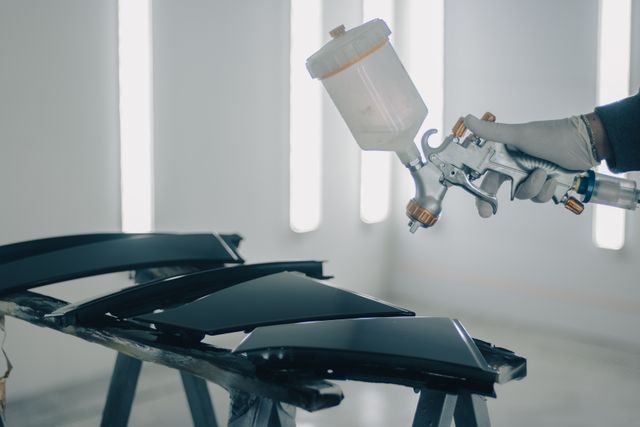
OEM colour matching is superior to generic touch-up paint as it recreates the precise factory mix of your car per its paint code so that the repair will be virtually invisible, whereas the spot may remain slightly off, being noticed in daylight as a different patch. Generic paint sold in broad shades like “silver” or “red” is an imprecise guess even a tiny mismatch will reveal itself under the sunlight. Having the same colour as the original paint in car repair means that the spot will not only disappear from view, but it will also prevent people from paying attention to the place where you were concealing.
In fact, the major issue that makes this matter so much is the nature of how human eyes detect color through a reference. Any paint left undried next to the factory surface surrounding it and your brain will automatically detect that the tone, brightness and or the reflection of light upon it are different. A minor discrepancy will still look out of place and most of the time the mismatch from the generic paint will be big enough to be clearly noticeable on a visible panel.
What OEM Colour Matching Actually Means
OEM is the abbreviation for original equipment manufacturer, and OEM colour matching involves the paint being mixed per the very formula that the factory used on the specific car from which the paint code was derived. Your paint code, a brief series of letters and numbers, can be found on a sticker inside the driver’s car, under the bonnet or in the service book. Two cars of the same model and year may look completely different because of their colours, and only the code can reveal the correct colour for yours.
Generic touch-up paints bypass this process. They are mixed with an abstract representation of a popular colour so that they look good on different types of cars with different colours, not being a perfect fit for any one of them. To avoid a one-size-fits-all bottle, a manufacturer may even change a single colour family into a dozen variations, each of which would have its own paint formula, so that a single paint can would only give a close shade.
On metallic and pearlescent ones, the paint colour is still shifting because of the light reflection that varies as the observer’s position varies around the car. These kinds of paints have been prepared with a combination of aluminium flakes or pearl pigments so that only when a flake changes position and packing density of the particle do we see changes in the colour perception. So the use of a regular factory paint can only give a very good approximation to the factory paint because the factory has a special kind of particle that the regular factory cannot imitate. This is the reason why many generic repairs on metallic cars appear to be dull, or have an unnatural shade from certain points of view.
Why Generic Paint Gives Itself Away
The most obvious tell is a clear and mismatched colour in daylight. In the dim light of a garage, almost every regular repair will show good results, but sunlight doesn’t forgive any kind of error and exposes, e.g. a patch which is one shade too warm, too cool or too dark. At this moment most people start to realize that they have really damaged more, rather than hidden it. Then again, the age of the colour is another problem. Factory paint is very light in colour and, since the UV rays are continuously causing the colour to fade, the bonnet which is ten years old can be seen to be quite lighter now than when it was new. Even when the fresh paint matches perfectly with the old one, that new paint is more accurate to the color of the original and the weathered surface is now not able to reflect it. For this reason, only top systems have a blending stage where fresh paint is gradually blended with the aged surrounding area rather than leaving the edge clearly defined.
Texture and finish also have a big impact. Generic paints quite regularly end up being a different shade compared to the surrounding clear coat. That’s why even if the colour matches to quite a good level, they do appear as a patch due to a different reflection of light. Factory finishes usually consist of a base plus clear coat combination, whereas many cheap paint cans suggest that the clear coat can be omitted from the repair, which would mean that the finished patch would be the duller finish compared to the panel around it.
How the Repair Process Differs in Practice
A proper OEM-matched repair is a layered job, and that structure is what makes it disappear. You clean and degrease the area, treat any bare metal or rust, apply primer where needed, build the colour in thin coats, blend it into the surrounding paint, and seal it with clear coat. Each step exists to make the final result flush and consistent with the original finish.
A quality kit built around your paint code supplies the matched colour along with the primer, blending solution, and clear coat, which is where something like chipex touch up paint does the work a single generic bottle can’t, because the blending stage levels the fresh paint into the old rather than leaving it sitting on top. Generic paint typically gives you colour and nothing else, leaving you to guess at the rest of the process.
The cost comparison is closer than people expect, which makes the quality gap harder to justify skipping. A generic touch-up bottle might cost £5 to £15, while a full colour-matched system usually runs £15 to £40. You’re spending marginally more for a result that actually hides the damage, versus saving a few pounds on a repair you may end up redoing or paying a body shop £80 to £300 to correct. The cheaper option often turns out to be the more expensive one.
When the Difference Matters Most and Least
The damage location and the make and model of the car will determine the extent to which you should pay a premium and getting a truthful understanding of that is a great way to avoid splurging unnecessarily. A perfect OEM match will be a fair investment for a part such as the bonnet, the wing, or the door that is always exposed. On a part such as the sill, door edge, or the bumper corner, one would never inspect closely; an imperfect repair slightly will still be completely alright, and the gap between OEM and generic will have little significance.
And, the car itself also affects the scenario. In a premium or practically brand new car, the presentation of the buyer and the valuer have got to be very close to perfection. So, a generic repair that is obvious to the eye could bring a lower price at the point of sale than the paint itself saved you. Whereas for a used car which you are driving until it dies, functionality will be the key factor and preventing corrosion will be the real aim, irrespective of the slight difference in shades.
Besides, color choice also matters. The most forgiving colors are the solid whites, blacks, and primary colors. The careful work of a generic paint job can still fool a discerning eye with these colors. Metallic, pearl and tri-coat (which is factory finish) are the ones where generic paint will not only look cheap or even invisible compared to the original but there simply will not be a possibility of replication in a generic formula of the original one. When your car gets one of those finishes, you will stop considering OEM matching if you want how the repair looks as your main concern.
