
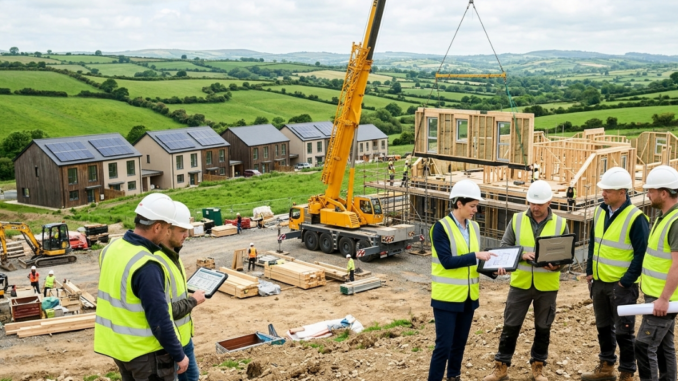
Nov 03: Ireland’s housing shortage is creating significant opportunities across the construction industry. With demand for new homes continuing to exceed the pace of delivery, the country needs more than residential developers to address the challenge. Building material manufacturers, engineering firms, infrastructure companies, technology providers and specialist contractors all have a role to play.
For businesses, this presents an opportunity to participate in a market shaped by population growth, government housing commitments and increasing infrastructure investment. The demand for new homes is also encouraging companies to explore faster construction methods, sustainable building materials and technologies that can improve project efficiency.
However, translating this demand into business growth will not be straightforward. Rising material costs, labour shortages, planning delays and infrastructure limitations continue to affect the pace of construction. How the industry responds to these challenges will influence the opportunities available to businesses over the coming years.
Ireland’s Housing Demand Is Creating New Construction Opportunities
Ireland’s housing requirements have become a major priority for policymakers, developers and the wider business community. Population growth, changing household structures and demand for affordable accommodation are putting additional pressure on the residential property market.
According to Ireland’s Central Statistics Office (CSO), 10,154 new homes were completed in the third quarter of 2026, an increase of 10.4% compared with the same period in 2025. Completions during the first nine months of the year reached 26,833, representing year-on-year growth of 10.6%.
The figures also show activity across different residential segments. Apartment completions increased by 9.8% during the third quarter, while housing scheme completions rose by 13.5%.
Over the 12 months to September 2026, Ireland recorded 38,589 new home completions. Although this represents progress, housing demand remains substantially higher than current delivery levels. Industry estimates suggest a pent-up housing requirement of between 250,000 and 300,000 homes.
For construction businesses, this gap represents a substantial potential market. Developers need more than additional building capacity; they also require reliable suppliers, skilled contractors, engineering expertise and supporting infrastructure to deliver projects at scale.
Government Housing Targets Are Supporting Long-Term Investment
Government policy will play an important role in determining how quickly Ireland can address its housing shortage.
Under its Delivering Homes, Building Communities 2025–2030 strategy, the government aims to deliver 300,000 homes by the end of 2030. The programme includes targets for 72,000 social homes and 90,000 affordable housing supports.
It is backed by a €275 billion National Development Plan covering ten years, with investment directed towards transport, water, energy and other essential infrastructure. The government has also allocated more than €9 billion in capital funding for housing in 2026.
The scale of the ambition highlights the gap between current delivery and long-term requirements. Delivering 300,000 homes over five years represents an average of approximately 60,000 homes annually if spread evenly across the period. Against this benchmark, the latest 12-month completion figure of 38,589 homes highlights the need for a substantial increase in construction capacity.
Industry forecasts nevertheless point towards further expansion. EY Ireland’s July 2026 assessment for EUROCONSTRUCT projected housing completions of 40,000 in 2026, increasing to 43,000 in 2027 and 47,000 in 2028. Construction output is forecast to grow by 5.3% in 2026, followed by 5.8% in 2027 and 6.2% in 2028.
These projections indicate that residential development and public infrastructure investment could remain important drivers of economic activity over the medium term. However, achieving the government’s housing ambitions will depend on turning planning permissions and project commencements into completed homes.
For businesses, this creates opportunities across public housing, private residential developments, site preparation, utilities, civil engineering and supporting services.
Where Are the Biggest Business Opportunities in Ireland’s Construction Sector?
The housing shortage is creating demand well beyond traditional construction companies. As more residential projects move forward, businesses providing materials, specialist services and construction technologies could benefit from the expanding market.
Building Materials and Supply Chain Businesses
Every new housing development requires a steady supply of cement, concrete, steel, timber, insulation, glass, plumbing products and electrical equipment. As construction activity increases, manufacturers, distributors and wholesalers have an opportunity to strengthen their presence in Ireland.
Price competitiveness will matter, but so will product quality and dependable delivery. Contractors working with tight project schedules need suppliers who can maintain consistent inventory and avoid delays.
Cost management is particularly important as building material prices continue to fluctuate. The CSO’s September 2026 Wholesale Price Index recorded a 3.8% annual increase in construction product prices. Reinforcing metal prices rose by 12.5%, while ready-mixed mortar and concrete increased by 6.6%.
These changes make procurement planning and supply chain management increasingly important for businesses looking to protect their margins.
For international manufacturers, Ireland could offer opportunities to supply specialist construction products, prefabricated components and energy-efficient materials through partnerships with local distributors and contractors.
Modular Construction and Prefabricated Building Solutions
Ireland’s housing requirements are also bringing greater attention to modern methods of construction (MMC). Modular housing and prefabricated building components offer an alternative to relying entirely on traditional construction techniques.
Under this approach, selected building components are manufactured in controlled factory environments and transported to construction sites for assembly. This can reduce the amount of work required on-site, improve consistency and help manage construction schedules.
The approach is particularly relevant when developers are looking to increase output while dealing with limited labour availability.
Manufacturers of prefabricated walls, structural components, modular housing units and bathroom pods could find opportunities as the industry explores more efficient ways to deliver residential projects.
The Irish Government has also highlighted the potential workforce benefits of modern construction methods. Its construction skills assessment estimates that wider adoption of MMC could reduce the additional workforce requirement for new homes and retrofits from approximately 79,000 workers to 69,000.
For manufacturers and technology companies, this creates an opportunity to introduce factory-based production systems, specialised equipment and construction solutions that support faster project delivery.
Sustainable Construction and Energy-Efficient Buildings
Sustainability is becoming an important part of construction planning in Ireland. Developers increasingly need to consider the energy performance of buildings, the environmental impact of materials and the long-term operating costs of properties.
This is creating demand for insulation products, energy-efficient windows, low-carbon construction materials, heat pumps and renewable energy systems.
There is also a sizeable opportunity in the renovation and retrofitting market. Ireland’s existing building stock requires energy improvements, creating work for insulation contractors, energy assessors, heating specialists and renewable technology providers.
For companies operating in this space, the opportunity is not limited to new residential developments. Retrofitting older properties offers another potential source of business, particularly for businesses specialising in energy upgrades and sustainable building solutions.
Engineering, Architecture and Project Management Services
Building more homes also means greater demand for professional services throughout the development process.
Architects, structural engineers, quantity surveyors, land surveyors and project management consultants are needed to take projects from the initial planning stage through to completion.
Developers must manage budgets, coordinate contractors, secure approvals and ensure that projects meet the required building standards. Firms that can provide dependable technical expertise and manage complex projects efficiently could benefit from increased development activity.
There is also room for specialist subcontractors working in electrical installations, plumbing, heating, roofing and other essential areas.
As housing projects become larger, companies offering integrated engineering and project management services could find opportunities to establish longer-term relationships with developers and infrastructure contractors.
Construction Technology and Digital Solutions
Technology is gradually changing how construction projects are planned and managed. As developments become more complex, contractors are looking for better ways to monitor progress, control costs and coordinate different teams.
Building Information Modelling (BIM), digital project management platforms, site monitoring tools and cloud-based collaboration systems can improve visibility across different stages of a project.
There is also demand for software that supports procurement, equipment tracking, workforce scheduling and health and safety management.
For technology providers, Ireland’s construction market offers an opportunity to develop solutions around practical industry requirements. Companies that can demonstrate measurable improvements in project coordination, cost management and productivity may find opportunities to work with developers and contractors.
Regional Development Is Creating Opportunities Beyond Dublin
Dublin remains an important centre for residential construction, but housing development is not limited to the capital.
CSO figures for the third quarter of 2026 show that Dublin accounted for 37% of new dwelling completions, followed by the Mid-East region at 18%.
The West recorded the strongest year-on-year regional growth at 33%, while the South-East and South-West recorded increases of 24% and 22%, respectively.
These figures highlight the importance of regional markets when evaluating opportunities in Ireland’s construction sector.
Dublin and its surrounding areas continue to offer opportunities in apartment developments, large residential projects and supporting infrastructure. Cork and Galway also offer potential for housing construction, building material distribution and specialist engineering services.
For suppliers and contractors, expanding beyond the capital could help them access a wider range of projects and build relationships with regional developers.
However, businesses should assess local planning activity, infrastructure availability, workforce capacity and the project pipeline before committing resources to a particular location.
Labour Shortages and Construction Costs Remain Major Challenges
Despite the positive outlook, the availability of skilled workers remains one of the biggest challenges facing Ireland’s construction sector.
Electricians, plumbers, carpenters, civil engineers, quantity surveyors and experienced site managers are all important to increasing housing output. However, expanding construction activity also increases competition for these skills.
Ireland’s March 2026 National Framework for Meeting Priority Construction Workforce Needs highlighted the importance of expanding apprenticeship and training capacity, improving productivity and attracting skilled workers to the sector.
This creates opportunities for recruitment agencies, vocational training providers and companies offering specialist workforce solutions.
Material costs present another challenge. Although construction demand is increasing, rising procurement costs can affect project budgets and contractor margins. Businesses will need to manage purchasing arrangements, maintain reliable supplier relationships and improve operational efficiency.
Planning approvals and access to essential infrastructure, particularly water, wastewater, energy and transport, will also influence how quickly new housing developments can move forward.
For construction companies, the ability to manage these challenges could become an important competitive advantage.
What International Businesses Should Consider Before Entering Ireland
Ireland’s housing and infrastructure requirements could attract international companies looking to enter or expand within the European construction market.
Manufacturers of prefabricated components, sustainable building materials, electrical systems and specialist construction equipment may find opportunities through local developers and contractors.
Engineering consultancies and technology providers could also explore partnerships with Irish companies working on residential and infrastructure projects.
However, entering the market requires an understanding of local building regulations, planning requirements, product standards and procurement practices.
International businesses should consider establishing relationships with local distributors, contractors, developers and engineering firms. Such partnerships can help them understand market expectations, identify suitable projects and build credibility.
Reliable delivery, technical support and compliance with Irish standards will be just as important as competitive pricing.
Companies exploring the market should also consider the availability of serviced development sites, the timing of public infrastructure projects and the financial viability of individual developments before making significant investments.
Ireland’s Construction Sector: What Lies Ahead?
Ireland’s housing shortage is creating a wider economic opportunity, but the industry’s growth will depend on how effectively it can turn demand into completed projects.
Government investment and residential development targets provide a strong foundation for future activity. At the same time, rising material costs, labour shortages, planning delays and infrastructure constraints will continue to test the capacity of construction businesses.
Companies that can improve productivity, manage supply chains and adopt modern construction methods may be better positioned to benefit from the next phase of development.
For the wider business community, the opportunity extends well beyond residential property. Building materials, engineering, renewable energy, recruitment, project management and construction technology are all closely connected to Ireland’s housing ambitions.
As Ireland works towards delivering more homes, the companies supporting the construction process could find some of the most promising business opportunities in the country’s evolving construction market.
