
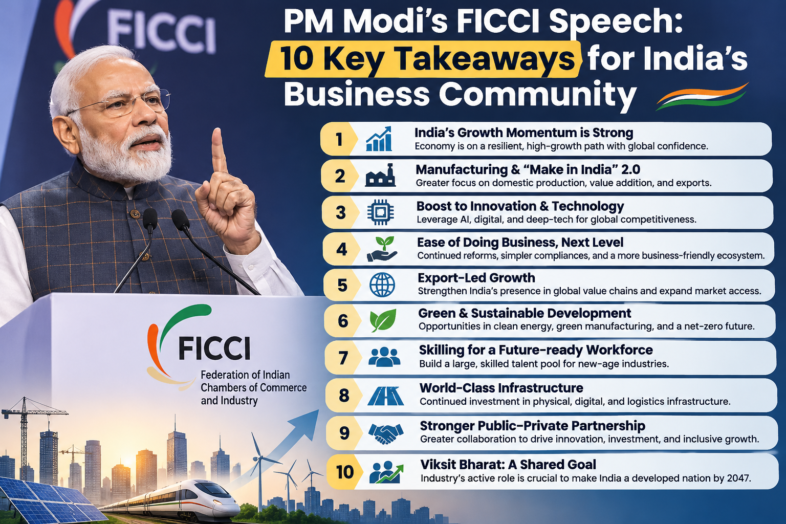
Nov 23: As the Federation of Indian Chambers of Commerce and Industry (FICCI) marks its centenary, Prime Minister Narendra Modi’s address to the business community carries significance beyond the organisation’s 100-year journey. His message focused on what Indian businesses need to achieve over the next two decades and the role industry must play in the country’s economic development.
Addressing industry leaders in New Delhi on November 19, 2026, the Prime Minister highlighted domestic manufacturing, self-reliance, product quality, employment generation, agricultural exports and India’s growing opportunities in international trade.
He also challenged businesses to make better use of government reforms, invest in domestic capabilities and prepare for a more competitive global marketplace.
For manufacturers, exporters, startups and micro, small and medium enterprises (MSMEs), the speech offers important insights into emerging opportunities and the responsibilities that come with India’s economic ambitions.
Here are 10 key business takeaways from the address.
1. Make India First a Priority in Long-Term Investment
One of the central messages of the speech was that businesses should place India First at the heart of their long-term investment decisions.
The Prime Minister encouraged industry leaders to look beyond immediate business performance and consider how their investments could strengthen India’s economic capabilities over the next 20 years.
For companies, this means identifying opportunities in manufacturing, technology, research, infrastructure and skill development. Businesses can build stronger domestic capabilities while continuing to expand their international presence.
The opportunity lies in creating investments that generate commercial value while contributing to India’s long-term economic growth.
2. Strengthen Swadeshi and Domestic Manufacturing
The Prime Minister drew attention to the importance of Swadeshi and self-reliance, recalling Mahatma Gandhi’s emphasis on domestic production.
He questioned why Indian industry still needed reminders to strengthen domestic manufacturing nearly a century after the Swadeshi movement.
He also highlighted areas where India continues to depend on imports, including active pharmaceutical ingredients, bulk drugs, specialised steel and aluminium products.
For manufacturers, this presents an opportunity to invest in domestic production, research and technology. Pharmaceutical companies, engineering businesses and metal manufacturers can explore areas where local production capabilities can be strengthened.
MSMEs can also benefit by developing specialised components and becoming suppliers to larger industrial companies.
3. Give Indian Consumers the Same Product Quality as Global Markets
Another important takeaway was the need to improve product quality for Indian consumers.
The Prime Minister emphasised that businesses should not treat Indian customers as a secondary market or reserve better-quality products for international buyers.
For companies, this means paying greater attention to product standards, quality control, design, innovation and customer service.
Consumer brands can strengthen their market position by investing in product development and delivering consistent quality. Manufacturers can also improve their competitiveness by adopting better production processes and quality-management systems.
As customer expectations rise, businesses that earn consumer trust through reliable products and services will have an advantage.
4. Convert Tax Benefits into Employment and Better Salaries
The Prime Minister challenged businesses to consider whether the benefits of government reforms and tax measures were translating into better opportunities for employees.
He referred to measures such as the reduction in the basic corporate tax rate to 22% and income-tax relief under the new tax regime.
His message to industry was that policy support should lead to visible economic outcomes, including employment generation and better employee compensation.
For businesses, this means looking at how improved efficiency, investment and profitability can support workforce expansion, employee development and better salaries.
Companies can also consider investing in employee training and technology skills to improve productivity and prepare their workforce for changing industry requirements.
5. Make Better Use of India’s Free Trade Agreements
India’s expanding network of free trade agreements can open new markets for domestic businesses. However, companies need to take a more active approach to using these opportunities.
The Prime Minister encouraged industry leaders to assess whether they had concrete plans to benefit from India’s trade agreements.
For exporters and manufacturers, this means understanding international market requirements, product standards, rules of origin and distribution networks.
MSMEs can explore export partnerships, identify products suited to overseas demand and work with larger businesses that already have international market access.
The opportunity is not simply to increase export volumes, but to build long-term relationships with international buyers and establish a stronger presence in global markets.
6. Explore Opportunities in Agriculture and Food Processing
The Prime Minister highlighted the potential to increase India’s contribution to global agricultural exports.
He encouraged greater investment in agriculture, procurement systems and food processing, with an emphasis on developing products that meet the requirements of international markets.
This creates opportunities beyond traditional farming. Businesses can explore food processing, cold-chain infrastructure, storage, packaging, logistics and agricultural technology.
For startups, this could mean developing digital solutions for farm procurement, supply-chain management and agricultural efficiency. Established businesses can invest in processing facilities, quality standards and export-ready products.
Value addition will be particularly important. Instead of focusing only on raw agricultural products, companies can develop processed and specialised products with higher market potential.
7. Build India’s Engineering and Machinery Manufacturing Capabilities
The address also highlighted opportunities in engineering products and machinery, including hand tools, power tools, packaging equipment, irrigation systems and factory machinery.
These are areas where Indian manufacturers can strengthen their domestic presence and explore export opportunities.
For MSMEs, the opportunity lies in developing specialised products, adopting modern manufacturing processes and meeting international quality standards.
Startups working in industrial automation, precision engineering and manufacturing technology can also explore opportunities to support this sector.
Larger companies can help smaller manufacturers through supplier partnerships, technology sharing and access to wider industrial networks.
8. Develop More Reliable Domestic Supply Chains
The emphasis on self-reliance also highlights the importance of building dependable domestic supply chains.
Businesses need to assess their dependence on imported components and identify where local suppliers can provide reliable alternatives.
For manufacturers, this involves developing stronger supplier relationships, improving procurement planning and investing in supply-chain technology.
MSMEs can benefit by supplying components, materials and specialised services to larger businesses. Technology startups can also explore solutions for inventory management, logistics coordination and supply-chain visibility.
The objective is to make business operations more resilient without losing access to international suppliers and markets.
9. Treat India’s Domestic Market as a Starting Point for Global Growth
India’s large consumer market offers considerable opportunities across manufacturing, technology, retail, financial services and consumer goods.
However, the Prime Minister cautioned businesses against taking domestic demand for granted.
Companies need to continuously improve their products, understand changing customer expectations and compete on quality and value.
For startups, India’s domestic market can provide an opportunity to test products, understand customer needs and develop scalable business models.
Established companies can use their domestic experience to improve product development and prepare for international competition.
The larger opportunity is to build businesses that are successful in India and capable of serving customers across global markets.
10. Strengthen Dialogue Between Industry and Government
An important aspect of the address was the Prime Minister’s invitation to industry leaders to share their suggestions directly with the government.
He encouraged businesses to identify areas where further reforms could improve the business environment and support economic growth.
This creates an opportunity for industry associations, manufacturers, startups and MSMEs to communicate practical challenges and suggest improvements in areas such as regulation, taxation, infrastructure and investment.
For businesses, active engagement with industry associations can help bring sector-specific concerns to the attention of policymakers.
A stronger dialogue can help the government understand the practical needs of businesses while enabling companies to participate more actively in shaping India’s economic priorities.
What Does the Speech Mean for Startups and MSMEs?
Although the address was directed at industry leaders, its implications extend to startups and smaller businesses.
Startups can explore opportunities in industrial technology, manufacturing automation, agricultural innovation, supply-chain solutions and export-oriented services.
MSMEs can strengthen their market position by improving product quality, adopting technology, meeting international standards and building partnerships with larger companies.
Manufacturers can explore domestic sourcing and specialised production, while exporters can assess how India’s trade agreements could help them enter new markets.
For both startups and MSMEs, the message is to move beyond short-term growth and develop capabilities that can support sustainable expansion.
India’s Next Growth Phase Needs Stronger Businesses
PM Modi’s FICCI address placed considerable responsibility on the business community to contribute to India’s long-term economic ambitions. Government reforms and policy support can create favourable conditions, but businesses must translate these opportunities into investment, innovation, employment and stronger manufacturing capabilities.
The address also reinforces the importance of balancing domestic strength with global ambition. Indian companies will need to improve product quality, develop reliable supply chains, explore new markets and invest in skilled talent to remain competitive.
For the business community, the message is clear: India’s next phase of economic growth will depend not only on government initiatives but also on how effectively businesses respond through innovation, investment and a stronger commitment to global competitiveness.
Shreyas Webmedia Solutions helps businesses strengthen their digital visibility and communicate their expertise across relevant business and industry platforms.
