
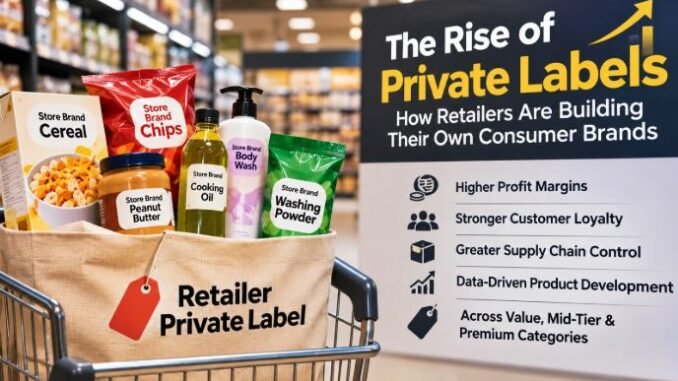
The retail industry is undergoing a significant transformation. For years, retailers primarily competed by offering products from established consumer brands, focusing on pricing, product availability and shopping experience. Today, that business model is evolving. From supermarkets and fashion stores to e-commerce platforms and large retail chains, businesses are increasingly investing in private-label brands to gain greater control over their products, pricing and customer relationships.
Private labels, also known as retailer-owned brands, are no longer limited to low-cost alternatives. They have developed into competitive consumer brands across value, mid-range and premium categories. Retailers are investing in product quality, packaging, innovation and marketing to make their own brands more attractive to modern consumers.
This shift is creating a new growth opportunity for the retail sector, allowing businesses to strengthen profitability while offering customers more choices.
Private Labels Move Beyond the Budget Segment
Private-label products were traditionally associated with affordable pricing and basic quality. Many consumers purchased them mainly to save money rather than because of brand preference.
However, changing shopping habits and growing consumer awareness have transformed this perception. Customers today are increasingly willing to try retailer-owned products when they offer quality, reliability and value for money.
Retailers are responding by expanding private-label portfolios beyond everyday essentials into premium food products, personal care, fashion, electronics accessories and household goods.
International examples such as Costco’s Kirkland Signature, Walmart’s Great Value and Amazon Basics demonstrate how retailers can build successful consumer brands by combining competitive pricing with consistent product quality.
Why Retailers Are Building Their Own Consumer Brands
The growing interest in private labels is closely linked to the changing economics of retail businesses. Selling established brands helps retailers attract customers, but developing their own products gives them greater control over the business.
One major advantage is improved profit margins. By working directly with manufacturers and managing product sourcing, packaging and pricing, retailers can reduce certain supply-chain costs and retain a greater share of product value.
Private labels also help businesses differentiate themselves from competitors. When customers develop trust in a retailer’s own brand, they have an additional reason to return to that store or shopping platform.
Another important advantage is access to consumer insights. Retailers have valuable information about shopping patterns, popular products, purchasing frequency and customer preferences. This data helps them identify market gaps and introduce products that meet actual consumer demand.
India’s Retail Market Offers New Opportunities
India is emerging as an important growth market for private-label consumer brands. The expansion of organised retail, increasing internet penetration, e-commerce adoption and changing consumption patterns are creating opportunities for retailers to develop their own product portfolios.
From grocery and packaged food to apparel, beauty, personal care and home essentials, Indian retailers are increasingly exploring private-label business models.
Large retail chains and online marketplaces are using their customer reach and distribution networks to introduce products at different price points. This allows businesses to target budget-conscious shoppers as well as consumers looking for premium products.
The opportunity is particularly significant in India’s smaller cities, where organised retail is expanding and consumers are gaining access to a wider range of branded products.
For domestic manufacturers, this development also creates opportunities to supply products to retailers and participate in the growing private-label supply chain.
Technology and Consumer Data Drive Private-Label Growth
Technology is playing an increasingly important role in the development of retailer-owned brands. Retailers are using sales data, digital platforms and customer feedback to understand demand and make better product decisions.
For example, sales information can help retailers identify which products are gaining popularity, which price ranges attract customers and where existing product offerings are falling short.
These insights allow businesses to develop more focused product lines, manage inventory efficiently and reduce the risk of excess stock.
Supply-chain management is equally important. Strong relationships with manufacturers, efficient logistics and consistent quality checks are essential for ensuring that private-label products meet customer expectations.
Profitability and Customer Loyalty: The Business Advantage
Private labels offer retailers an opportunity to build a more sustainable business model. Unlike conventional retailing, where businesses largely depend on selling third-party brands, retailer-owned products give companies greater influence over product positioning and pricing strategies.
They can also help retailers create a stronger connection with consumers. When customers repeatedly purchase a private-label product and have a positive experience, trust gradually develops into brand loyalty.
This creates long-term business value through repeat purchases, stronger customer retention and improved brand recognition.
However, profitability cannot come at the cost of quality. Retailers must ensure that their products deliver consistent performance, safety and value. A negative customer experience can affect confidence not only in the product but also in the retailer itself.
Challenges Retailers Must Address
Despite their growing popularity, private-label brands face several challenges.
Building consumer trust takes time, particularly in categories dominated by established national and international brands. Retailers must also invest in product development, quality control, packaging, marketing and reliable manufacturing partnerships.
Changing consumer preferences, raw material costs and supply-chain disruptions can also affect profitability.
For long-term success, retailers need to focus on more than competitive pricing. Product differentiation, quality consistency and customer satisfaction will be equally important.
Conclusion:
The rise of private labels marks an important change in the global retail business. Retailers are no longer competing only on the strength of the consumer brands they sell; they are increasingly building brands of their own.
This shift is creating new opportunities to improve profit margins, strengthen customer loyalty, gain greater control over supply chains and respond more quickly to changing consumer preferences.
For India’s retail industry, the opportunity extends beyond large retail chains and e-commerce companies. Domestic manufacturers, suppliers and emerging consumer businesses can also benefit from the growing demand for retailer-owned products.
Going forward, the success of private-label brands will depend on how effectively retailers combine affordability, quality, innovation and consumer trust.
Ultimately, private labels are moving from the shelves to the centre of retail business strategy. The retailers that successfully turn customer insights into trusted consumer brands could gain a significant competitive advantage in the next phase of retail growth.
