
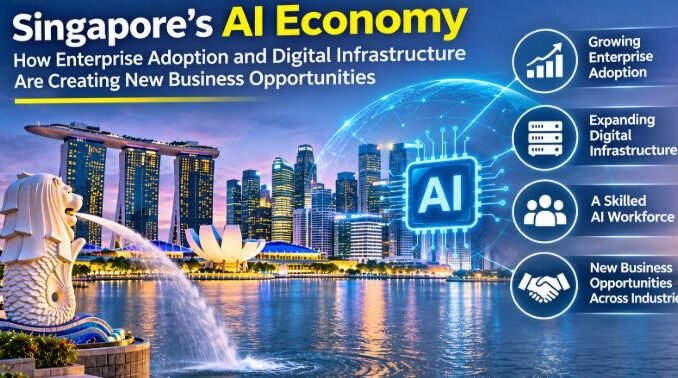
Singapore’s growing artificial intelligence market is opening new business opportunities across technology, finance, manufacturing, retail and professional services. As companies increase their investment in AI, demand is rising for software solutions, cloud services, data management, cybersecurity and specialist consulting. This is creating a wider commercial ecosystem in which both established technology firms and smaller service providers can find opportunities for growth.
The country’s digital economy reached S$144.1 billion in 2025, contributing 19.3% to Singapore’s GDP, according to the Infocomm Media Development Authority (IMDA). The expansion reflects the growing importance of technology in business operations and highlights Singapore’s ambition to strengthen its position as a regional centre for digital innovation.
For businesses, the opportunity lies in more than developing AI tools. Companies that can help organisations reduce operating costs, improve productivity, manage data and modernise their systems are also positioned to benefit from the next phase of digital investment.
Enterprise Adoption Creates Demand for AI Solutions
AI adoption among Singapore businesses is gaining momentum. The proportion of enterprises using AI increased from 14.7% in 2024 to 23.5% in 2025. Adoption among large companies reached 70.4%, while 23.4% of small and medium-sized enterprises (SMEs) reported using AI.
Businesses are increasingly applying the technology to everyday activities such as customer service, document processing, financial administration, marketing and data analysis. These applications can reduce manual workloads, speed up processes and help management teams make decisions using business information more effectively.
The reported results are encouraging. IMDA found that 87.6% of businesses using AI experienced improvements in productivity and business processes, while 44% reported cost reductions and more efficient resource use.
This growing demand is creating a market for AI software developers, technology consultants and system integration companies. Businesses need solutions that address specific operational problems rather than technology that adds complexity without delivering measurable value. Providers that can demonstrate practical business benefits may have an advantage as adoption increases.
SMEs Offer a Growing Market for AI Providers
Small and medium-sized businesses represent an important opportunity for Singapore’s AI industry. Although adoption among SMEs remains below the level recorded by large companies, more smaller firms are exploring affordable ways to introduce automation and digital tools.
Many SMEs do not have large IT departments or the resources to develop their own AI systems. They are therefore more likely to seek ready-to-use solutions for accounting, inventory management, customer enquiries, sales analysis and marketing.
This creates business opportunities for technology companies offering affordable software, implementation support and customised services. Consulting firms and training providers may also benefit as smaller businesses seek help identifying suitable applications and preparing employees to use them.
The Singapore government is supporting this transition through its National AI Impact Programme, launched in March 2026. The programme aims to support 10,000 enterprises over three years and develop 100,000 AI-bilingual workers by 2029.
For businesses operating in the technology services market, this initiative could encourage further demand for AI training, workflow improvements, software integration and professional advice. It also gives SMEs a stronger incentive to explore how AI can improve their competitiveness.
Digital Infrastructure Investment Supports Market Growth
The expansion of AI depends on more than software and applications. Businesses need computing capacity, data storage, reliable connectivity and secure digital systems to support their growing technology requirements.
Singapore has been investing in its digital infrastructure to meet this demand. Under its Green Data Centre Roadmap, the country aims to add at least 300 megawatts of data-centre capacity in the near term, while encouraging more energy-efficient operations.
This creates opportunities for data-centre operators, cloud service providers, cybersecurity companies and suppliers of energy-management technology. As organisations process larger volumes of information and use more advanced AI applications, demand for reliable digital infrastructure is expected to remain an important part of the market.
The expansion also brings commercial considerations. Data centres require substantial electricity and cooling capacity, making energy efficiency a major factor in operating costs. Businesses that can provide efficient cooling systems, power management and sustainable infrastructure solutions could find opportunities as Singapore develops its AI capabilities.
AI Investment Is Spreading Across Industries
The business potential of AI extends well beyond the technology sector. Manufacturers can use AI to monitor production, improve quality control and identify equipment problems before they interrupt operations. Retailers can apply it to sales forecasting, inventory planning and customer analysis.
Financial institutions and professional service firms are exploring applications for research, document processing and data analysis. These tools can help reduce time spent on repetitive activities, although human supervision remains important where accuracy, confidentiality and regulatory responsibilities are involved.
This wider adoption creates opportunities for companies that understand the operational needs of individual industries. Businesses offering customised software, data services and technology integration can work with organisations to introduce AI into existing systems.
Singapore’s position as a regional business hub adds another dimension to the opportunity. Technology companies can use the country as a base to develop partnerships, provide services and expand into other Southeast Asian markets. This could attract further investment in regional technology operations and specialised business services.
Demand for AI Skills Creates New Business Opportunities
The growth of AI is also changing the employment and training market. Companies need professionals who can understand the technology and apply it to real business situations.
Singapore’s technology workforce reached 222,200 in 2025, with demand increasing in areas such as AI, data and cybersecurity. Technology skills are also becoming more important in traditional industries as businesses introduce digital systems into their operations.
This creates opportunities for training companies, educational institutions and professional development providers. Employers will also need to invest in employee training to ensure that workers can use AI tools effectively and understand their limitations.
The demand is not restricted to technical roles. Finance professionals, marketers, managers, analysts and operations teams may all need a working understanding of AI as it becomes part of their daily responsibilities. Companies that combine industry knowledge with digital skills will be better positioned to manage changing business requirements.
Turning AI Adoption Into Business Growth
Singapore’s AI economy is creating a broader market for technology investment and business services. Rising enterprise adoption is supporting demand for software, cloud infrastructure, cybersecurity, consulting and workforce training. Government initiatives are also encouraging more companies, particularly SMEs, to explore practical uses of AI.
For businesses, the next opportunity will be to turn technology investment into measurable commercial results. Companies that can help clients improve productivity, manage costs, strengthen data security and modernise operations will have opportunities to build long-term business relationships.
Singapore’s expanding digital infrastructure and growing pool of AI-skilled professionals also strengthen its appeal as a base for regional technology operations. As investment continues, the benefits could extend across multiple industries, creating opportunities for local companies and international businesses looking to serve the Southeast Asian market.
The commercial direction is becoming clearer: AI is developing into a business capability that influences operating costs, productivity and competitiveness. Companies that build the right services and expertise around this demand will be better placed to capture opportunities in Singapore’s next phase of digital growth.
