

Digital banking has transformed the way people manage their money. Customers can transfer funds, pay bills, check account balances and access financial services within minutes using mobile applications and online platforms. While this convenience has made banking more accessible, it has also increased the importance of protecting financial information from cybercriminals.
As digital payments and online transactions become part of everyday life, cybersecurity is no longer just a technical concern for banks. It has become a major factor influencing customer confidence, business reputation and the future of digital financial services.
Cybercriminals are using increasingly sophisticated methods to target banking customers, including fake messages, fraudulent websites, malicious applications and identity theft. Even when a bank has strong security systems, customers can remain vulnerable to scams that exploit human behaviour and trust.
For financial institutions, the challenge is twofold: protect customers’ money and personal information while making sure people feel confident using digital services.
The Growing Threat of Online Banking Fraud
The expansion of digital banking has created more opportunities for fraudsters to target customers through online channels. Phishing and social engineering remain significant concerns because they attempt to manipulate people into revealing sensitive information.
Fraudsters may send messages that appear to come from a bank, warn customers about suspicious transactions or claim that an account will be blocked unless immediate action is taken. These messages often direct victims to fake websites designed to collect passwords, PINs and one-time passwords (OTPs).
Artificial intelligence is adding another layer of complexity. Scammers can use AI tools to create convincing messages, imitate familiar communication styles and produce realistic audio or video impersonations. As a result, identifying fraudulent communication may require greater care than simply checking for spelling mistakes or unusual wording.
Other threats include malicious mobile applications, stolen login credentials, SIM-swapping attacks and account takeovers. In some cases, criminals also exploit weaknesses in third-party services connected to financial platforms.
These risks demonstrate why digital banking security requires continuous monitoring, updated technology and greater customer awareness.
Why Consumer Trust Is Essential for Digital Banking
Trust is one of the foundations of the banking industry. Customers expect financial institutions to safeguard their savings, protect their personal details and respond quickly when something goes wrong.
A security breach or fraudulent transaction can damage that relationship. Customers may become reluctant to use mobile banking, question how their information is handled or consider moving their accounts to another institution.
The impact can extend beyond the immediate financial loss. Banks may face higher fraud-related costs, customer complaints, regulatory scrutiny and reputational damage. Restoring confidence can take considerable time, particularly when customers feel that a security incident was handled poorly.
This makes transparency essential. Customers need clear information about security measures, potential risks and the steps they should take if they suspect fraud. When banks communicate promptly and provide accessible support, they can help customers make informed decisions and strengthen confidence in digital services.
How Banks Can Strengthen Digital Security
Financial institutions are increasingly relying on multiple layers of protection rather than depending on a single security measure. The aim is to make it more difficult for unauthorised users to access accounts and to identify suspicious activity before it causes significant harm.
Multi-Factor Authentication and Biometric Security
Multi-factor authentication adds an extra layer of verification when customers log in or perform certain transactions. Depending on the bank’s system, this may involve a password combined with a trusted device, biometric verification or another authentication method.
Fingerprint and facial recognition can also make account access more convenient while supporting identity verification. However, no single method is completely risk-free. Banks need to combine authentication with transaction monitoring and other protective measures.
Customers should never share passwords, PINs or OTPs with anyone claiming to represent their bank.
AI-Powered Fraud Detection
Artificial intelligence can help banks analyse transaction patterns and identify activity that differs from a customer’s usual behaviour. These systems may flag unusual transfers, repeated failed login attempts or other warning signs for further investigation.
Real-time monitoring can help financial institutions respond more quickly to potential fraud. Depending on the system, a suspicious transaction may trigger an alert, additional verification or a temporary restriction while the activity is reviewed.
However, AI systems can also generate false alarms or miss certain forms of fraud. Human oversight, regular system testing and effective investigation procedures remain important.
Secure Banking Applications and Infrastructure
Banks must regularly update their applications, strengthen access controls and test their systems for vulnerabilities. Protecting customer information also requires careful management of third-party technology providers that may have access to banking systems or data.
Security cannot be treated as a one-time investment. As fraud techniques change, financial institutions need to review their defences, prepare for incidents and ensure that customers can access reliable support when problems arise.
What Customers Can Do to Protect Their Money
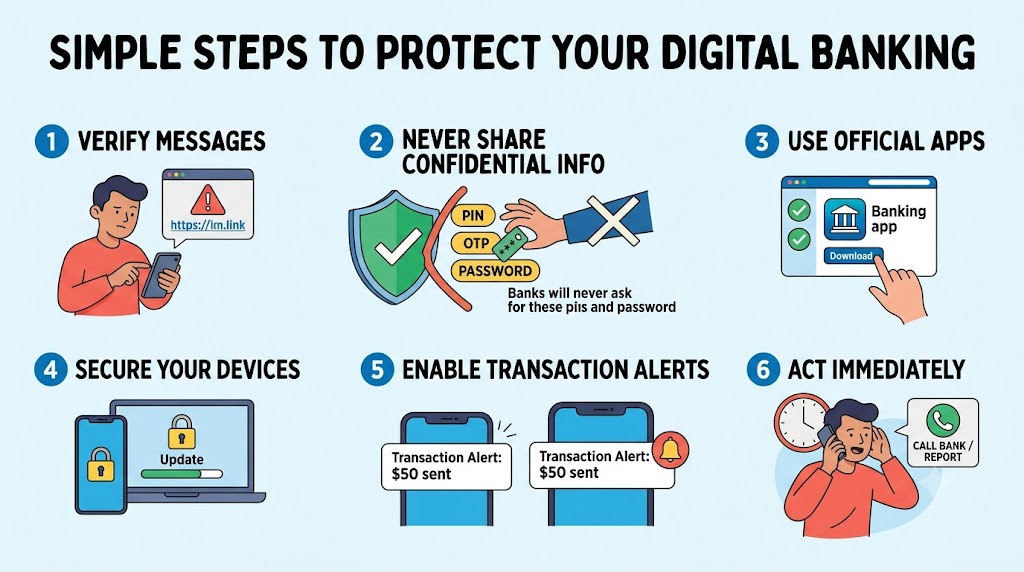
Technology can reduce the risk of fraud, but customer awareness remains an important part of digital banking security. Simple precautions can help people avoid common scams and respond quickly when something appears suspicious.
-
Verify messages before clicking: Avoid opening unexpected banking links received through SMS, email or messaging applications. Access your bank through its official application or website instead.
-
Never share confidential information: Banks should not ask customers to disclose their passwords, PINs or OTPs to verify an account through an unsolicited call or message.
-
Use official applications: Download banking applications from trusted official sources and check the developer details before installation.
-
Secure your devices: Keep your phone, computer and banking applications updated. Use a strong device lock and avoid conducting sensitive transactions on untrusted devices or networks.
-
Enable transaction alerts: Notifications can help customers identify unfamiliar activity and report it quickly.
-
Act immediately if fraud is suspected: Contact the bank through an official channel, secure the account and report the incident to the relevant authorities.
Customers should also remember that fraudsters may impersonate bank employees, police officers or government officials. Pressure to act immediately, requests to install remote-access applications and demands for confidential credentials are important warning signs.
Transparency and Customer Education Can Build Confidence
Strong cybersecurity depends on more than advanced software. Banks also need to help customers understand how digital fraud works and how to recognise suspicious activity.
Regular awareness campaigns, simple security instructions and timely fraud alerts can make protection easier to understand. Banks should explain security procedures in clear language rather than relying on technical terms that customers may find difficult to follow.
When a security incident occurs, communication matters just as much. Customers need to know what happened, what action the bank is taking and what steps they should follow to protect themselves. Delayed or confusing updates can increase anxiety and weaken confidence.
Financial institutions should also provide accessible channels for reporting fraud and resolving disputes. A prompt, clear response can help prevent further losses and demonstrate that customer protection is a priority.
The Business Impact of Banking Cybersecurity
Cybersecurity has direct financial and operational implications for banks and the wider digital economy. Effective protection can reduce fraud losses, limit disruption and support the continued adoption of online financial services.
For banks, investment in security can also help protect long-term customer relationships. For businesses that depend on digital payments, reliable banking systems support smoother transactions and reduce uncertainty around receiving and transferring funds.
By contrast, repeated security failures can increase operating expenses and discourage customers from using digital channels. This can undermine the benefits of convenience and efficiency that digital banking is designed to provide.
As financial services become more connected, banks must also pay attention to risks involving external service providers, payment platforms and other technology partners. Security standards and incident-response procedures need to extend across these relationships.
The Future of Cybersecurity in Digital Banking
The future of digital banking will depend not only on faster transactions and more convenient applications, but also on the ability to protect customers against changing cyber threats.
AI-assisted fraud detection, stronger authentication, secure digital infrastructure and better customer education are likely to remain important parts of banking security. At the same time, financial institutions must ensure that new technologies are tested carefully and that customers can still access human assistance when they need it.
Consumers also have a role to play by following safe banking practices, questioning unusual requests and reporting suspicious activity without delay.
Ultimately, cybersecurity and consumer trust are closely connected. Banks that combine reliable protection with honest communication and responsive customer service will be better positioned to maintain confidence in an increasingly digital financial system. As online banking continues to evolve, protecting trust will be just as important as developing the next generation of financial technology.
