
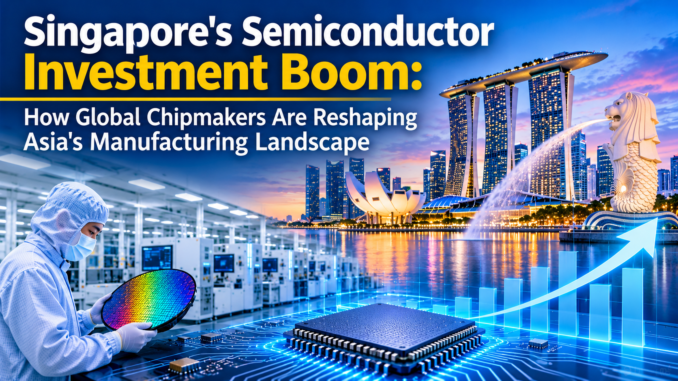
Nov 02: Singapore is emerging as an increasingly important destination for semiconductor investments as global technology companies rethink their manufacturing strategies. The growing use of artificial intelligence, expansion of data centres and rising demand for advanced electronics are creating fresh opportunities for chipmakers. Against this backdrop, Singapore is attracting major investments that could strengthen its position in the international semiconductor market.
The country’s appeal lies in its established manufacturing infrastructure, access to specialised talent and strong connections with global technology markets. Recent commitments from companies such as Micron Technology and VisionPower Semiconductor Manufacturing Company (VSMC) demonstrate how international manufacturers are looking at Singapore not just for production, but also for long-term technological growth.
This investment momentum also reflects a larger shift in Asia’s industrial landscape, where countries are seeking stronger positions in the global semiconductor supply chain.
Billions of Dollars Flow into Singapore’s Chip Manufacturing Sector
Singapore’s semiconductor industry has received significant attention following a series of large-scale investment announcements.
In January 2026, US-based Micron Technology began construction of a new advanced wafer fabrication facility in Singapore. The project forms part of the company’s planned US$24 billion investment over the next decade to strengthen its NAND manufacturing operations.
The proposed facility will include approximately 700,000 square feet of cleanroom space. Production is expected to commence in the second half of 2028, with the development projected to generate around 1,600 employment opportunities across engineering and manufacturing functions.
The investment is particularly significant because memory and storage technologies are becoming increasingly important to AI infrastructure, cloud platforms and enterprise computing.
Another notable development came in September 2026 with the opening of VSMC’s S$8.5 billion semiconductor fabrication facility in Tampines. The venture, backed by Taiwan’s Vanguard International Semiconductor and the Netherlands-based NXP Semiconductors, is expected to start volume production in early 2027.
The facility will manufacture chips using 40-nanometre to 130-nanometre technologies. These components serve a wide range of applications, including automotive electronics, industrial systems and power management.
Together, the two developments illustrate Singapore’s expanding role across different semiconductor categories, from memory production to specialised chips used in everyday industrial and electronic applications.
The AI Boom Is Creating New Opportunities for Chipmakers
The rapid adoption of artificial intelligence is changing the semiconductor industry’s growth outlook.
AI applications depend on powerful computing systems capable of processing large volumes of information. This has increased demand for processors, memory components and storage solutions. Technology companies are responding by expanding data centre infrastructure, creating additional opportunities for semiconductor manufacturers.
Singapore is positioned to benefit from this demand because it already hosts several major players across the semiconductor value chain.
Micron’s manufacturing expansion is one example of how companies are responding to the changing requirements of the AI economy. Growing demand for memory and storage technologies is encouraging manufacturers to invest in production capacity and improve their technological capabilities.
The impact is also reaching businesses that supply semiconductor equipment, specialised materials, precision engineering services and testing solutions.
This wider network of supporting industries makes semiconductor investment particularly valuable for Singapore. Each new manufacturing facility can generate business opportunities for several connected sectors.
What Makes Singapore Attractive to International Manufacturers?
Choosing a location for semiconductor manufacturing involves more than identifying an available industrial site. Companies need dependable utilities, specialised suppliers, advanced logistics and a workforce capable of operating sophisticated production facilities.
Singapore has developed these capabilities over several decades.
Its semiconductor ecosystem includes chip design, wafer fabrication, equipment manufacturing, assembly, packaging and testing. The presence of established companies such as Micron, GlobalFoundries, Infineon and UMC has further strengthened the country’s industrial network.
The business environment is another important consideration. Regulatory consistency, intellectual property protection and international trade connectivity provide companies with greater confidence when making investments that require years of planning and substantial capital.
Singapore’s geographical position also supports its role as a regional business and logistics centre. Manufacturers can operate within a well-connected market while maintaining links with suppliers and customers across Asia and other international destinations.
These advantages have helped the country develop a reputation as a strategic location for semiconductor manufacturing and related technology operations.
S$800 Million Research Commitment Supports Future Technologies
Singapore is also focusing on the technologies that will define the next generation of semiconductor manufacturing.
Under its Research, Innovation and Enterprise 2030 programme, the government has committed S$800 million to semiconductor research and innovation.
The initiative places emphasis on areas such as silicon photonics, advanced packaging, power electronics and integrated circuit technologies.
These developments are important because the semiconductor industry is facing increasingly complex engineering requirements. Manufacturers are looking for ways to improve processing efficiency, reduce energy consumption and develop smaller, more capable electronic components.
Research collaboration between universities, technology companies and scientific institutions can help accelerate these developments.
For Singapore, the objective is to build capabilities that extend beyond conventional manufacturing. A stronger research ecosystem could encourage more companies to undertake product development, engineering and other high-value activities locally.
Singapore’s Expansion Could Strengthen Asia’s Manufacturing Network
The impact of Singapore’s semiconductor investments is likely to extend beyond its borders.
Asia already plays a major role in global electronics production, with different countries contributing specialised capabilities to the semiconductor supply chain.
Taiwan and South Korea have significant positions in chip manufacturing, while Japan is important for semiconductor materials and equipment. Malaysia has developed a strong presence in assembly, testing and packaging.
Singapore’s expanding wafer fabrication and research capabilities could complement these existing strengths.
India also has an opportunity to build stronger connections with the regional semiconductor industry. Its developing manufacturing ecosystem, engineering workforce and electronics sector could create opportunities for international partnerships in component production, equipment, technical services and research.
For smaller businesses, the expansion of semiconductor operations across Asia could generate demand for cleanroom solutions, industrial automation, precision components, logistics and specialised engineering services.
This makes the semiconductor industry relevant not only to large multinational corporations but also to businesses operating within the wider manufacturing supply chain.
Skilled Professionals Will Be Essential to Sustaining Growth
As semiconductor facilities become more advanced, the demand for specialised employees is increasing.
Manufacturing operations require professionals with expertise in electronics, mechanical engineering, materials science, automation and equipment maintenance.
The introduction of AI-based monitoring, robotics and advanced production systems is also changing the skills required on factory floors.
Employees are increasingly expected to understand both traditional engineering processes and digital manufacturing technologies.
Singapore’s investment in research, technical education and industry collaboration will therefore be important in addressing future workforce requirements.
For companies planning long-term operations, access to skilled professionals will remain a major factor in determining manufacturing locations.
Infrastructure and Global Competition Remain Key Challenges
While Singapore’s semiconductor outlook is encouraging, the industry also faces several operational challenges.
Chip manufacturing requires uninterrupted electricity supplies, substantial water resources and highly controlled production environments. Expanding capacity will place greater emphasis on efficient resource management and sustainable industrial practices.
The country must also compete with other manufacturing destinations that are investing heavily in their semiconductor industries. Taiwan, South Korea, Japan, Malaysia, China and the United States are all working to strengthen their positions through infrastructure development, research funding and industry incentives.
Global economic uncertainty and geopolitical tensions add another layer of complexity. Changes in trade policies, restrictions on technology transfers and fluctuations in semiconductor demand can influence production decisions.
Maintaining competitiveness will therefore require continuous investment in technology, workforce development and industrial infrastructure.
Singapore’s Semiconductor Growth Signals a New Phase for Asian Manufacturing
The semiconductor industry is becoming central to the future of several major economic sectors, including artificial intelligence, automotive technology, telecommunications and advanced computing.
Singapore’s latest investment developments show how the country is preparing to capture a larger share of this expanding market. Micron’s long-term manufacturing commitment, VSMC’s new fabrication facility and the government’s research initiatives collectively point towards a stronger semiconductor ecosystem.
The opportunity, however, goes beyond attracting international companies. Singapore’s long-term success will depend on its ability to develop local expertise, support specialised suppliers and translate research into commercially valuable technologies.
For Asia, the expansion offers an opportunity to build closer industrial connections and strengthen regional participation in the global semiconductor supply chain.
As chipmakers continue to reassess their manufacturing priorities, Singapore is positioning itself as an important destination for investment and innovation, with the potential to influence the next phase of Asia’s technology-led manufacturing growth.
