
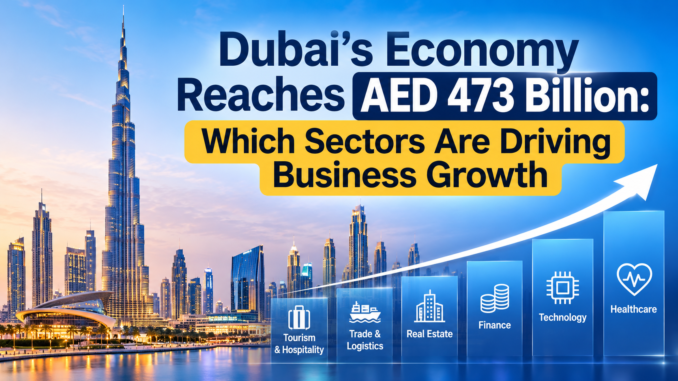
Oct 31: Dubai continues to strengthen its position as an international business and investment destination, supported by an economy that spans global trade, financial services, real estate, healthcare and technology. The emirate recorded a real Gross Domestic Product (GDP) of approximately AED 473 billion during the first half of 2026, reflecting the scale of its economic activity and the changing contribution of its major industries.
According to the Dubai Data and Statistics Establishment at Digital Dubai, real GDP declined by 2.3% compared with the first half of 2025. However, GDP at current prices reached approximately AED 505 billion, recording a marginal increase of 0.2%.
The overall figures tell only part of the story. While some traditional industries experienced a slowdown, financial services, healthcare, construction and information technology continued to expand. These developments highlight how Dubai’s economic priorities are evolving and where businesses may find new opportunities.
Dubai Economy at a Glance: Key Figures for H1 2026
Dubai’s latest economic performance highlights the difference between industries with the largest contribution to GDP and those recording the strongest growth.
- AED 473 billion: Real GDP during H1 2026.
- AED 505 billion: GDP at current prices, representing 0.2% growth.
- 14.3%: Real growth in healthcare and social work activities.
- 8.8%: Real growth in financial and insurance activities.
- 2.7%: Real growth in information and communication.
- 2.4%: Real growth in construction.
- 20.5%: Share of wholesale and retail trade in real GDP.
While trade remains Dubai’s largest economic activity, healthcare and financial services are among the fastest-growing sectors, indicating a gradual shift towards higher-value economic activities.
Which Sectors Are Driving Dubai’s Economy?
1. Financial Services Strengthen Dubai’s Global Business Position
Financial and insurance activities emerged as one of Dubai’s strongest-performing sectors during the first half of 2026, recording 8.8% real growth. The sector generated approximately AED 65.9 billion in value added, increasing its contribution to the emirate’s GDP to 14%.
Dubai’s growing financial ecosystem includes banking, insurance, investment management, wealth management and financial technology. Its international business connections continue to attract institutions and companies seeking access to markets across the Middle East, Asia and Africa.
The expansion also creates opportunities beyond traditional financial services. Fintech solutions, digital payment infrastructure, cybersecurity, regulatory technology and financial consulting are becoming important areas for specialised businesses.
For startups and SMEs, this creates scope to develop technology-led services that support financial institutions and improve business operations.
2. Wholesale and Retail Trade Remain Major Economic Contributors
Wholesale and retail trade continued to be Dubai’s largest economic activity, accounting for 20.5% of real GDP during H1 2026. The sector generated approximately AED 96.9 billion in real value added.
However, the industry recorded a 6% decline in real terms, despite achieving 2% growth at current prices.
Dubai’s position as an international trading and distribution centre continues to support businesses involved in imports, exports, wholesale distribution and retail operations. Its established logistics infrastructure and international connectivity remain important advantages for companies operating across different markets.
E-commerce is also changing the way businesses approach sales and customer engagement. Retailers are increasingly investing in digital storefronts, payment systems, inventory management and delivery solutions.
For smaller companies, these developments offer opportunities in online retail, product distribution, e-commerce management and specialised trading services.
3. Real Estate Continues to Influence Business Activity
Real estate accounted for approximately 11.8% of Dubai’s real GDP during the first half of 2026, generating AED 55.8 billion in real value added.
Although the sector recorded a 2.5% decline in real terms, its value at current prices increased by 5.4% to AED 65.1 billion.
The industry’s contribution extends beyond property development and transactions. Construction, architecture, interior design, property management and facilities management support a wider network of businesses.
Technology is also changing the real estate landscape. Smart building systems, digital property platforms, energy management and sustainable infrastructure are creating demand for specialised solutions.
For SMEs, opportunities exist in property maintenance, building technology, engineering support and professional services connected to the real estate industry.
4. Transportation and Logistics Support International Trade
Transportation and storage contributed approximately AED 50.6 billion to Dubai’s real GDP during H1 2026, representing 10.7% of total economic activity.
However, the sector experienced a 7.4% decline in real terms during the period.
Despite this slowdown, Dubai’s geographical position and established transport infrastructure continue to support its importance as an international logistics and distribution centre.
The industry includes freight forwarding, cargo handling, warehousing, supply chain management and last-mile delivery. Businesses are also exploring technology solutions to improve shipment tracking, inventory management and operational efficiency.
This creates opportunities for logistics software providers, warehouse operators, supply chain consultants and companies offering specialised transportation services.
5. Healthcare Emerges as One of Dubai’s Fastest-Growing Sectors
Healthcare and social work activities recorded the strongest growth among the major expanding sectors, increasing by 14.3% in real terms during the first half of 2026.
The sector’s real value added reached approximately AED 6.2 billion, compared with AED 5.4 billion during the corresponding period in 2025.
The expansion reflects the growing importance of healthcare services, specialised treatment, medical facilities and supporting technologies.
Businesses can explore opportunities in medical equipment distribution, healthcare administration, digital health platforms and specialised support services.
As healthcare providers increasingly adopt technology, solutions that improve patient management, operational efficiency and access to services could become important areas of business development.
6. Information and Communication Drive Digital Transformation
Dubai’s information and communication sector recorded 2.7% real growth during H1 2026, with value added reaching approximately AED 24.7 billion.
The expansion highlights the increasing importance of digital infrastructure and technology-driven business services.
Artificial intelligence, cloud computing, cybersecurity, enterprise software and automation are becoming relevant across industries. Businesses are increasingly looking for ways to improve productivity, manage information and reduce manual processes.
For technology startups and SMEs, this creates opportunities to develop digital products, provide IT consulting and support companies undergoing digital transformation.
The demand for specialised technology services is also extending beyond the IT industry, with finance, healthcare, retail and logistics increasingly relying on digital solutions.
7. Construction Supports Dubai’s Long-Term Development
Construction recorded 2.4% real growth during the first half of 2026, with value added reaching approximately AED 33.2 billion.
The sector supports a broad commercial ecosystem involving engineering firms, infrastructure developers, building material suppliers, architects and specialised contractors.
Beyond major development projects, businesses can find opportunities in project management, sustainable construction, smart building technologies and engineering services.
As infrastructure requirements evolve, companies offering specialised solutions and efficient project delivery services could benefit from demand across the construction industry.
Where Are the Emerging Business Opportunities for SMEs in Dubai?
The latest economic figures indicate that opportunities in Dubai are not restricted to its largest industries. Smaller companies can also benefit from sectors experiencing strong growth and increasing demand for specialised services.
Some promising areas include:
- Business automation: Helping companies reduce manual processes, streamline workflows and improve productivity.
- Financial technology: Developing digital payment solutions, financial management platforms and specialised fintech services.
- Healthcare technology: Providing medical technology, digital administration and patient management solutions.
- E-commerce and distribution: Supporting retailers through online sales platforms, inventory management and cross-border distribution.
- Construction technology: Offering project management systems, engineering solutions and sustainable building services.
- Professional business services: Providing recruitment, accounting, consulting, digital marketing and outsourced operational support.
For SMEs, the opportunity lies in understanding specific industry requirements rather than competing directly with established companies. Businesses that provide cost-effective, specialised solutions can find opportunities within Dubai’s expanding commercial ecosystem.
Dubai Economic Agenda D33: Supporting the Next Phase of Growth
Dubai’s long-term economic ambitions are closely connected to its Economic Agenda D33, which aims to strengthen the emirate’s position as one of the world’s leading business and investment destinations.
The agenda focuses on expanding international trade, attracting foreign investment, encouraging innovation and developing future-oriented industries.
Digital transformation and artificial intelligence are also becoming important components of this strategy. Businesses across finance, healthcare, logistics, retail and construction are exploring how advanced technologies can improve efficiency and support expansion.
For international companies and entrepreneurs, Dubai offers access to regional markets, established commercial infrastructure and a growing network of business opportunities.
However, entering the market requires an understanding of operating costs, regulatory requirements, customer demand and competition. Companies must evaluate these factors before deciding where to invest and how to position their services.
What Does Dubai’s Economic Performance Mean for Investors and Businesses?
Dubai’s H1 2026 economic figures reveal two important trends. First, traditional industries such as trade, real estate and transportation continue to account for a substantial share of the economy. Second, sectors such as healthcare and financial services are recording stronger growth, creating opportunities in specialised and technology-driven activities.
For investors, the distinction between sector size and growth momentum is important. Larger industries offer an established commercial base, while faster-growing sectors may present opportunities in emerging services and specialised solutions.
SMEs can also benefit from this changing environment by supporting established industries through automation, consulting, digital marketing, technology and outsourced business services.
Rather than focusing exclusively on entering high-profile sectors, businesses should identify gaps in existing markets and develop solutions that address practical operational challenges.
Conclusion: Which Industries Will Shape Dubai’s Next Phase of Business Growth?
Dubai’s AED 473 billion economy reflects the scale and diversity of its commercial landscape. Although real GDP declined by 2.3% during the first half of 2026, the performance of financial services, healthcare, construction and information technology highlights areas of continued economic expansion.
Trade, real estate and transportation remain central to the emirate’s economic structure, while technology-led services and specialised industries are creating additional opportunities for businesses.
The next phase of growth will depend on how effectively Dubai attracts investment, encourages innovation and strengthens its business ecosystem amid changing global economic conditions.
For startups, SMEs and international investors, the emirate continues to offer opportunities across established industries and emerging markets. Businesses that understand sector-specific demand, adopt technology and develop sustainable growth strategies will be better positioned to participate in Dubai’s evolving economy.
