
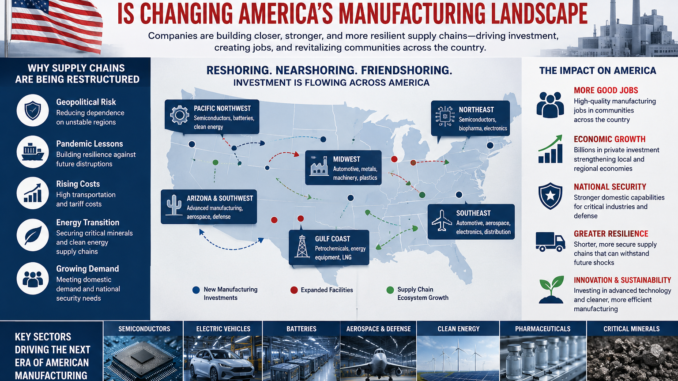
Nov 02: The United States is rethinking how it manufactures, sources and distributes goods. For decades, American businesses relied heavily on overseas production centres, particularly in Asia, to access competitive manufacturing costs and established supplier networks. However, global disruptions, geopolitical tensions and changing trade policies have encouraged companies to reconsider how much they depend on distant manufacturing hubs.
The focus is increasingly shifting towards domestic manufacturing, reshoring and nearshoring. Businesses are looking to bring production closer to the US market, establish regional supplier relationships and reduce the risks associated with relying on a limited number of overseas suppliers.
This transition is creating opportunities across manufacturing, logistics, industrial infrastructure, warehousing and technology. It is also opening new possibilities for small and medium-sized manufacturers that can support the changing requirements of larger American companies.
The investment activity reflects this changing landscape. According to the US Bureau of Economic Analysis, new foreign direct investment expenditures in the United States reached US$232.1 billion in 2025. Manufacturing accounted for US$121.8 billion, or 52.5% of the total. Chemicals manufacturing alone attracted US$45.4 billion in new investment expenditures.
These figures underline the importance of manufacturing in attracting international capital and strengthening America’s industrial base.
Why American Businesses Are Rethinking Their Supply Chains
The pandemic exposed the weaknesses of highly interconnected global supply networks. Shortages of semiconductors, medical supplies, electronic components and industrial materials disrupted production across several American industries.
The experience made businesses more aware of how delays or shortages in one country could affect factories, retailers and customers thousands of miles away.
Geopolitical uncertainty and changing trade policies have added to these concerns. Companies dependent on overseas suppliers must consider transportation expenses, tariffs, regulatory changes and the possibility of sudden disruptions.
For many manufacturers, choosing the lowest-cost supplier is no longer the only priority. Reliable deliveries, access to critical materials, quality control and the ability to respond quickly to market changes are becoming equally important.
As a result, companies are exploring a more balanced approach that combines domestic production, regional partnerships and diversified international sourcing.
The objective is not necessarily to eliminate global trade. Instead, businesses want supply chains that can continue operating even when one supplier, location or transportation route faces difficulties.
Reshoring: Bringing Manufacturing Back to the United States
Reshoring refers to bringing manufacturing operations or supplier activities back to the United States after they were previously moved overseas.
For American companies, domestic production can offer better coordination between factories and customers, shorter delivery times and greater control over manufacturing quality. It can also reduce exposure to certain international shipping disruptions and sourcing risks.
The trend is particularly relevant to industries such as semiconductors, electronics, pharmaceuticals, medical equipment, automotive components and aerospace manufacturing.
Recent foreign investment figures also demonstrate the importance of the US manufacturing market. The Bureau of Economic Analysis reported that manufacturing attracted more than half of total new foreign direct investment expenditures in 2025.
However, reshoring is not simply about building factories. Manufacturers also need local suppliers, skilled workers, industrial equipment, maintenance services and reliable logistics networks. This creates opportunities for businesses that can support the entire production ecosystem.
Companies specialising in precision engineering, industrial components, electrical systems, packaging and factory automation could benefit as domestic manufacturing capabilities expand.
Nearshoring: Why Mexico and Canada Matter to American Manufacturing
Bringing every stage of production back to the United States is not always practical. For some companies, working with manufacturers in neighbouring countries offers a more cost-effective way to improve supply chain reliability.
This is where nearshoring becomes important.
Nearshoring involves moving manufacturing or sourcing activities closer to the main consumer market. For American businesses, Mexico and Canada are particularly important because of their geographical proximity, established industrial capabilities and longstanding trade relationships.
Mexico has developed a strong manufacturing presence in automotive production, electronics, aerospace components, electrical equipment and medical devices. Its location also allows companies to move products into the US market through established road, rail and logistics networks.
Canada contributes through its automotive, aerospace, energy, metals and industrial materials industries.
Together, the three countries form an interconnected manufacturing and trade network. Automotive production is a good example, with components often crossing national borders at different stages before a finished vehicle reaches the market.
The United States-Mexico-Canada Agreement (USMCA) has provided an important framework for this regional trade. However, the agreement’s first joint review on July 1, 2026, did not result in renewal in its current form, according to the US Trade Representative. The agreement remains in force while discussions continue.
For manufacturers, the review process makes trade rules, regional content requirements and cross-border regulations important factors in future investment decisions.
Nearshoring can offer shorter transportation routes, easier supplier coordination and more flexible inventory management. However, businesses must also consider labour availability, infrastructure capacity and changing trade requirements.
The emerging opportunity lies in developing a manufacturing network that uses the strengths of all three North American economies.
Industries Creating New Manufacturing Opportunities
US supply chain restructuring is influencing several major industries, each with its own investment and business opportunities.
Semiconductors and Electronics
Semiconductors are essential to automobiles, smartphones, data centres, industrial equipment and defence systems. Their importance has made domestic chip manufacturing a strategic priority for the United States.
Investment in semiconductor fabrication, advanced packaging, testing facilities and specialised materials is creating opportunities for equipment manufacturers, engineering companies and industrial suppliers.
Businesses offering precision components, cleanroom systems, production machinery and semiconductor materials can benefit from the expansion of manufacturing capacity.
Automotive and Electric Vehicles
The automotive industry is another important part of North America’s manufacturing network.
Electric vehicles require batteries, motors, power electronics, sensors and specialised materials. Automakers and component manufacturers are therefore examining ways to strengthen regional production and reduce dependence on concentrated international supply networks.
Mexico’s established automotive industry makes it an important partner in this transition.
Opportunities extend beyond vehicle assembly to battery components, automotive electronics, charging infrastructure, specialised machinery and battery recycling.
Pharmaceuticals and Medical Equipment
The pandemic highlighted the importance of reliable access to essential medicines, pharmaceutical ingredients and medical equipment.
American businesses are increasingly examining domestic production and diversified sourcing arrangements for critical healthcare products.
This creates opportunities for pharmaceutical manufacturers, medical device producers, laboratory equipment suppliers and companies offering packaging, testing and quality assurance services.
Aerospace and Defence Manufacturing
Aerospace and defence production requires specialised components, precision engineering and reliable access to materials.
National security considerations and government procurement requirements are encouraging greater attention to domestic suppliers and manufacturing capabilities.
Small and medium-sized businesses capable of producing precision parts, metal components, electronic systems and specialised industrial equipment may find opportunities through partnerships with larger contractors.
Industrial Machinery and Infrastructure
Expanding manufacturing facilities requires much more than factory space. Companies need machinery, electrical systems, automation equipment, storage facilities and maintenance services.
This creates opportunities for industrial equipment suppliers, engineering companies, factory automation providers and infrastructure service businesses.
The supporting industrial ecosystem is particularly important because domestic manufacturing cannot expand successfully without dependable suppliers and service providers.
Small and Medium-Sized Manufacturers Could Gain New Opportunities
One of the most important effects of US supply chain restructuring could be the growing role of smaller manufacturing businesses.
Large companies rarely produce every component themselves. They depend on networks of specialised suppliers for materials, packaging, machinery, parts and technical services.
As manufacturers expand domestic operations, they need reliable suppliers who can maintain consistent quality and meet production schedules.
This creates opportunities for small and medium-sized businesses in:
- Precision engineering and component manufacturing.
- Metal fabrication and industrial packaging.
- Electrical components and control systems.
- Contract manufacturing and assembly.
- Industrial equipment maintenance.
- Quality testing and compliance services.
However, entering these supply networks requires preparation. Smaller manufacturers may need to invest in modern machinery, workforce training, quality certifications and better production management systems.
The US National Institute of Standards and Technology’s Manufacturing Extension Partnership supports smaller American manufacturers through programmes aimed at improving productivity, competitiveness and supply chain capabilities.
For businesses willing to modernise, supply chain restructuring could provide access to new customers and longer-term manufacturing contracts.
Logistics, Warehousing and Industrial Real Estate Gain Importance
The restructuring of manufacturing networks is creating opportunities beyond the factory floor.
As production becomes more regional, companies need strategically located warehouses, distribution centres, freight facilities and transportation networks.
Cross-border trade between the United States, Mexico and Canada is increasing the importance of freight transportation, customs services and logistics management. At the same time, domestic manufacturing expansion requires efficient connections between factories, suppliers, ports, rail terminals and customers.
Third-party logistics providers, freight forwarders, warehouse operators and inventory management companies could benefit from these changing requirements.
Industrial real estate is another area worth watching. Manufacturers need production facilities and storage space in locations with access to transportation infrastructure, industrial utilities and skilled workers.
Businesses offering warehouse automation, inventory tracking, cold-chain logistics and supply chain management software may also find opportunities as companies modernise their operations.
Technology Is Making Supply Chains More Resilient
Building a stronger supply chain is not simply about relocating factories. Companies also need better visibility into their suppliers, inventory, production schedules and transportation networks.
Technology is becoming an important part of this transition.
Artificial intelligence, predictive analytics, robotics and digital twins can help manufacturers identify potential disruptions, improve production planning and manage inventory more efficiently.
For example, predictive analytics can help companies identify possible supplier delays before they affect production. Automation can improve manufacturing consistency, while digital platforms can connect suppliers, manufacturers and logistics providers more effectively.
Advanced manufacturing technologies are also helping businesses manage workforce constraints and improve productivity.
This creates opportunities for industrial software developers, robotics companies, engineering service providers and technology businesses specialising in manufacturing operations.
Challenges That Could Slow Down US Supply Chain Restructuring
Despite growing interest in reshoring and nearshoring, rebuilding supply chains is not a simple process.
Production costs remain a major concern. Manufacturing in the United States can involve higher labour, energy, property and regulatory expenses than some overseas locations. Companies must assess whether the benefits of improved reliability and shorter delivery times justify the additional costs.
Workforce availability is another challenge. Advanced manufacturing requires skilled technicians, engineers, automation specialists and production managers. Finding enough qualified workers can become difficult when several companies expand their operations simultaneously.
Supplier availability also matters. Establishing a new factory does not automatically create a complete domestic supply network. Manufacturers may continue to depend on international sources for specialised materials and components.
Trade-policy uncertainty is another consideration, particularly for companies making long-term investments across North America. The ongoing USMCA discussions make trade rules, regional content requirements and cross-border regulations important considerations for manufacturers.
These challenges suggest that supply chain restructuring will be a gradual process rather than an immediate shift away from global manufacturing.
The Road Ahead for American Manufacturing
US supply chain restructuring represents an important change in the country’s industrial and business landscape. Companies are increasingly evaluating where they manufacture products, how they source components and which markets offer the right balance of cost, reliability and operational flexibility.
Reshoring is creating opportunities for domestic manufacturers and specialised suppliers, while nearshoring is strengthening the importance of Mexico and Canada as manufacturing partners.
The impact extends beyond large industrial companies. Small manufacturers, logistics providers, technology businesses, warehouse operators and engineering service firms can all participate in the changing supply chain ecosystem.
For investors and entrepreneurs, the opportunity lies in identifying the gaps that emerge as manufacturers expand production closer to the US market. Industrial components, automation, warehousing, specialised manufacturing and logistics services are among the areas worth watching.
Ultimately, the future of American manufacturing may not depend on bringing every stage of production back within national borders. A more practical approach is likely to involve a combination of domestic capabilities, regional partnerships and diversified international sourcing.
As American businesses continue to rethink their global supply chains, this transition could create a new phase of industrial investment and business growth across North America.
