
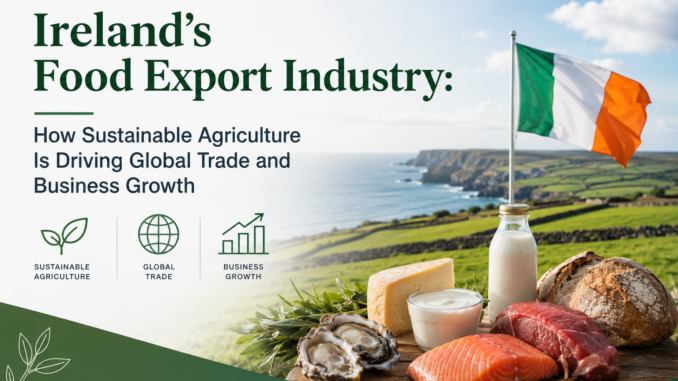
Ireland’s food export industry is entering a new phase as global demand for high-quality, traceable and sustainably produced food creates fresh opportunities for businesses. With an established agricultural sector, strong dairy and meat industries, and growing investments in food innovation, Ireland is looking to strengthen its position in international markets.
The country’s focus is gradually shifting beyond traditional agricultural production. Sustainable farming, advanced food processing, agricultural technology and responsible supply chains are becoming important parts of its export strategy. This transition is also creating opportunities for investors, technology providers, food manufacturers and logistics companies.
The scale of the opportunity is reflected in Ireland’s latest export performance. According to Bord Bia’s Export Performance and Prospects Report 2025/26, published in January 2026, the country’s food, drink and horticulture exports increased by 12% in 2025 to reach a record €19 billion. Much of the growth was driven by higher prices in key categories, particularly beef and dairy, rather than simply an increase in production volumes.
For Ireland, the next challenge is to convert this strong export performance into sustainable, long-term growth while remaining competitive in an increasingly demanding global food market.
Ireland’s Food Export Markets: Where the Growth Is Coming From
The United Kingdom and European Union continue to dominate Ireland’s food export trade, but international markets are becoming increasingly important.
Bord Bia’s 2025 figures highlight the geographical spread of the industry:
-
United Kingdom: Exports increased by 14% to €6.7 billion, making it Ireland’s largest individual export market.
-
European Union: Exports grew by 16% to €7.1 billion, accounting for 37% of total food, drink and horticulture exports.
-
International markets: Exports increased by 5% to approximately €5.2 billion, representing 28% of the total.
North America recorded stronger demand for Irish dairy products, with dairy export value to the region increasing by 11% to €1 billion. Exports to Asia remained broadly stable at €1.1 billion, while Africa recorded 9% growth to €975 million, supported by increased drinks and seafood exports.
This geographical diversification is important for Irish exporters. Greater access to international markets can reduce dependence on individual trading partners and create opportunities to develop new customer relationships.
However, entering new markets requires businesses to understand local food regulations, import duties, consumer preferences, distribution networks and pricing expectations.
Sustainable Agriculture Is Becoming a Competitive Advantage
Sustainability is increasingly influencing how international food companies select suppliers. Retailers, manufacturers and consumers are paying closer attention to food production methods, environmental impact, traceability and responsible sourcing.
Ireland is responding by encouraging farmers to improve grassland management, reduce fertiliser use, protect water quality and adopt more efficient livestock production practices.
The country’s grass-based dairy and beef production systems remain an important part of its agricultural identity. However, maintaining this advantage requires a balance between productivity, environmental responsibility and the cost of production.
For exporters, sustainability is becoming an important commercial consideration. Food companies that can demonstrate responsible sourcing, transparent production processes and measurable environmental improvements may be better positioned to meet the expectations of international buyers.
Origin Green Strengthens Ireland’s Global Food Identity
One of the most recognised initiatives supporting Ireland’s sustainability ambitions is Origin Green, the national food sustainability programme led by Bord Bia.
The programme connects farmers, food manufacturers and retailers through a framework designed to encourage measurable improvements across the food supply chain.
Its focus includes reducing greenhouse gas emissions, improving energy efficiency, managing water resources, minimising waste and protecting biodiversity.
More than 77,000 Irish food producers participate in Bord Bia’s sustainable assurance schemes, while hundreds of food and drink manufacturers are involved in Origin Green.
For international buyers, such initiatives provide greater visibility into how agricultural products are sourced and processed. They also help Irish businesses communicate their sustainability commitments to customers.
However, maintaining this reputation will require continuous improvements. International markets are increasingly looking for measurable environmental performance rather than broad sustainability claims.
Climate Challenges Are Reshaping Irish Agriculture
Despite its agricultural strengths, Ireland faces considerable environmental challenges.
Agriculture remains a major source of greenhouse gas emissions, particularly methane from livestock and nitrous oxide associated with fertiliser use and manure management.
Ireland’s Environmental Protection Agency reported that agriculture accounted for 37.9% of national greenhouse gas emissions in 2024.
More recent provisional figures published in July 2026 show that agricultural emissions declined by just 0.2% in 2025. This highlights the difficulty of reducing emissions while maintaining agricultural output. Ireland’s agricultural sector has a target of reducing emissions by 25% by 2030 compared with 2018 levels.
Meeting this target will require improvements in livestock management, fertiliser application, manure treatment and farm-level efficiency.
For farmers, the transition can involve additional investment. However, it is also creating opportunities for businesses developing emissions-monitoring systems, sustainable agricultural inputs, farm management technologies and renewable energy solutions.
Climate resilience is equally important. Changing rainfall patterns and extreme weather conditions can affect grass growth, crop yields and livestock productivity. Improving the ability of farms to adapt to these conditions will be essential for maintaining Ireland’s agricultural competitiveness.
Agritech and Digital Farming Create New Business Opportunities
Technology is becoming an important part of Ireland’s agricultural transformation. Digital farming platforms, precision agriculture and automated systems are helping farmers improve productivity and manage resources more efficiently.
For example, soil-monitoring technology can help farmers make informed decisions about fertiliser application, while digital livestock monitoring can support animal health and farm management.
Food manufacturers are also exploring automation, advanced processing equipment and data-driven production systems to reduce waste and improve efficiency.
Several business opportunities are emerging from this transition:
-
Precision agriculture: Digital soil analysis, farm management software and smart agricultural equipment can help improve resource efficiency.
-
Livestock technology: Sensors and monitoring systems can support animal health, productivity and farm operations.
-
Food processing automation: Advanced machinery can improve production capacity, consistency and operational efficiency.
-
Renewable energy: Solar power and other renewable energy solutions can help farms and processing facilities manage energy requirements.
-
Agricultural data management: Digital platforms can help businesses monitor production, costs and environmental performance.
These developments create opportunities for technology companies, equipment manufacturers, software providers and specialist agricultural service businesses.
Ireland’s agricultural transformation could therefore support a broader business ecosystem extending well beyond traditional farming.
Horticulture Offers Another Area for Export Growth
While dairy and meat dominate Ireland’s food export industry, horticulture presents opportunities for diversification.
According to Teagasc’s Horticulture Road Map 2030, Ireland’s horticulture sector contributed approximately €644 million to agricultural output in 2025, including potatoes. The sector also provides employment across primary production and downstream services.
Mushrooms are particularly important to Ireland’s horticultural export industry, with more than 85% of production exported, mainly to the United Kingdom.
Teagasc also highlights an opportunity for domestic horticultural production to expand, given that Ireland imports more than €1 billion worth of horticultural food products annually.
This creates potential opportunities for commercial growers, greenhouse operators, agricultural technology providers and food-processing companies.
Investment in controlled-environment agriculture, automated harvesting, precision irrigation and improved growing systems could help producers extend growing seasons and improve productivity.
For businesses looking to enter Ireland’s agricultural market, horticulture offers an opportunity to diversify beyond the established dairy and livestock industries.
Value-Added Food Processing Can Strengthen Export Competitiveness
Ireland’s food export industry is also benefiting from demand for processed and specialised food products.
Bord Bia reported that prepared consumer food exports increased by 9% to €3.6 billion in 2025. Growth came from categories including chocolate confectionery, juices, beverages and meal solutions.
This highlights an important opportunity for Irish manufacturers: moving beyond the export of basic agricultural commodities towards higher-value products.
Specialised dairy ingredients, premium seafood, ready-to-eat meals, functional food ingredients and convenient food products can help businesses reach different consumer segments.
Food processing companies can also benefit from investments in energy-efficient machinery, automation, improved storage systems and sustainable packaging.
For smaller manufacturers, developing specialised products and building relationships with international distributors could provide opportunities to enter markets traditionally dominated by larger food companies.
Sustainable Packaging and Supply Chains Gain Importance
The sustainability transition extends beyond agricultural production to packaging, transportation and distribution.
Food manufacturers are under increasing pressure to reduce packaging waste, improve energy efficiency and minimise the environmental impact of their operations.
This is creating opportunities for companies developing recyclable packaging, alternative materials, food-waste management systems and more efficient cold-chain logistics.
Traceability is another important consideration. International buyers increasingly want information about the origin of food products, production methods and supply-chain standards.
Digital tracking systems and improved supply-chain management can help exporters provide this information while strengthening relationships with retailers and food manufacturers.
For Ireland, investments in these areas could support a more competitive food export ecosystem and create opportunities for businesses across multiple industries.
Challenges Facing Ireland’s Food Export Industry
Despite strong export performance, Ireland’s food industry faces several challenges that could influence future growth.
Rising production costs: Higher labour, energy, fertiliser and transportation expenses can affect the competitiveness of Irish agricultural products.
Environmental regulations: Meeting climate targets will require investment and changes to established farming practices.
International competition: Food-producing countries are investing in technology, processing capabilities and export infrastructure, increasing competition in global markets.
Trade uncertainty: Geopolitical developments, tariffs and changing import regulations can affect international business relationships.
Climate risks: Unpredictable weather conditions can affect agricultural productivity and the reliability of food supplies.
Market concentration: Continued dependence on established markets makes geographical diversification important for long-term export growth.
Addressing these challenges will require cooperation between farmers, food manufacturers, government agencies, research institutions and international trading partners.
The Road Ahead: Can Ireland Become a Leader in Sustainable Food Exports?
Ireland’s food export industry has a strong foundation, but its next phase of growth will depend on how effectively it combines agricultural production with sustainability, innovation and international market development.
The country’s established dairy, meat and seafood industries provide a competitive base, while horticulture and prepared consumer foods offer additional opportunities for diversification.
Teagasc’s Road Map Series 2030 provides a useful direction for the sector, outlining future priorities and challenges across dairy, beef, sheep, pigs, horticulture and other agricultural activities. Its February 2026 overview also highlights the importance of the agri-food sector to Ireland’s wider economy and export performance.
For investors and businesses, the opportunities extend beyond farming. Agricultural technology, renewable energy, sustainable packaging, food processing, cold-chain logistics and specialised food ingredients could all benefit from the industry’s transformation.
As international food markets become more competitive, Ireland’s ability to deliver quality products through transparent, efficient and environmentally responsible supply chains will become increasingly important.
The country’s long-term opportunity lies in turning its agricultural heritage into a modern, technology-enabled and sustainable export economy. If Ireland can successfully balance environmental targets with productivity and commercial competitiveness, its food industry could strengthen its position as a valuable supplier in the evolving global food trade.
