
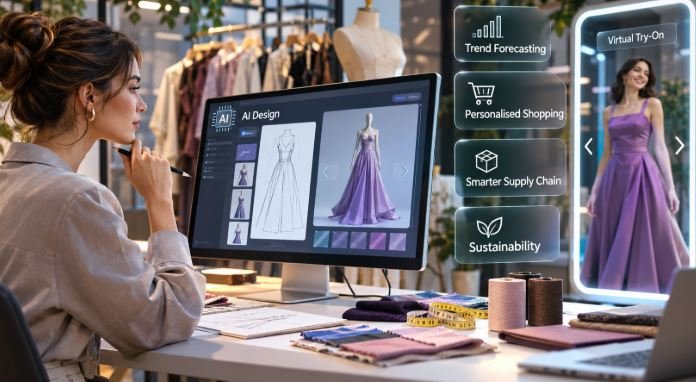
Artificial intelligence is becoming an important part of the fashion industry, changing how brands design collections, understand customers, manage production and sell products. What was once an industry driven largely by creative instinct and seasonal planning is increasingly using technology to make faster decisions and respond to changing consumer preferences.
From digital design and trend forecasting to personalised shopping and supply chain management, AI is creating new possibilities for fashion companies. According to industry findings, more than 35% of surveyed fashion executives said their companies were already using generative AI in areas such as customer service, image creation, copywriting, product discovery and consumer search.
For businesses, this shift is about more than adopting new technology. It is about improving efficiency, controlling costs, understanding customers and finding new ways to compete in a rapidly changing market.
Faster design and product development
Fashion design involves several stages, including research, sketching, sampling and product development. These activities require time, resources and coordination between designers, manufacturers and product teams.
AI tools are helping designers explore new concepts, experiment with colours and patterns, and develop different versions of a design. Three-dimensional design platforms also allow teams to create digital garment samples and review products before moving to physical production.
This can help fashion businesses reduce some of the time and expense involved in product development. Designers can explore more ideas, while brands can review collections before committing resources to manufacturing.
For smaller fashion labels, these tools offer an opportunity to develop product ranges and marketing visuals with greater flexibility. However, human expertise remains essential for assessing fabric quality, fit, construction and manufacturing requirements.
Better trend forecasting and inventory planning
Understanding what customers will buy is one of the biggest challenges in fashion. Trends can change quickly, and producing large quantities of products that fail to attract demand can affect a company’s profitability.
AI-powered forecasting tools analyse consumer preferences, online searches, social media activity and shopping patterns to identify emerging styles, colours and designs.
This information can help fashion businesses make better decisions about future collections, purchasing and inventory.
More accurate demand planning can reduce the risk of excess stock, minimise unnecessary discounts and help companies use their working capital more effectively. It can also support retailers in identifying products that are attracting greater customer interest.
For fashion businesses, the value of AI forecasting lies in combining data with the experience of designers, buyers and merchandising teams.
Personalised shopping creates stronger customer connections
Customer expectations are changing as online fashion shopping becomes more competitive. Consumers increasingly want product recommendations that reflect their preferences, sizes, budgets and personal styles.
AI-powered recommendation systems can analyse browsing activity and previous purchases to suggest relevant clothing and accessories. Digital styling assistants can help customers explore outfit combinations, while virtual try-on technology allows shoppers to visualise how selected products may look before making a purchase.
These developments can help retailers improve product discovery and create more engaging online shopping experiences.
For businesses, personalisation can support customer retention, encourage repeat purchases and help brands build stronger relationships with shoppers. It also gives smaller online retailers access to tools that were once largely associated with bigger companies.
Smarter production and supply chain management
AI is also changing how fashion products are manufactured and delivered. The industry depends on a complex network of suppliers, factories, distributors and retailers, where delays and inaccurate demand estimates can increase operating costs.
AI-based systems can analyse inventory, production schedules and supplier information to help companies identify potential problems. In manufacturing, computer vision can assist with quality checks by detecting visible fabric defects and stitching irregularities.
These applications can help businesses improve production planning, monitor product quality and reduce material wastage.
For manufacturers and retailers, better coordination across the supply chain can support more reliable deliveries and stronger cost management. It can also help companies respond more quickly when customer demand changes.
Sustainability becomes part of business strategy
The fashion industry faces growing pressure to address textile waste, overproduction and the environmental impact of manufacturing. AI can support businesses by improving demand forecasting, reducing unnecessary production and helping them monitor material use.
Digital sampling can reduce the need for repeated physical prototypes, while better inventory planning can help brands avoid producing more stock than customers are likely to purchase.
For businesses, these improvements can offer both environmental and financial benefits. Reducing waste and using resources more efficiently can lower operating costs, while more transparent production practices can strengthen customer confidence.
However, technology alone cannot make a fashion business sustainable. Responsible sourcing, reliable supplier information and better manufacturing practices remain important.
New opportunities for fashion technology businesses
The growing use of AI is creating opportunities beyond fashion brands and retailers. Technology companies and specialist service providers can develop solutions to help businesses modernise their operations.
Some important business opportunities include:
- AI-powered design services: Helping brands develop concepts, create design variations and prepare digital samples.
- Trend forecasting platforms: Providing data-based insights into consumer preferences and emerging styles.
- Virtual fitting solutions: Developing tools that improve online product visualisation and size recommendations.
- Inventory management software: Helping businesses forecast demand and manage stock more efficiently.
- Personalised retail services: Offering digital styling assistants and product recommendation systems.
- AI consulting and integration: Supporting fashion companies in adopting suitable technologies and improving existing business processes.
These opportunities are relevant to large fashion houses as well as independent designers, online retailers and smaller manufacturers.
Challenges businesses must consider
Despite its potential, AI adoption requires investment in technology, reliable data and employee training. Businesses may also face challenges when integrating new systems with existing operations.
Fashion companies need to consider data privacy, intellectual property, accuracy and the responsible use of AI-generated content. They must also ensure that technology investments deliver measurable business value.
Rather than adopting AI across every department at once, companies can begin with specific operational needs, such as improving inventory planning, reducing design development time or strengthening online customer engagement.
Training employees to use these tools effectively will also be important. Designers, marketing teams, merchandisers and supply chain professionals will increasingly need to combine their industry knowledge with digital capabilities.
Human creativity remains central to fashion
Fashion is built on creativity, culture, craftsmanship and personal expression. While AI can generate design ideas and analyse consumer behaviour, it cannot independently replace the human understanding that gives a collection its identity.
Designers remain responsible for creative direction, product quality and the emotional connection between a brand and its customers. AI is most valuable when it supports these decisions by handling repetitive tasks, analysing information and opening up new possibilities.
For the fashion business, the real opportunity lies in combining technology with human expertise. Companies that use AI to improve design, production, customer experience and business planning can build more efficient operations while preserving the creativity that makes fashion distinctive.
