
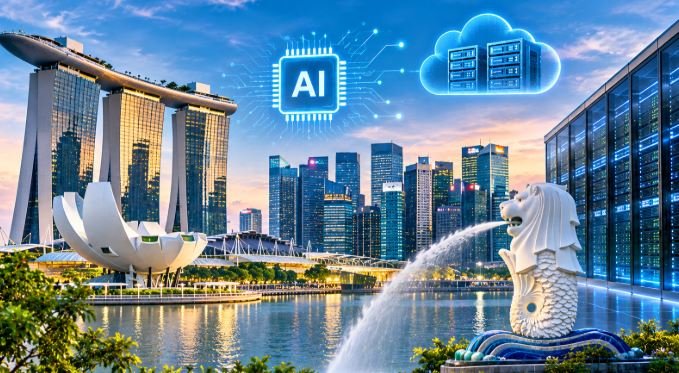
Singapore’s data centre industry is entering a defining period. As artificial intelligence becomes an increasingly important part of modern business, demand for computing power, cloud services and secure digital infrastructure is growing rapidly. Technology companies are looking beyond conventional data storage facilities towards advanced data centres capable of supporting complex AI applications, high-performance computing and large-scale digital operations.
For Singapore, this shift presents both an opportunity and a challenge. The country has established itself as one of Asia’s leading digital infrastructure and connectivity hubs, attracting global technology companies, financial institutions and cloud service providers. However, limited land, electricity and water resources mean that expanding capacity cannot simply be a matter of building more facilities.
The government’s approach is therefore becoming more selective. Rather than pursuing growth through capacity alone, Singapore is placing greater emphasis on energy efficiency, advanced technology, sustainable operations and the wider economic contribution of new projects.
This changing strategy is creating opportunities across the business ecosystem, from data centre operators and semiconductor manufacturers to engineering companies, cooling technology providers, energy businesses and regional infrastructure investors.
AI Is Changing the Economics of Data Centres
Artificial intelligence is transforming the way data centres are designed, developed and operated. Traditional facilities primarily supported cloud storage, websites, enterprise applications and conventional computing workloads. Today’s AI applications require substantially more processing capacity, specialised chips, faster networking and advanced cooling systems.
Training and running large AI models involves processing enormous volumes of information. Generative AI applications, automated business platforms and machine-learning systems also require reliable computing resources that can respond to growing workloads.
This is driving investment in high-density server environments, advanced processors, high-speed storage and specialised infrastructure.
According to Mordor Intelligence’s market estimates, Singapore’s AI data centre market is projected to increase from approximately US$810 million in 2026 to US$1.47 billion by 2031, representing a compound annual growth rate of 10.41%. This estimate relates to the AI-focused segment rather than the entire data centre industry.
The commercial implications extend well beyond the construction of new facilities. Companies supplying processors, memory systems, networking equipment, power infrastructure, cooling solutions and cloud services are all positioned within the expanding AI infrastructure value chain.
For investors, this creates a broader opportunity. The companies supporting AI computing may benefit from rising demand even if they are not directly involved in developing artificial intelligence applications.
Singapore Is Prioritising Sustainable Capacity Expansion
Singapore’s approach to data centre development has evolved considerably over the past several years.
The government introduced a moratorium on new data centre developments in 2019 while reviewing the sector’s growing demands on electricity, water and land. Although restrictions were subsequently eased through a more selective allocation approach, sustainability has remained central to the country’s digital infrastructure strategy.
In May 2024, Singapore’s Infocomm Media Development Authority (IMDA) introduced the Green Data Centre Roadmap. The initiative aims to provide at least 300 megawatts of additional data centre capacity in the near term, with opportunities for further expansion through green energy deployment.
The roadmap also encourages operators to improve energy efficiency. One of its key ambitions is for data centres to achieve a Power Usage Effectiveness (PUE) of 1.3 or lower over the next decade.
PUE measures the total energy consumed by a data centre against the electricity used by its IT equipment. A lower figure generally indicates that less additional energy is required for cooling, lighting and other supporting operations.
This focus on efficiency reflects a broader change in the investment environment. Developers are increasingly expected to demonstrate how their facilities will manage power consumption, improve cooling performance and contribute to Singapore’s economic priorities.
For businesses, this means that sustainable infrastructure is becoming a commercial requirement rather than simply an environmental commitment.
New Government Allocations Signal Continued Investor Confidence
Singapore’s controlled expansion strategy does not mean that the country is closing its doors to new investment.
In August 2026, the Economic Development Board (EDB) and IMDA provisionally allocated 200 megawatts of new data centre capacity to four operators under the second Data Centre Call for Application exercise, known as DC-CFA2.
The allocation followed an application process launched in December 2025, through which the government invited proposals that could strengthen Singapore’s position as a trusted hub for AI and digital infrastructure investment.
The four selected proposals were assessed not only on their proposed computing capacity but also on their expected economic contributions, innovation activities, talent development and sustainability commitments.
A September 2026 parliamentary response indicated that the provisionally allocated 200 MW would represent approximately 12% of Singapore’s total data centre capacity. More than half of the capacity is expected to be supported by Singapore-based low-carbon power generation, including building-integrated solar and low-carbon fuels such as biomethane, ammonia and hydrogen.
This development sends an important signal to the market. Singapore continues to welcome data centre investment, but projects must increasingly demonstrate how they can operate within the country’s resource constraints while delivering wider economic value.
For investors and operators, access to new capacity is therefore closely connected with sustainability, technology capability and long-term business commitments.
Singapore and the Rise of Regional Data Centre Partnerships
One of the most interesting changes in Southeast Asia’s digital infrastructure market is the growing relationship between Singapore and neighbouring data centre locations.
Singapore remains attractive because of its international connectivity, financial ecosystem, reliable infrastructure and established technology workforce. However, the availability of land and electricity can make large-scale expansion more challenging.
Neighbouring markets are increasingly becoming part of the solution.
Johor in Malaysia has attracted substantial interest from hyperscale cloud providers and data centre developers. Indonesia, particularly Batam, and Thailand are also developing their positions in the regional digital infrastructure market.
The geographical proximity between Singapore and Johor is especially important. Businesses can explore cross-border infrastructure strategies that combine Singapore’s connectivity and business ecosystem with additional capacity in nearby markets.
This creates opportunities for fibre networks, cloud connectivity, engineering services, power infrastructure and regional data management.
The relationship should not be viewed as a simple movement of all computing activity away from Singapore. Some applications require low latency, local data processing or specific regulatory arrangements. Financial institutions, for example, may need certain services and data environments to remain close to their operations.
Instead, companies are increasingly considering a regional model in which Singapore serves as a strategic coordination, connectivity and business hub, while neighbouring markets support additional infrastructure requirements.
For developers and investors, the opportunity lies in building an interconnected Southeast Asian digital infrastructure ecosystem.
Cooling Technology Becomes a Major Business Opportunity
Cooling is one of the most important operational considerations for data centres, particularly in a tropical country such as Singapore.
High-performance servers generate substantial heat, and AI workloads can place additional demands on thermal management systems. Maintaining suitable operating temperatures is essential for protecting equipment, ensuring reliability and controlling electricity consumption.
Traditional air-cooling systems remain widely used, but the growing density of AI computing is encouraging operators to explore more advanced solutions.
Liquid cooling is gaining attention because it can remove heat more directly from high-performance processors and server racks. Other approaches, including immersion cooling, advanced heat exchangers and intelligent cooling controls, are also being developed and deployed.
These technologies create commercial opportunities for equipment manufacturers, engineering companies, cooling specialists and software providers.
The benefits can extend beyond lower operating costs. More efficient cooling can help operators accommodate higher computing densities without proportionately increasing the energy required for facility management.
For Singapore, where land and energy efficiency are important considerations, advanced cooling technology could become a significant competitive advantage.
Companies that can deliver reliable, scalable and energy-efficient thermal management solutions may find growing demand across the region.
Semiconductor Manufacturing Strengthens the AI Infrastructure Ecosystem
Singapore’s data centre ambitions are supported by an established semiconductor industry, giving the country an important position in the wider AI supply chain.
Artificial intelligence depends on advanced processors, memory chips and specialised electronic components. As demand for AI computing increases, the importance of companies manufacturing and supplying these technologies also grows.
Singapore already has a strong industrial foundation in this area.
According to the Singapore Economic Development Board, the country accounts for approximately one in ten chips and one-fifth of global semiconductor manufacturing equipment production. The semiconductor industry contributes close to 6% of Singapore’s GDP and employs more than 35,000 people.
The EDB also reported that Singapore attracted more than S$30 billion in semiconductor investments between 2022 and 2025.
These figures highlight the depth of the country’s technology ecosystem. Global semiconductor companies, equipment manufacturers and research organisations have established operations in Singapore, creating opportunities across chip manufacturing, engineering, research and development.
The connection with AI infrastructure is significant. Data centres require advanced computing hardware, while semiconductor manufacturers are investing in the technologies that make more powerful computing possible.
This creates opportunities for businesses across several stages of the value chain, including chip design, manufacturing equipment, advanced packaging, testing, materials and specialist engineering services.
For Singapore, strengthening these capabilities helps ensure that the economic benefits of AI extend beyond data centre operations into advanced manufacturing and research.
Cloud Computing and Colocation Drive Enterprise Demand
The expansion of AI is also strengthening demand for cloud computing and colocation services.
Many businesses want access to advanced computing infrastructure but do not have the resources or expertise to build and operate their own data centres. Cloud platforms allow organisations to access computing, storage and software services through flexible commercial arrangements.
Colocation provides another option. Businesses can place their own servers and IT equipment inside professionally managed facilities, gaining access to reliable power, cooling, physical security and network connectivity.
These models are important for companies expanding their digital operations across Southeast Asia.
Financial institutions, e-commerce businesses, telecommunications providers, healthcare organisations and multinational corporations all depend on reliable data infrastructure. As AI becomes more widely integrated into their operations, demand for specialised cloud and colocation services is likely to become more sophisticated.
For operators, the opportunity is to offer more than physical space. Businesses increasingly value secure connectivity, flexible computing capacity, strong service reliability and the ability to support demanding AI workloads.
Major Companies Shape Singapore’s Data Centre Market
Singapore’s data centre ecosystem includes international infrastructure operators, regional telecommunications companies and specialist investment platforms.
ST Telemedia Global Data Centres (STT GDC) is an established regional operator with a presence across several international markets. Equinix and Digital Realty are major global providers of data centre, colocation and interconnection services.
Singtel’s Nxera business is developing its position in digital infrastructure, while Keppel DC REIT provides investors with exposure to data centre properties through a listed real estate investment trust structure.
These businesses participate in different parts of the market. Some develop and operate facilities, others focus on connectivity and digital services, while investment trusts provide exposure to income-generating data centre assets.
Their continued development reflects the growing importance of data centres as a core part of the digital economy.
However, the investment case varies across business models. Data centre operators must manage construction costs, electricity requirements, financing and customer demand. REIT investors, meanwhile, need to consider rental income, occupancy, debt levels, asset quality and interest-rate conditions.
Understanding these differences is essential when assessing opportunities in Singapore’s digital infrastructure market.
Sustainability and Energy Security Will Determine Future Growth
The next phase of data centre investment will depend heavily on Singapore’s ability to manage electricity demand and environmental impact.
AI computing requires substantial processing power, and the expansion of high-density facilities can increase electricity consumption significantly. At the same time, Singapore must balance digital infrastructure development with energy security and its broader decarbonisation objectives.
The government is therefore encouraging operators to explore more sustainable energy sources and improve facility efficiency.
This creates opportunities for renewable energy developers, battery storage companies, energy management providers and businesses developing advanced power systems.
Water efficiency is another important consideration. Cooling systems must be designed to minimise unnecessary resource consumption while maintaining reliable operating conditions.
For companies entering the market, environmental performance is becoming closely linked to commercial competitiveness. Facilities that can demonstrate efficient power use, responsible water management and reliable operations are likely to be better positioned in a market where new capacity is carefully assessed.
What Singapore’s Data Centre Expansion Means for Investors
Singapore’s evolving data centre industry offers opportunities across several connected markets.
For infrastructure investors, the sector provides exposure to facilities, colocation services and digital infrastructure assets. However, investment decisions need to account for capital expenditure, occupancy, power availability and long-term customer contracts.
For technology companies, opportunities are emerging in cloud computing, cybersecurity, networking, data management and AI infrastructure services.
For manufacturers and engineering businesses, growing demand for advanced cooling systems, electrical equipment, semiconductor components and power management solutions creates opportunities to supply operators and infrastructure developers.
For regional businesses, the expansion of Singapore’s digital ecosystem creates opportunities to develop partnerships across Malaysia, Indonesia and other Southeast Asian markets.
The strongest commercial prospects may belong to companies that can solve practical infrastructure problems. Reliable power, efficient cooling, high-speed connectivity and secure computing are becoming essential requirements for the next generation of data centres.
Singapore’s Next Chapter as a High-Value Digital Infrastructure Hub
Artificial intelligence is changing the global data centre industry, and Singapore is adapting its strategy to remain competitive.
The country is moving towards a model that prioritises efficient infrastructure, advanced computing, semiconductor capabilities and regional collaboration rather than unrestricted capacity expansion.
The latest 200 MW allocation to four data centre operators demonstrates that new investment remains possible. At the same time, the Green Data Centre Roadmap and sustainability requirements show that future development will be measured against wider economic and environmental objectives.
For businesses, the opportunities extend far beyond building data centres. Semiconductor manufacturing, cloud platforms, cooling technology, cybersecurity, energy management and regional connectivity are all becoming important parts of the investment landscape.
Singapore’s established strengths in technology, finance, manufacturing and international business provide a strong foundation for this transition. Its ability to connect these capabilities with neighbouring Southeast Asian markets could prove especially valuable as demand for AI infrastructure continues to grow.
Ultimately, the next stage of success will depend not on how many data centres Singapore builds, but on how efficiently they operate, how much value they create and how effectively they support the wider digital economy.
