
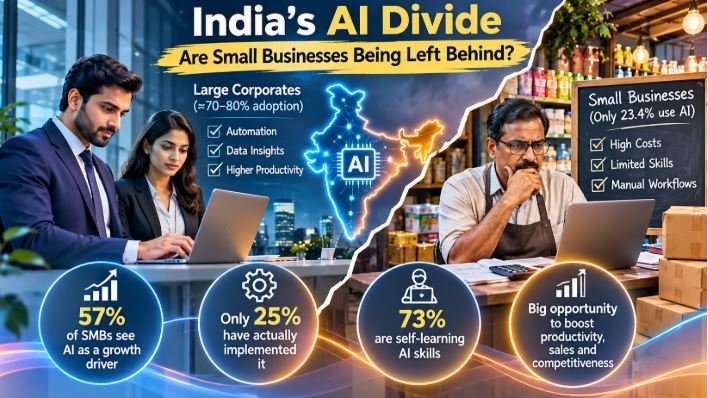
India’s artificial intelligence boom is creating new opportunities for businesses, but the benefits are not reaching every company at the same speed. Large corporations have the budgets, technology teams and data infrastructure to experiment with advanced AI systems. Many smaller businesses, meanwhile, are still working out how to use the technology without stretching already limited resources.
This is becoming an important business issue. India’s micro, small and medium enterprises (MSMEs) contribute around 31.1% of the country’s GDP, 35.4% of manufacturing output and 48.58% of exports, according to the Economic Survey 2025–26. Their ability to adopt new technology will therefore have consequences well beyond individual companies. It could influence productivity, employment, industrial competitiveness and India’s position in global supply chains.
The divide is not simply about who can afford the latest software. It is about whether smaller businesses can turn AI into practical improvements in sales, customer service, production, finance and everyday decision-making.
AI Adoption Is Growing, but Integration Remains a Challenge
The picture of AI adoption among Indian MSMEs is more complicated than a simple divide between companies that use AI and those that do not.
A CII–Indian School of Business study reported in October 2026 found that 65.8% of surveyed MSMEs used AI tools. However, only 21% used enterprise resource planning (ERP) systems or customised business software to manage operations. A separate Vi Business study found that 57% of surveyed MSMEs viewed AI as important for business growth, while 25% had integrated it into their business practices and workflows.
These findings point to an important distinction: using an AI application occasionally is not the same as building it into the way a business operates.
A shop owner might use AI to write product descriptions or prepare social media posts. That is useful, but the bigger operational opportunity comes when technology helps manage stock, understand buying patterns, respond to customers and improve purchasing decisions.
For many smaller companies, moving from experimentation to meaningful integration is the difficult part.
The Real Cost of Bringing AI into a Small Business
For a large corporation, investing in AI may involve a dedicated technology budget and specialist staff. For a small manufacturer, retailer or professional services firm, the same decision can compete with everyday expenses such as salaries, rent, raw materials and working capital.
The cost of AI adoption also goes beyond a monthly software subscription. Businesses may need better computers, reliable internet, data storage, system integration, employee training and technical support. If information is spread across paper records, spreadsheets and different applications, organising that data can become a project in itself.
Consider a small distributor handling hundreds of orders each month. Its owner may want to introduce AI-based demand forecasting, but sales information, customer records and inventory figures may be maintained separately. Before the technology can produce useful recommendations, those records need to be organised and connected.
This creates a practical barrier. Businesses are not necessarily short of interest in AI; they may be short of the time, money and technical support required to make it work.
The risk is that companies spend money on multiple tools without seeing a clear return. For an MSME operating on tight margins, that can make technology adoption feel like an unnecessary expense rather than an investment in growth.
Where AI Can Make a Real Difference to Business
Smaller companies do not need to begin with complex AI systems. Some of the most valuable applications are relatively straightforward and address problems business owners already understand.
Retail and customer service: AI-powered chat and messaging tools can help businesses respond to routine enquiries, prepare product information and support customers outside normal working hours. Retailers can also use sales data to identify popular products and plan stock requirements.
Manufacturing: Small manufacturers can explore AI-assisted quality inspection, production planning and predictive maintenance. Identifying equipment problems earlier or reducing production errors can help control costs and improve delivery reliability.
Accounting and finance: AI-enabled document processing can assist with invoice extraction, expense categorisation and routine reporting. Human review remains essential, particularly for financial decisions, compliance and tax-related work.
Agriculture and food businesses: Data-driven tools can help businesses monitor demand, plan procurement and manage supply chains. Processors and distributors may use forecasting to reduce waste and improve inventory planning.
Logistics and distribution: AI can support route planning, delivery scheduling and demand forecasting. For businesses managing frequent deliveries, even modest improvements in planning can make operations more efficient.
The commercial case is straightforward: the most useful AI investment is not necessarily the most sophisticated one. It is the one that solves a recurring problem, saves measurable time or improves the quality of a business decision.
A Skills Gap Could Become a Competitive Disadvantage
Technology alone cannot transform a business. Employees and owners need to understand how to use it, check its outputs and recognise when human judgement is necessary.
Many smaller companies do not have dedicated IT departments or data specialists. The responsibility for adopting new tools often falls on the owner or a small group of employees who are already managing several functions.
This can slow implementation. Staff may be uncertain about which applications to trust, how to write effective instructions for AI tools or how to protect customer information. Business owners may also struggle to assess whether a software provider offers genuine value.
Training needs to be practical and connected to daily work. A retailer may benefit more from learning how to use AI for inventory planning and customer communication than from a general introduction to advanced machine learning. A small manufacturer may need guidance on production data, quality control and equipment monitoring.
Regional-language interfaces and voice-based applications could make this learning process more accessible. They can help business owners who are less comfortable with complex English-language software engage with digital tools more confidently.
India’s AI Mission Could Help Lower the Barriers
India is also building public infrastructure intended to widen access to artificial intelligence.
The IndiaAI Mission, approved with an outlay of ₹10,371.92 crore, includes programmes covering computing capacity, datasets, application development, future skills, startup financing and safe and trusted AI. The government’s stated objective includes making AI capabilities more accessible to smaller businesses and other parts of the economy.
By June 2026, the mission had expanded shared computing capacity to more than 45,000 GPUs. Government figures also reported that 237 projects had accessed subsidised AI computing by August 2026, covering more than 93 lakh GPU hours.
This infrastructure is relevant because developing and testing AI applications can require significant computing resources. Shared access and subsidised services can reduce some of the costs faced by startups and innovators developing solutions for the Indian market.
However, access to computing power does not automatically solve the problems facing a small business. MSMEs also need affordable applications, reliable connectivity, suitable data systems, training and support when something goes wrong.
The next challenge is making these capabilities useful at the business level, particularly for enterprises outside major technology hubs.
A Growing Market for AI Service Providers
The AI adoption gap is not only a challenge for MSMEs. It is also creating a commercial opportunity for technology companies.
Software providers, IT services firms, startups and consultants have an opportunity to develop solutions designed around the needs and budgets of smaller enterprises. Instead of selling expensive, complicated platforms, providers could offer affordable, sector-specific services that businesses can introduce gradually.
For example, a small retailer may need a simple inventory and customer-management tool, while a food-processing unit may need assistance with quality monitoring and demand forecasting. A local logistics company may be more interested in delivery optimisation than in a general-purpose AI platform.
Technology providers that understand these differences could find a substantial market among businesses seeking practical digital upgrades.
There is also scope for partnerships between banks, industry associations, training institutions and software companies. These organisations can help MSMEs identify suitable products, access finance and build the skills required to use them.
For India’s IT services industry, the opportunity extends beyond large enterprise contracts. Supporting smaller companies through managed services, implementation support and affordable AI solutions could become an important area of business growth.
The Risks Businesses Cannot Afford to Ignore
AI can improve efficiency, but adopting it without proper safeguards can create new problems.
Customer information, employee records and financial documents should not be entered into AI services without understanding how the data will be stored and used. Businesses should check privacy policies, access controls and security arrangements before connecting sensitive systems.
AI-generated information can also be inaccurate. A chatbot may give a customer the wrong answer, a financial tool may misclassify a transaction, or a forecasting system may produce misleading recommendations when its underlying data is incomplete.
For this reason, human oversight remains essential. Businesses should start with clearly defined tasks, test results against real operating conditions and retain human approval for important financial, legal and customer-related decisions.
The objective should be to strengthen employees’ capabilities, not remove accountability from the business.
What Small Businesses Should Do Next
For MSMEs, the most sensible route into AI is a measured one. Rather than investing in several applications at once, business owners can begin by identifying one activity that consumes too much time or creates repeated errors.
They can then compare available tools, test a limited implementation and measure the results. Useful indicators might include hours saved, fewer stock shortages, faster customer responses, reduced processing errors or improved delivery performance.
Businesses should also organise their existing records before introducing more advanced systems. Clean, consistent information makes it easier for AI tools to produce useful results.
Training employees and setting clear rules for data handling should be part of the process from the beginning. If a tool does not deliver measurable value, the business should be prepared to change it rather than continue paying for an underused subscription.
This approach makes AI adoption a business decision grounded in productivity and returns, rather than a technology trend followed for its own sake.
India’s AI Growth Must Include Its Small Businesses
India’s AI story will not be complete if its benefits remain concentrated among large corporations and technology companies. MSMEs are too important to the country’s manufacturing base, exports and employment for them to be left out of the next phase of digital transformation.
The signs of interest are already visible. More small businesses are experimenting with AI, government-backed computing infrastructure is expanding, and technology providers are developing solutions for a wider market. The remaining challenge is to make adoption affordable, practical and sustainable.
For a small business, the value of AI may not lie in building a sophisticated algorithm. It may simply mean fewer hours spent on paperwork, better control over inventory, faster service for customers or the ability to compete for a larger order.
Those improvements can make a meaningful difference to a company’s growth.
The real test for India’s AI economy will be whether a small manufacturer, retailer, service provider or exporter can use the technology as confidently and effectively as a large corporation. Closing that gap could turn AI from a competitive advantage enjoyed by a few into a wider driver of business productivity and economic growth.
