
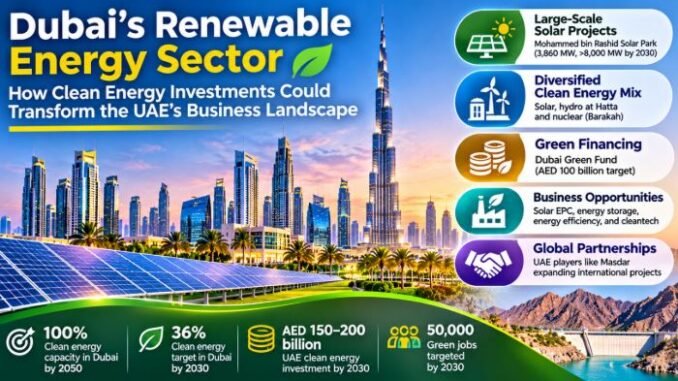
The UAE’s renewable energy transition is becoming an increasingly important part of its economic diversification strategy. What was once viewed largely as an environmental commitment is now developing into a major investment opportunity, with implications for electricity costs, industrial growth, infrastructure development and international trade.
Dubai is at the centre of this transformation. Large-scale solar projects, investment in energy infrastructure and policies encouraging sustainable development are creating new opportunities for businesses across the energy value chain. From engineering and construction to battery storage, financial services and advanced technology, a wider range of industries stands to benefit as the market expands.
The scale of the ambition is significant. Under the updated UAE Energy Strategy 2050, the country aims to triple the contribution of renewable energy by 2030 and mobilise between AED 150 billion and AED 200 billion in investment. The strategy also targets an increase in installed clean energy capacity from 14.2 GW to 19.8 GW by 2030, alongside improvements in energy efficiency.
For businesses and investors, these targets signal a long-term shift in where capital, technology and commercial demand could be concentrated.
Solar Power Is Becoming a Major Investment Market
Solar energy is driving much of Dubai’s clean energy expansion. The Mohammed bin Rashid Al Maktoum Solar Park is one of the most important projects supporting the emirate’s ambitions. According to Dubai Electricity and Water Authority (DEWA), the solar park had reached 3,860 MW of installed capacity by the end of 2025. Its planned capacity is expected to exceed 8,060 MW by 2030, with total investment estimated at approximately AED 50 billion.
This scale of development is creating demand well beyond electricity generation. Large solar projects require engineering, procurement and construction services, specialist equipment, electrical systems, maintenance and digital monitoring. They also create opportunities for companies involved in grid connections, land development and infrastructure support.
The commercial impact could extend to smaller suppliers and specialist contractors. While large developers lead major projects, local businesses can participate by providing installation services, technical support, equipment and operational solutions.
The expansion of solar power is also relevant to industrial and commercial property developers. Warehouses, factories and large commercial buildings are increasingly under pressure to manage energy consumption and improve sustainability performance. This creates a potential market for rooftop solar installations, energy management systems and integrated power solutions.
Clean Energy Generation Is Already Increasing
The transition is no longer only about future targets. DEWA’s preliminary financial and operational results for 2025 provide an indication of how quickly Dubai’s electricity system is changing.
The utility generated 62.21 terawatt-hours (TWh) of electricity during 2025, up from 59.19 TWh in 2024. Clean power generation reached 10.10 TWh, representing an increase of 52.38% compared with the previous year. Clean electricity accounted for 16.23% of DEWA’s total power generation.
The figures highlight two important business trends. First, electricity demand is continuing to grow as Dubai expands its population, commercial activity and infrastructure. Second, clean energy is becoming a larger part of the system supplying that demand.
DEWA also reported preliminary 2025 revenue of AED 32.84 billion and EBITDA of AED 17.37 billion. The utility invested AED 11.72 billion during the year, mainly in renewable energy capacity, desalination facilities and electricity transmission and distribution networks.
For businesses, these investments matter because renewable power cannot expand effectively without supporting infrastructure. Grid connections, transmission equipment, storage systems and reliable electricity networks will all be essential to bringing new capacity into operation.
A More Diverse Energy Mix Can Support Industrial Growth
The UAE’s energy transition involves more than solar power. The country is developing a broader mix that includes renewable energy, nuclear power and other lower-emission technologies.
The Barakah Nuclear Energy Plant is an important part of this wider clean energy mix. However, nuclear power and renewable energy are different categories: nuclear provides low-carbon electricity, while solar and hydropower are renewable sources.
A more diverse electricity system can help meet rising demand while supporting industries that depend on a reliable power supply. This is particularly important for data centres, manufacturing facilities, logistics operations and large commercial developments.
Electricity reliability and long-term cost planning are major considerations for businesses deciding where to invest. Companies operating energy-intensive facilities need confidence that power will remain available as their operations grow.
The expansion of clean generation, supported by investment in grid infrastructure, could strengthen the UAE’s appeal as a location for industrial and digital businesses. It may also encourage companies to consider energy efficiency and renewable electricity as part of their long-term investment decisions.
Green Financing Is Creating New Investment Opportunities
The renewable energy market requires substantial capital, and financing will play a central role in determining how quickly projects can move forward.
Dubai’s Clean Energy Strategy includes the Dubai Green Fund, designed with a target of AED 100 billion to support investment in clean energy and sustainable development through financing mechanisms, including loans at reduced interest rates.
Such initiatives can help developers and businesses manage the upfront cost of renewable energy projects. They may also encourage investment in energy-efficient buildings, cleaner industrial equipment and technologies that reduce electricity consumption.
For small and medium-sized enterprises, access to finance could be particularly important. Many SMEs may not have the resources to develop large-scale energy infrastructure, but they can benefit from financing for rooftop solar systems, efficient machinery and energy management upgrades.
Financial institutions may also find opportunities in project finance, green lending and sustainability-linked investment products. As the market matures, the need to assess project performance, energy savings and environmental outcomes could create additional demand for specialist financial and advisory services.
Battery Storage and Smart Energy Technology Could Become Key Growth Areas
One of the major challenges facing renewable energy systems is managing the difference between when electricity is generated and when it is needed. Solar power production is strongest during daylight hours, while demand can continue into the evening.
Energy storage can help address this challenge by storing electricity for later use. Battery systems, grid management software and smart energy controls are therefore likely to become increasingly important as renewable capacity expands.
This creates opportunities for technology providers, engineering firms and companies specialising in energy infrastructure. Businesses that can improve battery performance, monitor electricity consumption or manage demand more efficiently may find growing demand from utilities and commercial customers.
The opportunity also extends to artificial intelligence and digital technology. Predictive maintenance, automated monitoring and energy forecasting can help operators identify faults, reduce downtime and improve the performance of renewable installations.
For start-ups, these areas offer a route into a market that is being shaped not only by large infrastructure projects but also by the need for more efficient and intelligent energy systems.
International Partnerships Could Strengthen the UAE’s Position
The UAE is increasingly using international partnerships to expand its clean energy presence. Abu Dhabi-based Masdar has built a substantial global renewable energy portfolio through investments and projects across several markets.
In January 2026, Reuters reported that Masdar had reached approximately 65 GW of global clean energy capacity and was working towards a target of 100 GW by 2030. Its international expansion demonstrates how UAE-based energy companies are participating in the global transition rather than concentrating only on domestic projects.
These partnerships can bring investment, technology and technical expertise into the UAE while allowing Emirati companies to participate in projects overseas.
India is an important market for potential cooperation. UAE investors and Indian companies can explore opportunities across solar development, equipment supply, energy storage, engineering and infrastructure services. Such partnerships can connect UAE capital with India’s manufacturing capabilities, project expertise and growing energy requirements.
For businesses in both markets, the opportunity is not limited to large power projects. Equipment suppliers, technology companies, consultants and specialist contractors can also benefit from cross-border partnerships.
Sustainability Is Becoming a Business Competitiveness Issue
Clean energy investment is also changing how companies approach international business. Customers, investors and supply-chain partners are increasingly interested in the environmental performance of the businesses they work with.
Access to cleaner electricity can help UAE-based manufacturers and service providers reduce the emissions associated with their operations. It may also support companies responding to sustainability requirements from international customers and markets.
For exporters, this could become an important commercial consideration as environmental reporting and carbon-related requirements develop across global supply chains. Businesses that invest early in energy efficiency and emissions management may be better prepared to meet changing customer expectations.
The impact could also be felt in commercial real estate. Developers and property owners may face growing demand for energy-efficient buildings, renewable power systems and better environmental performance. These features can influence operating expenses and the attractiveness of commercial properties to international tenants.
In this way, renewable energy investment could influence decisions across the wider economy, from industrial expansion to property development and corporate procurement.
Challenges Will Shape the Pace of the Transition
Despite the opportunities, the expansion of renewable energy involves practical and financial challenges. Solar panels operating in the UAE must withstand high temperatures and frequent dust exposure. Maintenance, cleaning and performance management are therefore important to ensure projects deliver the expected output.
Grid infrastructure and energy storage will also require continued investment. Adding renewable capacity is only part of the task; electricity must be transmitted, managed and supplied reliably to businesses and households.
Another challenge is developing domestic manufacturing, research and technical expertise. Building local capabilities in equipment production, battery technology and advanced energy systems could help the UAE capture more economic value from the transition.
Businesses entering the sector will also need to assess project financing, technology costs, contract structures and long-term electricity demand. Ambitious government targets can create market confidence, but commercial success will ultimately depend on projects being technically reliable and financially viable.
The Business Outlook for Dubai’s Renewable Energy Sector
Dubai’s renewable energy expansion is creating a broader investment market that reaches beyond electricity production. Solar infrastructure, grid development, energy storage, green finance and digital energy management are all becoming relevant to the emirate’s future business landscape.
The UAE’s national strategy also identifies the potential for 50,000 new green jobs by 2030, alongside energy-efficiency improvements of 42% to 45% compared with 2019 levels. These targets point to growing demand for technical skills, engineering expertise and specialist services.
For investors, the sector offers exposure to a long-term infrastructure and technology transition. For established companies, it creates opportunities to improve energy efficiency, strengthen supply chains and develop new commercial partnerships. For SMEs and start-ups, it opens potential markets in installation, maintenance, software, storage and energy services.
The next phase of growth will depend on how effectively the UAE converts its policy ambitions into operating projects, reliable infrastructure and commercially sustainable businesses. If investment and technology development continue at scale, renewable energy could become a significant contributor to the country’s economic diversification, industrial competitiveness and international investment appeal.
Dubai’s clean energy ambitions are therefore about more than changing the source of electricity. They are helping shape a new business environment in which energy efficiency, technology and sustainability are increasingly connected to long-term economic growth.
