
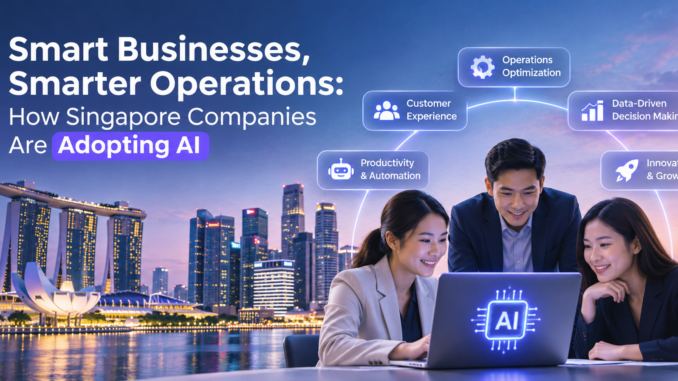
Nov 23: Singapore’s business landscape is undergoing a significant transformation as artificial intelligence (AI) becomes an increasingly important part of corporate operations. From financial management and customer service to digital marketing, manufacturing and supply chain management, companies are exploring how AI can improve productivity, reduce operating costs and strengthen their competitive position.
The shift is no longer limited to technology companies or large corporations. Small and medium-sized enterprises (SMEs) are also beginning to integrate AI-powered solutions into everyday business activities, creating opportunities to streamline operations without proportionately increasing their workforce.
With Singapore strengthening its position as a regional technology and business hub, the growing adoption of AI is becoming an important factor in how companies prepare for future economic and operational challenges.
AI Adoption in Singapore Businesses Is Accelerating
Singapore’s progress in AI adoption is reflected in the latest figures published by the Infocomm Media Development Authority (IMDA).
The Singapore Digital Economy Report 2026, released in October, revealed that AI adoption among Singapore enterprises increased from 14.7% in 2024 to 23.5% in 2025.
The improvement was particularly notable among smaller businesses. AI adoption among SMEs increased from 14.5% in 2024 to 23.4% in 2025. Among larger enterprises, adoption rose from 62.5% to 70.4%.
The report also highlighted the growing economic importance of digitalisation. Singapore’s digital economy reached S$144.1 billion in 2025, accounting for 19.3% of the country’s GDP, compared with 18.8% in 2024.
These developments demonstrate that digital technologies are increasingly contributing to business activity beyond the traditional technology sector.
For Singapore companies, AI is gradually moving from an experimental investment to a practical operational tool.
How AI Is Transforming Business Operations
The commercial value of AI lies in its ability to improve multiple business functions. Companies are increasingly exploring applications that can reduce repetitive work, support decision-making and help employees concentrate on more complex responsibilities.
1. Business Process Automation
One of the most immediate applications of AI is the automation of repetitive business activities.
Companies are using AI-powered platforms to assist with invoice processing, document management, data entry, report preparation and administrative workflows.
Automation can reduce the time employees spend on routine activities while improving processing consistency.
For businesses handling large volumes of transactions, these improvements can contribute to lower administrative costs and more efficient resource allocation.
2. AI-Powered Customer Service
Customer experience is becoming an important competitive factor across Singapore’s retail, banking, hospitality and e-commerce sectors.
AI-powered chatbots and virtual assistants can respond to common customer enquiries, provide product information, assist with bookings and direct complex requests to the appropriate employees.
Businesses can also analyse customer interactions to identify frequently reported problems and understand changing preferences.
This allows companies to improve customer support while maintaining service availability beyond conventional working hours.
3. Smarter Financial Management
Financial departments are increasingly exploring AI applications to improve accounting, budgeting and financial analysis.
AI-powered systems can assist with expense classification, invoice verification, transaction monitoring and financial reporting.
Predictive analytics can also help businesses examine historical revenue and expenditure patterns to improve cash-flow planning.
For SMEs, these capabilities can make financial administration more manageable and help management teams identify potential operational risks earlier.
However, financial decisions and regulatory responsibilities continue to require professional oversight.
4. AI in Digital Marketing and Sales
AI is changing how businesses identify customers, develop campaigns and evaluate marketing performance.
Companies are using AI tools to analyse consumer behaviour, identify potential audiences, personalise marketing messages and evaluate campaign effectiveness.
Generative AI is also helping marketing teams prepare content, product descriptions, campaign ideas and customer communication.
For smaller businesses, these capabilities can improve marketing productivity without requiring extensive internal resources.
However, businesses must maintain human editorial oversight to ensure that AI-generated content remains accurate, relevant and consistent with their brand identity.
5. Intelligent Supply Chain and Logistics Management
Singapore’s position as an international trading and logistics centre makes supply chain efficiency particularly important.
AI-powered systems can help companies forecast demand, monitor inventory, optimise delivery schedules and identify potential disruptions.
Predictive analytics can also support warehouse planning and improve coordination between suppliers, distributors and retailers.
In manufacturing, AI applications can assist with equipment monitoring, quality inspection and predictive maintenance.
These technologies can help businesses reduce operational interruptions, improve resource utilisation and respond more effectively to changing market requirements.
6. Human Resources and Workforce Productivity
AI is also changing how companies approach recruitment, employee administration and workforce development.
Human resource departments can use AI to organise applications, prepare job descriptions, manage employee enquiries and identify training requirements.
Businesses can also analyse workforce data to understand skill gaps and plan employee development programmes.
Rather than viewing AI entirely as a replacement for human employees, companies are increasingly exploring how it can support existing teams and allow employees to concentrate on higher-value responsibilities.
Which Industries Are Benefiting From AI Adoption?
AI adoption is progressing across Singapore’s economy, although the level of implementation differs between industries.
The Ministry of Manpower’s April 2026 report on AI adoption among firms identified information and communications, professional services, and financial and insurance services as sectors with relatively high adoption.
The report found adoption rates of 74.1% in information and communications, 57.5% in professional services and 56.4% in financial and insurance services.
These figures are based on a separate survey of establishments with at least 10 employees and should be distinguished from IMDA’s broader enterprise adoption statistics.
Several industries are particularly well positioned to benefit from AI integration.
Financial services: Banks and financial institutions are exploring AI for fraud detection, transaction monitoring, customer assistance and risk analysis.
Manufacturing: Manufacturers can use intelligent systems for production monitoring, predictive maintenance, quality control and resource planning.
Retail and e-commerce: AI can support demand forecasting, personalised recommendations, inventory management and automated customer support.
Professional services: Accounting, consulting and legal businesses are exploring AI for research, document analysis, financial reporting and administrative activities.
Logistics and transportation: AI-powered forecasting and operational analytics can help companies improve delivery planning, warehouse management and supply chain coordination.
The growing use of AI across these sectors indicates that its business applications are extending well beyond software development and technology services.
Singapore’s Government Initiatives Are Encouraging AI Adoption
Singapore’s AI development is supported by government initiatives designed to improve enterprise capabilities and prepare employees for changing workplace requirements.
One significant development was the announcement of the National AI Impact Programme by the Ministry of Digital Development and Information on March 2, 2026.
The programme aims to support 10,000 enterprises over three years in advancing their AI adoption journeys. It also initially outlined support for 100,000 workers to become AI Bilingual by strengthening their ability to apply AI within their respective professional fields.
The initiative includes efforts to expand access to pre-approved AI solutions, provide practical training for business leaders and improve AI capabilities among professionals in sectors such as accounting and legal services.
The programme reflects an important shift in Singapore’s approach: encouraging businesses not only to purchase AI tools but also to redesign workflows and develop the workforce capabilities required to use them effectively.
For SMEs, access to suitable solutions, training and implementation support can help reduce some of the barriers associated with AI adoption.
Are Singapore Businesses Already Seeing Measurable Benefits?
The growing adoption of AI is being accompanied by measurable improvements in business operations.
According to IMDA’s Singapore Digital Economy Report 2026, 87.6% of AI-adopting enterprises identified improvements in productivity and business processes as a key benefit.
Around 44% also reported cost reduction and resource optimisation.
These findings suggest that businesses are increasingly looking at AI through a commercial lens.
The objective is not simply to introduce new technology but to improve how employees work, how resources are allocated and how business decisions are made.
For example, an SME using AI to automate routine financial administration may be able to redirect employee time towards financial planning and customer management. Similarly, a retailer using predictive analytics may improve inventory planning and reduce the risk of overstocking.
The greatest benefits are likely to emerge when AI applications are integrated into broader business processes rather than used as isolated productivity tools.
Challenges That Businesses Must Address
Despite the growing opportunities, AI adoption is not without challenges.
Singapore’s Ministry of Manpower, in its April 2026 report, found that 71.5% of surveyed firms had yet to adopt AI. Among the firms that had started adopting the technology, only 3.8% had integrated it into their core processes.
The report identified high implementation costs and a lack of in-house expertise as two major barriers.
Other challenges include:
Implementation costs: Software subscriptions, infrastructure, integration and maintenance can increase technology expenditure, particularly for smaller companies.
Skills shortages: Employees require practical AI knowledge to use technology effectively and understand its limitations.
Data privacy and security: Businesses must protect confidential customer, employee and commercial information when using AI platforms.
System integration: Connecting AI applications with existing business software can be complicated and may require additional technical investment.
Accuracy and accountability: AI-generated information requires verification, particularly in financial, legal and customer-facing activities.
These challenges highlight why successful AI adoption requires a clear business strategy rather than an isolated technology purchase.
Why SMEs Need a Practical AI Strategy
For Singapore’s SMEs, AI presents an opportunity to improve operational efficiency and compete more effectively with larger organisations.
However, smaller businesses should avoid adopting multiple AI platforms without understanding their actual business requirements.
A practical starting point is to identify activities that consume significant employee time or create recurring operational difficulties.
Businesses can then introduce AI solutions in areas such as customer support, accounting, marketing or inventory management.
Employee training, data protection and performance evaluation should form part of the implementation process.
Companies should also measure the commercial outcomes of AI adoption, including improvements in processing time, operating costs, customer satisfaction and employee productivity.
A gradual implementation strategy can help SMEs manage costs while identifying applications that deliver meaningful returns.
The Future of AI-Powered Business Operations in Singapore
The next phase of AI adoption in Singapore is likely to focus on deeper integration across business functions.
AI agents and more advanced automation systems could help companies coordinate multiple activities, retrieve business information, process requests and support employees with complex workflows.
Manufacturers may explore intelligent production environments, financial institutions could expand predictive risk analysis, and retailers may increasingly use AI to connect customer insights with inventory and sales planning.
Workforce development will also become increasingly important. Businesses will need employees who can combine professional expertise with the ability to work effectively alongside AI systems.
Singapore’s growing investment in AI capabilities, digital infrastructure and workforce training provides a foundation for this transformation.
However, the long-term competitive advantage will depend on how effectively companies translate technological capabilities into measurable business improvements.
Conclusion
Singapore’s AI adoption journey is creating new opportunities for businesses to improve productivity, streamline operations and strengthen their competitive position.
The latest IMDA figures demonstrate that adoption is accelerating among both SMEs and larger enterprises, while the expansion of the digital economy highlights the growing contribution of technology to Singapore’s business landscape.
For companies, the priority is now shifting from experimenting with AI to identifying practical applications that can improve everyday operations.
Businesses that invest in employee capabilities, responsible technology adoption and effective workflow integration will be better positioned to benefit from this transition.
Ultimately, the future of smarter business operations in Singapore will not be determined by how many AI tools companies introduce, but by how effectively they use intelligent technology to create measurable value, improve decision-making and achieve sustainable growth.
