
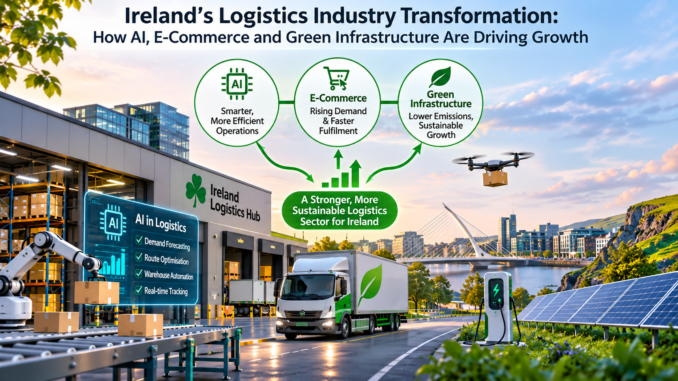
Nov 21: Ireland’s logistics industry is entering a new phase of transformation as artificial intelligence (AI), warehouse automation, e-commerce and sustainable infrastructure reshape how goods are stored, transported and delivered. Businesses are increasingly looking beyond traditional warehousing and transportation models to build supply chains that are faster, more flexible, digitally connected and environmentally responsible.
The changing requirements of retailers, manufacturers and third-party logistics providers are creating demand for advanced logistics facilities, predictive supply chain technologies, automated warehouses and strategically located distribution centres. These developments are also opening opportunities for technology companies, infrastructure investors, property developers and international service providers.
A November 18, 2026, industry analysis by Addleshaw Goddard identifies AI-driven forecasting, robotics, micro-fulfilment centres, electric vehicle charging and sustainable logistics facilities among the key themes expected to influence Ireland’s logistics and industrial property sector. The analysis highlights how technology and environmental considerations are becoming central to the future design and operation of logistics facilities.
For Ireland, the opportunity extends beyond improving delivery operations. The next stage of logistics development could strengthen the country’s position as a European distribution location while creating opportunities for businesses that can provide the technology and infrastructure required by modern supply chains.
How AI Is Transforming Ireland’s Logistics Industry
Artificial intelligence is changing supply chain management by enabling businesses to anticipate demand, identify operational risks and make decisions using real-time information.
Traditional logistics planning often depends on historical sales figures, manual inventory checks and fixed delivery schedules. AI-powered systems can analyse a wider range of information, including seasonal demand, customer purchasing patterns, weather conditions, supplier performance and transportation data.
This allows logistics operators to move from reactive decision-making towards predictive supply chain management.
For example, an AI-powered forecasting platform can help a retailer estimate demand for specific products before a seasonal sales period. A distribution company can use predictive analytics to identify potential delivery delays, adjust inventory allocation and improve route planning.
These applications can support:
- More accurate demand forecasting.
- Better inventory and warehouse management.
- Reduced stock shortages and excess inventory.
- Improved transportation and delivery planning.
- Faster identification of supply chain disruptions.
- Greater visibility across suppliers and distribution networks.
AI adoption is also influencing warehouse design. Facilities increasingly require reliable power supplies, digital connectivity and layouts that can accommodate automated systems.
The European logistics market is reflecting this shift. CBRE’s 2026 European Logistics Market Outlook identifies automation capability as an important factor influencing occupiers’ warehouse selection. Its research also highlights concerns about electricity availability and grid reliability among logistics occupiers.
For Irish businesses, this means technology investment is no longer limited to software procurement. It is becoming part of a wider infrastructure and operational strategy.
Warehouse Automation and Robotics Are Changing Distribution Operations
Warehouse automation is emerging as another important driver of change in Ireland’s logistics sector.
As businesses face pressure to process orders quickly and maintain accuracy, automated systems are increasingly being considered for repetitive and time-sensitive warehouse activities.
Autonomous mobile robots can transport goods across warehouse floors, while robotic picking and sorting systems can support order preparation and inventory handling. Automated storage and retrieval systems can also improve the use of available warehouse space.
These technologies can help businesses increase throughput, reduce manual handling and improve operational consistency.
However, automation does not necessarily mean replacing the entire warehouse workforce. In many operations, technology is more likely to support employees by handling repetitive tasks and allowing staff to focus on supervision, maintenance, quality control and complex operational decisions.
For developers, this creates new requirements for industrial properties. Warehouse buildings must be designed with suitable floor specifications, clear internal layouts, sufficient power capacity and digital infrastructure to support automation.
The opportunity is therefore expanding beyond robotics manufacturers. Software developers, systems integrators, equipment maintenance providers and specialist engineering companies can also benefit from the growing demand for automated logistics solutions.
E-Commerce Growth Is Increasing Demand for Micro-Fulfilment Centres
Changing consumer expectations are reshaping how retailers and logistics companies organise their distribution networks.
Online shoppers increasingly expect faster delivery, flexible collection options and accurate information about their orders. Meeting these expectations requires businesses to position inventory closer to customers and improve the efficiency of the final delivery stage.
This is encouraging interest in micro-fulfilment centres and decentralised distribution networks.
Unlike large regional warehouses that serve extensive geographical areas, micro-fulfilment facilities are smaller distribution locations positioned closer to urban customers. They can help retailers process online orders more quickly and reduce the distance between inventory and delivery destinations.
Dublin and other growing urban centres could benefit from this model as retailers and third-party logistics providers explore ways to improve last-mile delivery.
Ireland’s industrial property market is also showing signs of diversification in the size of facilities being developed. An Addleshaw Goddard analysis published on November 4, 2026, indicates that warehouses exceeding 100,000 square feet, which represented approximately 65% of new supply annually over the previous five years, are projected to account for 47% in 2026 and 30% in 2027.
The analysis also points to an increase in the expected share of units between 20,000 and 50,000 square feet, alongside the return of meaningful development activity in units below 10,000 square feet.
This changing supply mix reflects demand from a wider range of occupiers, including smaller businesses, last-mile operators and logistics providers seeking more flexible facilities.
For investors and developers, the opportunity lies in creating logistics properties that can serve different business requirements rather than focusing exclusively on large warehouse developments.
Green Logistics Is Becoming a Business Priority
Sustainability is increasingly influencing investment decisions across the logistics industry.
Warehousing, freight transportation, packaging and last-mile delivery all contribute to the environmental footprint of supply chains. Businesses are therefore exploring ways to reduce emissions, improve energy efficiency and manage waste throughout their operations.
Green logistics strategies include:
- Using renewable energy in warehouses and distribution facilities.
- Optimising delivery routes to reduce unnecessary travel.
- Consolidating shipments to improve vehicle utilisation.
- Introducing electric vehicles where operationally practical.
- Improving building insulation and energy management.
- Adopting reusable, recyclable and lower-impact packaging.
- Developing reverse logistics systems for product returns and recycling.
These measures are becoming relevant not only to businesses with formal sustainability commitments but also to logistics operators responding to customer expectations and changing investment requirements.
Modern logistics developments are increasingly expected to incorporate energy-efficient building systems, rooftop solar installations, EV charging infrastructure and sustainable construction materials.
The November analysis by Addleshaw Goddard identifies the development of sustainable logistics hubs as an important direction for the Irish market. Such facilities combine renewable energy, digital building management, low-emission transport infrastructure and more efficient warehouse operations.
For businesses, the commercial value of sustainability will depend on the ability to balance environmental improvements with operational costs, energy availability and long-term returns.
Electric Vehicle Infrastructure Could Create New Logistics Opportunities
The transition towards lower-emission transportation is creating additional demand for charging infrastructure across Ireland.
Electric vans and passenger vehicles are becoming increasingly relevant to urban distribution and delivery operations. However, electrifying heavy-duty freight vehicles presents more complex requirements because of vehicle range, charging capacity, operating schedules and the availability of suitable charging locations.
Ireland’s National EV Infrastructure Strategy 2026–2028, announced in November, sets out the next phase of the country’s charging network development. It also recognises the need to plan for depot and en-route charging solutions for commercial fleets and heavy-duty vehicles.
This is particularly relevant to logistics operators that need reliable charging facilities at distribution centres and along important freight corridors.
The opportunity extends to several business segments:
- Commercial EV charging equipment and installation.
- Depot charging infrastructure.
- Energy management and load-balancing software.
- Fleet monitoring and charging management platforms.
- Renewable energy integration.
- Battery storage and supporting electrical infrastructure.
However, the transition will require substantial investment. Logistics facilities must assess electricity capacity, grid connections, charging requirements and vehicle utilisation before committing to large-scale electrification.
For developers, incorporating charging infrastructure during the initial planning and construction stages may be more practical than retrofitting facilities later.
Sustainable Packaging and Reverse Logistics Are Creating New Markets
Packaging is another area where the logistics industry is undergoing change.
The growth of online shopping has increased the movement of packaged products, while product returns have added complexity to distribution networks. Businesses are therefore looking for packaging solutions that reduce waste without compromising product protection and delivery efficiency.
Reusable containers, recyclable materials, biodegradable packaging and packaging designed for multiple delivery cycles are gaining attention.
Reverse logistics is also becoming an important operational consideration. It involves managing the movement of returned, repaired, refurbished or recycled products from customers back to businesses or processing facilities.
For retailers and manufacturers, efficient reverse logistics can help recover product value, reduce waste and improve customer service.
This creates opportunities for packaging manufacturers, recycling companies, warehouse operators and technology providers developing systems to track returned goods and manage inventory across multiple locations.
Businesses that can combine sustainable packaging with efficient collection, sorting and redistribution services may find new commercial opportunities as supply chains become more circular.
Ireland’s Logistics Property Market Is Shifting Towards Flexible Facilities
Ireland’s logistics property market is evolving alongside changing occupier requirements.
Businesses are increasingly looking for facilities that can support automation, higher-density storage, digital inventory management and energy-efficient operations. Location remains important, but building specifications and access to infrastructure are becoming equally significant.
Colliers’ Q2 2026 Industrial and Logistics Market Report recorded approximately 621,000 square feet of take-up during the quarter, representing a 44% increase compared with the previous quarter. Vacancy remained at approximately 4%, while prime rents stood at around €14.50 per square foot.
The sector also attracted €513 million in investment across four transactions during the quarter, demonstrating continued investor interest in Irish industrial and logistics property.
These figures indicate that demand for quality logistics accommodation remains relevant, although the market is becoming more selective about the type of facilities required.
Dublin continues to be a major logistics location because of its access to population centres, Dublin Port and Dublin Airport. However, higher land costs and limited availability are encouraging developers and occupiers to consider regional alternatives.
Cork, Limerick and locations across the Midlands may offer opportunities for businesses seeking different cost structures, larger sites and access to regional transport networks.
The next generation of logistics facilities will need to balance location, power availability, automation readiness, sustainability and flexibility.
Infrastructure and Energy Constraints Could Slow Expansion
Despite the opportunities, Ireland’s logistics industry faces several challenges that could influence the pace of investment.
Electricity availability is one of the most important considerations. Automated warehouses, high-density storage systems, refrigeration and EV charging infrastructure can significantly increase power requirements.
An Addleshaw Goddard analysis published on November 16, 2026, highlights the importance of securing grid connections early in the development process. It notes that applications requiring a substation can take at least six to nine months from application to connection, while major business loads requiring a high-voltage connection can take more than two years.
These timelines can affect project costs, construction schedules and the commercial viability of new developments.
Other challenges include:
Planning and regulatory requirements: Logistics developments must meet planning, fire safety, environmental and building compliance requirements. These can increase development costs and extend project timelines.
Road congestion: Heavy reliance on road freight makes transport reliability essential. Congestion around major routes, particularly Dublin’s M50, can affect delivery schedules and operating costs.
Workforce availability: Shortages of experienced HGV drivers and other logistics professionals can place pressure on transportation capacity and operational efficiency.
Capital investment: Warehouse automation, energy infrastructure, charging facilities and sustainable building systems require significant upfront spending. Smaller operators may find it difficult to adopt these technologies without suitable financing.
Technology integration: Businesses must ensure that new software, robotics and tracking systems work with existing warehouse management, transport management and enterprise platforms.
Addressing these constraints will require coordination between developers, logistics operators, technology companies, energy providers and public authorities.
India–Ireland Opportunities in Logistics Technology and Digital Services
Ireland’s logistics transformation also creates opportunities for international technology providers, particularly Indian IT and business services companies.
As logistics operators invest in digital supply chains, they will need specialised software, systems integration, data analytics and ongoing technology support.
Indian IT companies with experience in enterprise software, cloud computing, artificial intelligence and digital transformation could explore opportunities to support Irish logistics businesses.
Potential areas of collaboration include:
AI-powered supply chain platforms: Developing demand forecasting, inventory optimisation and predictive analytics solutions.
Warehouse management systems: Implementing software that connects inventory, order processing, warehouse operations and distribution activities.
Transport management solutions: Supporting route optimisation, fleet tracking, delivery scheduling and freight visibility.
Automation integration: Connecting robotics, warehouse equipment and digital platforms to improve operational efficiency.
Cloud and cybersecurity services: Helping logistics companies modernise their IT infrastructure while protecting commercially sensitive supply chain information.
Sustainability analytics: Developing platforms that measure transport emissions, monitor energy consumption and support environmental performance reporting.
The opportunity is not limited to large technology projects. Irish logistics businesses may also require managed IT services, software maintenance, technical support and customised digital solutions.
For Indian service providers, a focused approach to logistics technology could create opportunities to build long-term business relationships in Ireland. Understanding local regulatory requirements, data protection obligations and the operational needs of Irish businesses will remain important for successful market entry.
The Future of Ireland’s Logistics Industry
Ireland’s logistics sector is likely to become increasingly technology-driven as businesses respond to changing consumer expectations, supply chain risks and sustainability requirements.
AI-powered forecasting, warehouse automation and real-time tracking can improve visibility and efficiency. Micro-fulfilment centres and regional distribution networks may support faster delivery, while sustainable buildings and EV infrastructure could influence future logistics investment.
However, the pace of transformation will depend on how effectively businesses address electricity capacity, planning timelines, financing requirements and workforce challenges.
The market is also moving towards more flexible logistics models. Businesses may increasingly combine outsourced warehousing, technology platforms and specialised distribution services rather than relying entirely on asset-heavy operations.
For developers, this means designing adaptable facilities that can accommodate changing technology requirements. For logistics operators, it means investing in digital capabilities and operational efficiency. For technology providers, it creates opportunities to develop solutions that connect different stages of the supply chain.
Ireland’s logistics industry is therefore moving beyond traditional warehousing and transportation. Its future competitiveness will increasingly depend on the integration of technology, infrastructure, sustainability and flexible business models.
Conclusion
The transformation of Ireland’s logistics industry reflects a broader shift in how businesses approach supply chain management. AI, robotics, e-commerce fulfilment, electric vehicle infrastructure and sustainable packaging are creating new requirements across warehousing, transportation and distribution.
The November 2026 industry developments highlight the growing importance of future-ready logistics facilities and digitally connected supply chains. Although infrastructure constraints and investment costs remain significant, the sector offers opportunities for property developers, logistics operators, technology companies and international service providers.
For Indian IT businesses, Ireland’s evolving logistics ecosystem presents potential opportunities in AI, cloud computing, automation integration and supply chain software. Companies that can deliver practical, scalable and secure solutions may be well positioned to participate in the next phase of Ireland’s logistics development.
As the industry evolves, the businesses most likely to benefit will be those that combine operational efficiency with technology adoption and sustainable infrastructure.
