

The rapid growth in demand for memory driven by artificial intelligence systems has enabled the world’s largest manufacturers to deliver record revenue, profit, and market capitalization for several consecutive years. Samsung Electronics, SK hynix, and Micron are actively expanding production, signing long-term contracts with major cloud providers, and announcing investment programs worth hundreds of billions of dollars. However, as capital expenditures continue to rise, investors are increasingly wondering whether the industry is laying the groundwork for another overproduction crisis in the second half of the decade.
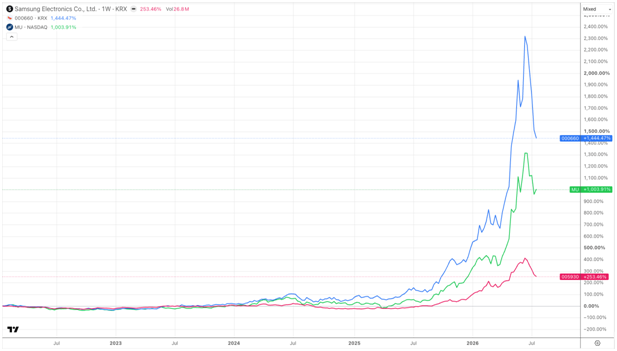
Current expansion plans are built on the assumption that demand from data centers will remain at an exceptionally high level for several more years. However, if investments in artificial intelligence generate returns more slowly than expected, the pace of infrastructure expansion will inevitably decline, reducing demand for memory. Under that scenario, the first signs of overproduction in the classic DRAM segment may emerge as early as 2028.
The history of the industry underscores its highly cyclical nature. While about two dozen companies manufactured memory chips in the 1990s, today the global market is effectively controlled by just three players — Samsung Electronics, SK hynix, and Micron. Yet consolidation alone does not eliminate cyclical risks. The largest manufacturers have already announced capacity expansion programs totaling about $1.5 trillion over the next fifteen years — roughly equivalent to SpaceX’s valuation at its record-breaking Nasdaq IPO, the largest market debut in history.
However, many of the new facilities are expected to begin production only after 2030. This means that companies are investing on the assumption that current demand will remain high for several more years, although predicting market dynamics over such a long horizon is becoming increasingly difficult. Long-term contracts remain an additional source of uncertainty. While they help stabilize cash flows and reduce short-term price volatility, they cannot eliminate the fundamental risk of overproduction if supply eventually outstrips demand.
At the same time, the situation within the memory market is becoming less homogeneous. HBM, the specialized memory used in AI accelerators, is considered the most stable segment. HBM products are typically developed for specific customers, with supply chains tightly integrated with leading AI chip designers. As a result, the risk of meaningful oversupply here remains significantly lower. The outlook is less certain for the broader DRAM market, where products are largely interchangeable across manufacturers, making prices far more sensitive to shifts in supply and demand.
China also adds another layer of uncertainty. Approximately 30% of the global increase in production capacity by 2028 is expected to come from Chinese manufacturers. Particular attention is focused on CXMT, which has already openly declared its intention to expand beyond the domestic market and compete internationally. If its expansion outpaces expectations, the global supply-demand balance could shift faster than industry leaders currently anticipate.
Despite these concerns, the largest market participants continue to invest aggressively in new manufacturing capacity. For example, TSMC recently raised its planned long-term investment in US facilities from $165 billion to $265 billion, announcing the construction of four additional fabs in Arizona, along with new chip testing and advanced packaging facilities.
Such a large-scale expansion reflects not only strong customer demand but also intensifying competition. Alongside Intel, which recently appeared among the premarket gainers, and Samsung, companies associated with Elon Musk are beginning to show interest in contract semiconductor manufacturing, prompting TSMC to strengthen its presence in North America, which already accounts for 78% of the company’s revenue.
At the same time, the Taiwanese manufacturer is maintaining a disciplined approach to investment. The company has been cautious about deploying ASML’s High-NA lithography systems, which cost around $400 million each, arguing that they are not yet sufficiently economical for large-scale production. Meanwhile, Intel’s success in developing its own 18A process technology makes it possible to gradually reduce the dependence of the American corporation on TSMC, freeing up some of the lines for other major customers, including AMD.
However, there are no signs that the current supply shortage will ease in the near term. As early as next year, demand for AI chips may increase by another 60-100%, while production capacity is unlikely to expand quickly enough to keep pace. As a result, market conditions are expected to remain favorable for memory manufacturers for the time being.
Thus, the industry is gradually approaching a point where investors have to evaluate not only today’s record financial results, but also the long-term consequences of unprecedented capital spending. For now, AI continues to support high demand and record profits for memory manufacturers, but their return on investments and the dynamics of global production capacity expansion will determine whether the current shortage persists or whether the market will return to its usual cyclical pattern.