
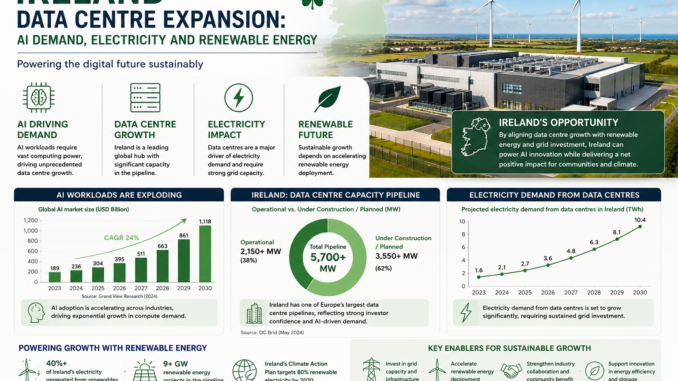
Oct 29: Ireland’s data centre industry is entering a critical phase as the rapid adoption of artificial intelligence (AI) increases demand for computing power and electricity. The country has built a strong position in the international technology sector, but maintaining that position will depend on whether its energy infrastructure can support further growth.
The challenge is significant. Data centres need reliable electricity to run servers, process information and keep cooling systems operating. At the same time, Ireland must meet the energy needs of households, manufacturers and other businesses while progressing towards a lower-carbon economy.
According to Ireland’s Central Statistics Office (CSO), data centres consumed 7,663 gigawatt-hours (GWh) of metered electricity in 2025, accounting for 23% of total metered electricity consumption. Their consumption increased by 10% from the previous year.
Can Ireland’s energy infrastructure keep pace with AI demand? The answer will depend on how quickly the country can expand renewable electricity generation, improve grid capacity, introduce effective energy storage and make data centre operations more efficient.
Ireland’s Data Centre Electricity Consumption: What the Latest Report Shows
The CSO’s Data Centres Metered Electricity Consumption 2025 release, published on 7 July 2026, highlights the scale of the sector’s growing electricity requirements.
| Indicator | 2024 | 2025 |
|---|---|---|
| Data centre electricity consumption | 6,973 GWh | 7,663 GWh |
| Share of total metered electricity consumption | 22% | 23% |
| Year-on-year growth in data centre consumption | — | 10% |
The longer-term trend is equally important. Data centres accounted for just 5% of total metered electricity consumption in 2015. By 2025, their share had risen to 23%.
This growth is taking place as Ireland’s wider economy becomes more dependent on electricity. The expansion of electric transport, changing heating systems and industrial investment will also influence future demand.
For policymakers and businesses, the figures underline the need to plan electricity supply and digital infrastructure together. Attracting more data centre investment without considering the availability of power could create difficulties for both new developments and existing electricity users.
Why AI Is Driving Demand for Digital Infrastructure
Artificial intelligence is changing the requirements of the technology infrastructure that businesses use every day. AI applications need computing capacity to process information, train models and generate responses. As organisations introduce AI into their operations, demand for data processing, storage and cloud services is also evolving.
Ireland’s established technology ecosystem makes this an important business issue. Data centres support digital services used by multinational companies, financial institutions, healthcare providers, retailers and professional services firms.
The industry also creates opportunities for businesses involved in construction, electrical engineering, cooling technology, cybersecurity and network management.
However, data centres differ from many other commercial developments because they need dependable power throughout the day and night. As AI workloads grow, developers must consider not only the availability of suitable sites but also the electricity connections and supporting infrastructure required to operate them.
This makes energy access an increasingly important factor in decisions about where to build new facilities and how quickly projects can proceed.
Can Ireland’s Electricity Grid Support Further Expansion?
Grid capacity is becoming a central consideration in Ireland’s data centre investment plans. A developer may secure land and planning permission but still face delays if the local electricity network cannot accommodate the proposed facility.
Ireland’s Commission for Regulation of Utilities (CRU) addressed this challenge through its new electricity connection policy for data centres, announced on 12 December 2025.
The policy sets out requirements intended to align new data centre connections with electricity system capacity and renewable energy development. Under the policy, new facilities must provide generation and/or storage capacity onsite or nearby to match their requested maximum electricity import capacity.
They must also meet at least 80% of their annual electricity demand through additional renewable electricity projects generating in Ireland. Developers have a six-year period for the associated renewable projects to be developed and begin generating power.
Electricity system operators must also consider the constraints of the specific network location when assessing connection applications. <Cite refs={[“turn902193search1”]}/>
These requirements make electricity planning a more significant part of data centre development. Companies must consider grid access, renewable energy contracts, storage arrangements and the cost of additional infrastructure when evaluating projects.
For Ireland, the objective is to provide a pathway for new digital infrastructure while accounting for the limits of the electricity system and the needs of other users.
Renewable Energy and the Future of Data Centre Investment
Renewable electricity will be essential to supporting further data centre development while reducing the carbon intensity of Ireland’s energy system.
Wind power is an important part of the country’s renewable energy resources, while solar generation is also expanding. However, electricity production from these sources varies according to weather conditions and the time of day. Data centres need a more consistent supply, which means renewable generation must be supported by suitable networks, storage and other reliable power arrangements.
Battery storage can help balance short-term differences between electricity supply and demand. Grid improvements can make it easier to transport electricity from generation sites to areas with high consumption. Interconnectors can also allow electricity to be exchanged with neighbouring markets, depending on available capacity and market conditions.
Power purchase agreements offer another route for data centre operators to support renewable energy investment. These contracts can provide revenue certainty for generators and help businesses secure electricity over an agreed period.
The CRU’s requirement for additional renewable electricity is particularly relevant because it encourages the development of new capacity rather than relying entirely on existing renewable projects.
However, matching annual electricity demand with renewable generation does not by itself guarantee that renewable power will be available at every hour. Reliable operations will still depend on the wider electricity system, including grid capacity, storage and suitable backup arrangements.
How Energy Availability Could Shape Ireland’s Technology Sector
Electricity access may increasingly influence where data centre developers invest. Locations with sufficient grid capacity, access to renewable generation and suitable infrastructure may offer advantages over areas where connections are constrained.
Energy costs also matter. Data centres require large amounts of power, so changes in electricity prices and the cost of supporting infrastructure can affect operating expenses and project viability.
This creates a close relationship between energy policy and Ireland’s technology competitiveness. A reliable electricity system can help support investment, while delays in delivering necessary infrastructure may affect the timing of new projects.
The challenge is to coordinate development across the electricity and technology sectors. Network upgrades, renewable energy projects and data centre construction often follow different timelines, making long-term planning particularly important.
Ireland must also account for the electricity requirements of other industries. Ensuring that digital infrastructure can expand without creating unnecessary constraints for households, manufacturers and smaller businesses will be an important part of future energy planning.
Business Opportunities Beyond Data Centre Operators
Ireland’s data centre expansion could create opportunities for businesses across several industries, not just technology companies.
Electrical engineering and construction firms can provide installation, maintenance and infrastructure services. Cooling specialists can help manage heat generated by computing equipment, while cybersecurity providers can protect the systems and networks on which digital facilities depend.
Renewable energy developers and storage companies may also benefit as operators seek additional clean electricity and more resilient energy arrangements.
Smaller businesses can participate by supplying equipment, providing technical support or helping data centre operators manage their energy use. Companies that offer reliable services and specialist expertise may find opportunities within the wider infrastructure supply chain.
There are also opportunities for businesses helping other organisations adopt AI and cloud computing. As companies modernise their operations, they may need assistance with software integration, workflow automation, cybersecurity and data management.
For firms seeking to enter this market, understanding procurement requirements, developing relevant technical skills and demonstrating measurable value will be important. Energy efficiency and operational reliability could become useful differentiators as businesses look for ways to manage the costs associated with digital infrastructure.
The Economic Value of Data Centres to Ireland
Data centres support economic activity through construction, operations, employment and the digital services used by other businesses.
A government-published report prepared by KPMG, The Value of Data Centres to Ireland, estimated that data centre construction and operations contributed €2.2 billion in gross value added (GVA) and supported 19,500 jobs in 2024.
The report also examined the wider economic activity enabled by data centres across sectors such as technology, finance, healthcare, retail and professional services. These broader effects should be distinguished from the direct contribution of data centre construction and operations.
The sector also creates demand for specialist expertise in electrical systems, cooling, infrastructure design and technical maintenance. Irish suppliers that develop these capabilities may be able to serve international markets as well as local customers.
The economic opportunity is therefore broader than the operation of individual facilities. Data centres can support an ecosystem of construction firms, engineering specialists, service providers and businesses that depend on reliable digital infrastructure.
However, sustaining these benefits will require Ireland to manage the sector’s electricity needs alongside the costs of network investment and the country’s environmental objectives.
What Ireland Needs to Prioritise in 2027
Ireland’s ability to support further data centre investment will depend on coordinated decisions across energy generation, electricity networks and digital infrastructure.
Expand electricity network capacity. Transmission and distribution upgrades will be important for accommodating new demand while maintaining reliable supplies for existing customers.
Accelerate renewable energy development. Additional wind and solar generation can contribute to meeting electricity demand and reducing reliance on fossil-fuel power, provided the necessary connections and supporting infrastructure are available.
Improve energy efficiency. Better cooling systems, efficient computing equipment and effective facility management can reduce the electricity needed to deliver computing services.
Plan developments around available infrastructure. Grid capacity, renewable energy access, environmental considerations and the needs of local communities should form part of data centre investment decisions.
Use storage and flexible demand where practical. These measures can help manage fluctuations in electricity supply and demand, although they cannot replace the need for sufficient generation and network capacity.
Taken together, these priorities could help Ireland align the development of digital infrastructure with the realities of its electricity system.
Ireland Data Centre Outlook: What to Expect Beyond 2027
The outlook for Ireland’s data centre industry will remain closely linked to demand for AI, cloud computing and other digital services. However, future expansion will also depend on the availability of electricity and the ability of developers to meet connection and renewable energy requirements.
The CRU has cited EirGrid projections indicating that, under currently contracted demand, data centre electricity consumption could increase from 9.4 terawatt-hours (TWh) in 2025 to 14.6 TWh in 2034. This is a projection based on contracted demand, not a guaranteed outcome.
If demand follows this path, further investment in electricity generation, grid capacity and renewable energy will be important. Energy planning is therefore likely to remain a major consideration for data centre developers, technology investors and infrastructure providers.
The sector may also create opportunities for businesses supplying renewable energy, storage, electrical systems, cooling equipment and specialist services.
For Ireland, the priority is to support the digital economy while ensuring that electricity infrastructure can meet demand reliably and that future development remains consistent with environmental objectives.
Conclusion
Ireland’s data centre expansion reflects the growing importance of AI, cloud computing and digital services. The industry creates opportunities for investment, employment and specialist suppliers, but its rising electricity consumption makes energy infrastructure a central issue for future growth.
CSO figures show that data centres accounted for 23% of total metered electricity consumption in 2025, up from 5% in 2015. This trend underlines why renewable energy development, grid investment and more efficient operations matter to Ireland’s technology ambitions.
The country’s ability to support further AI investment will depend on how effectively it coordinates digital infrastructure with electricity generation and network capacity. A balanced approach can help Ireland remain an important technology location while protecting the reliability of electricity supplies and supporting the transition to a lower-carbon economy.
