

In today’s digital-first world, a business website serves as the foundation of online success. Whether you operate a small local business or a multinational company, your website is often the first interaction potential customers have with your brand. Learning how to optimise your business websites using digital marketing tools can significantly improve traffic, engagement, conversions, and revenue.
Website optimization is the process of enhancing various aspects of a website to improve its visibility, usability, performance, and effectiveness. Modern digital marketing tools make this process easier by providing data-driven insights, automation capabilities, and performance tracking.
Businesses that continuously optimize their websites gain a competitive advantage because they can better understand customer behavior, improve user experiences, and maximize marketing investments.
Understanding Digital Marketing Tools
Digital marketing tools are software applications designed to help businesses manage, analyze, and improve their online marketing activities. These tools assist with:
- Search Engine Optimization (SEO)
- Content Marketing
- Email Marketing
- Social Media Management
- Analytics and Reporting
- Conversion Rate Optimization
- Customer Relationship Management (CRM)
Popular examples include:
| Tool Category | Purpose |
|---|---|
| Google Analytics | Website traffic analysis |
| Google Search Console | SEO monitoring |
| SEMrush | Keyword research and competitor analysis |
| Ahrefs | Backlink and SEO analysis |
| HubSpot | Marketing automation |
| Mailchimp | Email marketing |
| Hotjar | User behavior tracking |
| Canva | Content design |
By integrating these tools into your marketing strategy, you can make smarter decisions based on real data rather than assumptions.
Why Website Optimization Matters for Business Growth
Website optimization directly affects several critical business outcomes:
Increased Organic Traffic
Search engines reward websites that provide excellent user experiences and relevant content. Optimized websites rank higher, attracting more visitors.
Better User Engagement
Visitors stay longer when websites load quickly, provide useful information, and offer intuitive navigation.
Higher Conversion Rates
Optimization helps turn visitors into customers by removing friction from the buying journey.
Improved Return on Investment (ROI)
Digital marketing efforts become more effective when website performance supports lead generation and sales objectives.
Setting Clear Website Goals and KPIs
Before implementing optimization strategies, establish measurable goals.
Defining Business Objectives
Your objectives may include:
- Increasing website traffic
- Generating leads
- Boosting online sales
- Growing email subscribers
- Improving customer retention
Measuring Success Metrics
Track Key Performance Indicators (KPIs) such as:
- Organic traffic growth
- Bounce rate
- Average session duration
- Conversion rate
- Customer acquisition cost
- Revenue generated
Clear goals ensure that optimization efforts remain aligned with business objectives.
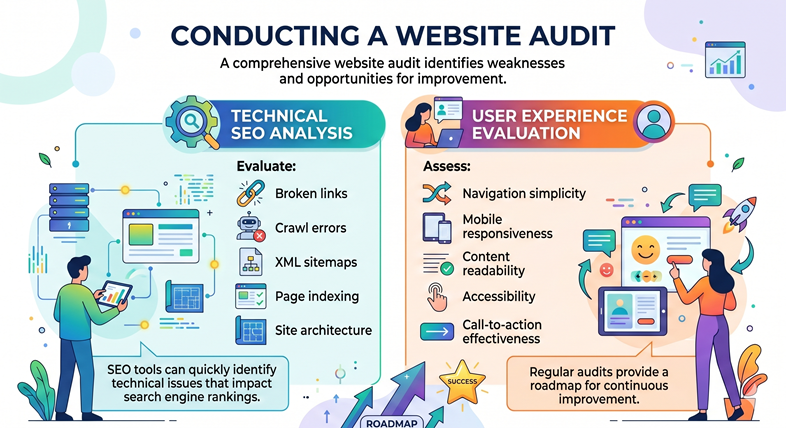
Conducting a Website Audit
A comprehensive website audit identifies weaknesses and opportunities for improvement.
Technical SEO Analysis
Evaluate:
- Broken links
- Crawl errors
- XML sitemaps
- Page indexing
- Site architecture
SEO tools can quickly identify technical issues that impact search engine rankings.
User Experience Evaluation
Assess:
- Navigation simplicity
- Mobile responsiveness
- Content readability
- Accessibility
- Call-to-action effectiveness
Regular audits provide a roadmap for continuous improvement.
Improving Website Speed and Performance
Website speed significantly influences both user satisfaction and search rankings.
Optimizing Images
Large image files often slow websites.
Best practices include:
- Compressing images
- Using modern formats like WebP
- Implementing lazy loading
- Resizing images appropriately
Using Content Delivery Networks (CDNs)
CDNs distribute website content across multiple servers globally, reducing load times for users regardless of location.
Additional speed optimization techniques include:
- Browser caching
- Code minification
- Server optimization
- Reducing unnecessary plugins
Fast-loading websites often experience lower bounce rates and higher conversions.
Leveraging SEO Tools for Better Visibility
Search engine optimization remains one of the most powerful methods for attracting qualified visitors.
Keyword Research Strategies
Identify keywords that potential customers actively search for.
Focus on:
- High-intent keywords
- Long-tail phrases
- Industry-specific terminology
- Competitor keyword gaps
For example, businesses searching for how to optimise your business websites using digital marketing tools may also target related terms such as:
- Website optimization strategies
- Digital marketing software
- SEO tools for businesses
- Conversion rate optimization
On-Page SEO Optimization
Optimize:
- Title tags
- Meta descriptions
- Header tags
- Internal links
- Image alt text
- Content structure
Proper on-page optimization improves search visibility and user experience simultaneously.
Enhancing User Experience with Analytics Tools
User behavior data provides valuable insights into website performance.
Visitor Behavior Tracking
Analytics platforms reveal:
- Traffic sources
- Visitor demographics
- Popular pages
- User journeys
These insights help identify areas needing improvement.
Heatmaps and Session Recordings
Tools such as heatmaps show where users click, scroll, and engage.
Benefits include:
- Identifying navigation problems
- Understanding user intent
- Improving page layouts
- Increasing conversion opportunities
Data-driven optimization is far more effective than relying on assumptions.

Content Marketing Optimization
Content remains a cornerstone of digital marketing success.
Creating High-Quality Content
Successful content should:
- Address customer questions
- Solve real problems
- Demonstrate expertise
- Provide actionable insights
Content formats include:
- Blog articles
- Videos
- Infographics
- Case studies
- Whitepapers
Content Performance Analysis
Track metrics such as:
- Page views
- Engagement rates
- Social shares
- Conversion impact
Regular analysis helps refine content strategies and maximize results.
Social Media Integration and Management
Social media can significantly amplify website traffic.
Effective integration strategies include:
- Social sharing buttons
- Embedded social feeds
- Cross-platform promotion
- Retargeting campaigns
Social media management tools help schedule posts, monitor engagement, and analyze performance across multiple channels.
Businesses that actively integrate social media often experience stronger brand awareness and customer engagement.

Email Marketing Automation
Email remains one of the highest-performing digital marketing channels.
Benefits include:
- Personalized communication
- Automated nurturing sequences
- Customer retention campaigns
- Product promotions
Key automation workflows:
- Welcome emails
- Lead nurturing campaigns
- Abandoned cart reminders
- Customer onboarding sequences
- Re-engagement campaigns
Automation improves efficiency while delivering timely, relevant communications.
Conversion Rate Optimization Techniques
Driving traffic is only part of the equation. Converting visitors into customers is equally important.
Landing Page Optimization
Effective landing pages include:
- Clear headlines
- Strong value propositions
- Persuasive copy
- Trust indicators
- Simple forms
A/B Testing Strategies
Test elements such as:
- Headlines
- Call-to-action buttons
- Images
- Form lengths
- Page layouts
Small improvements can produce substantial increases in conversions over time.
Using CRM Tools for Customer Insights
Customer Relationship Management tools centralize customer data and interactions.
Benefits include:
- Better lead management
- Personalized marketing
- Improved customer service
- Enhanced retention strategies
CRM insights help businesses understand customer needs and tailor website experiences accordingly.
Mobile Optimization Best Practices
Mobile traffic now represents a significant portion of internet usage.
Key mobile optimization techniques include:
- Responsive design
- Fast mobile loading speeds
- Touch-friendly navigation
- Readable text sizes
- Mobile-friendly forms
Search engines prioritize mobile-friendly websites, making optimization essential.
Security and Trust Signals
Website security directly impacts user trust.
Important measures include:
- SSL certificates
- Secure payment gateways
- Privacy policies
- GDPR compliance
- Regular security updates
Trust signals may also include:
- Customer reviews
- Industry certifications
- Security badges
- Testimonials
Secure websites encourage users to engage confidently with your brand.
Monitoring and Continuous Improvement
Website optimization is an ongoing process.
Regular monitoring should include:
- Traffic analysis
- SEO performance
- Conversion tracking
- Technical health checks
- User feedback collection
Businesses that continuously improve their websites often outperform competitors who treat optimization as a one-time project.
Common Website Optimization Mistakes
Avoid these common errors:
- Ignoring mobile users
- Neglecting SEO fundamentals
- Publishing low-quality content
- Slow page loading speeds
- Poor navigation design
- Weak calls to action
- Lack of analytics tracking
Recognizing and correcting these issues can significantly improve website performance.
Future Trends in Digital Marketing Tools
Emerging technologies continue to reshape website optimization.
Key trends include:
Artificial Intelligence
AI-driven tools provide:
- Predictive analytics
- Content generation
- Personalized experiences
- Automated customer support
Voice Search Optimization
Businesses increasingly optimize content for conversational search queries.
Advanced Personalization
Modern tools enable highly customized user experiences based on behavior and preferences.
Marketing Automation Expansion
Automation platforms continue to become more sophisticated, reducing manual effort while increasing effectiveness.
Staying ahead of these trends helps businesses maintain a competitive advantage.
Frequently Asked Questions (FAQs)
1. What are digital marketing tools?
Digital marketing tools are software platforms that help businesses manage SEO, analytics, content marketing, social media, email campaigns, and customer relationships.
2. Why is website optimization important?
Website optimization improves user experience, search rankings, conversion rates, and overall business performance.
3. Which SEO tool is best for beginners?
Google Search Console and Google Analytics are excellent starting points because they are free and provide valuable insights.
4. How often should I optimize my website?
Optimization should be continuous, with regular audits conducted at least quarterly.
5. Does website speed affect SEO?
Yes. Faster websites generally rank better in search engines and provide improved user experiences.
6. Can small businesses benefit from digital marketing tools?
Absolutely. Many tools offer affordable plans that help small businesses compete effectively online.
7. What is conversion rate optimization?
Conversion Rate Optimization (CRO) focuses on increasing the percentage of website visitors who complete desired actions such as purchases, sign-ups, or inquiries.
8. How do analytics tools improve website performance?
Analytics tools provide data about user behavior, helping businesses identify issues and opportunities for improvement.
Conclusion
Understanding how to optimise your business websites using digital marketing tools is essential for sustainable online growth. From SEO and analytics to content marketing, CRM systems, and automation platforms, digital marketing tools provide the insights and capabilities needed to improve website performance continuously.
The most successful businesses treat optimization as an ongoing process rather than a one-time project. By leveraging data, improving user experiences, strengthening SEO, and embracing emerging technologies, organizations can attract more visitors, generate higher-quality leads, and increase revenue over the long term.
1 Trackback / Pingback
Comments are closed.