
The Haritha Karma Sena model shows how community participation, local governance and organised collection can make plastic waste management part of everyday life
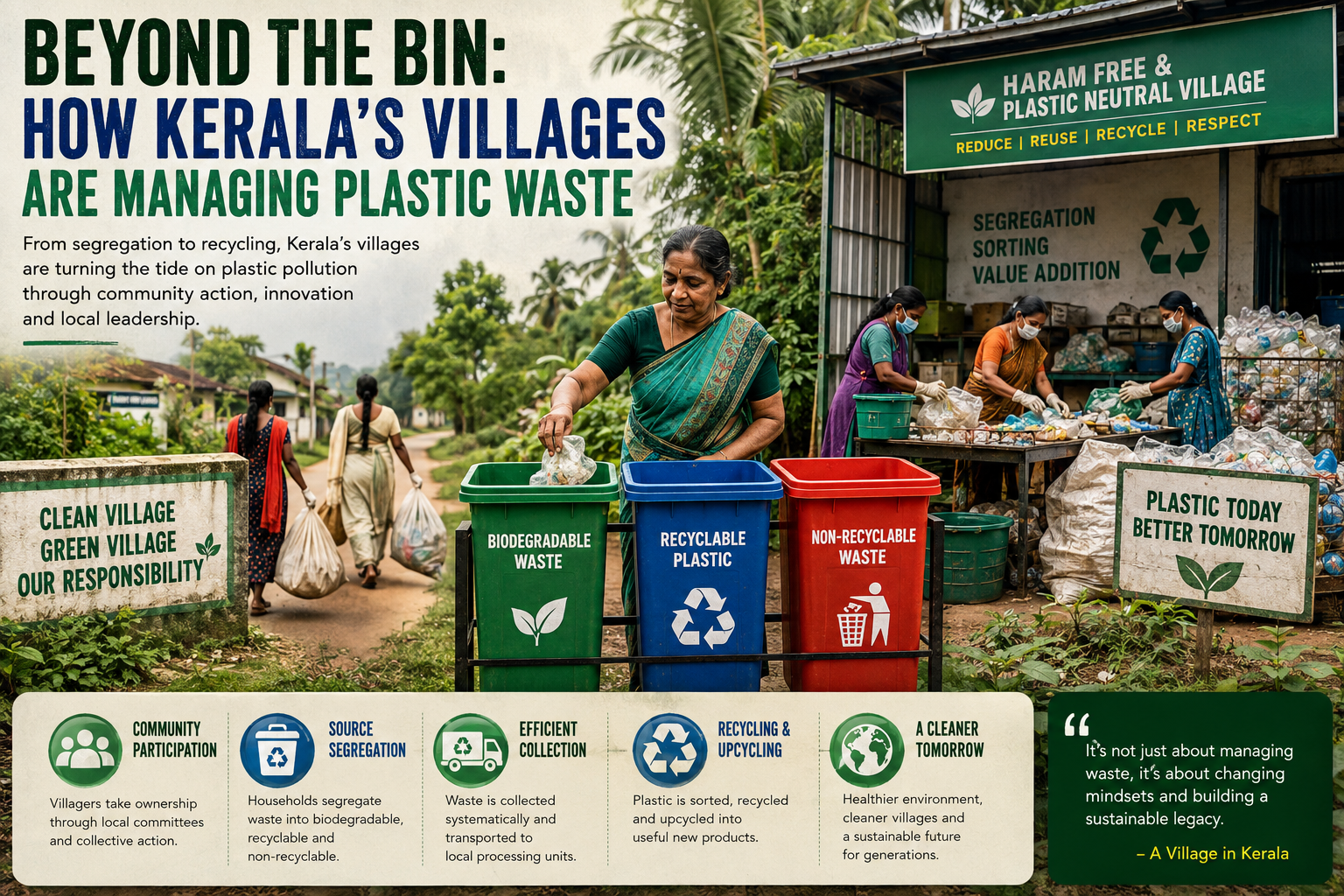
Every morning, waste begins its journey from thousands of homes across Kerala. Food scraps, bottles, wrappers, packets and other discarded materials leave kitchens and shops, often without us giving much thought to where they will eventually end up. But plastic is different from much of the waste we generate. It does not simply disappear. So, what happens when a community decides to take responsibility for that plastic before it reaches a river, backwater, roadside or landfill? In Kerala, part of the answer can be seen at the doorstep through the Haritha Karma Sena.
Bringing Waste Management Closer to Communities
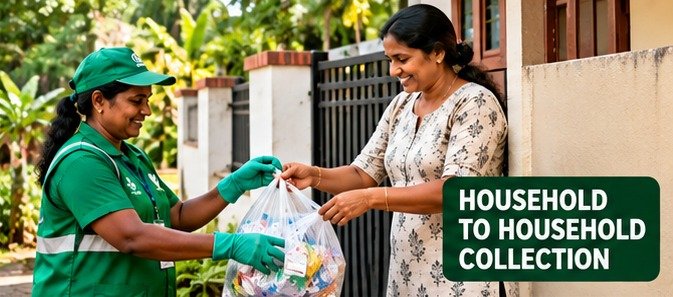
Working alongside local self-government institutions, Haritha Karma Sena workers collect non-biodegradable waste from households and institutions and help move it into the formal waste-management system. On the surface, it may look like a collection service, but the idea is much bigger. It brings the household, the local government and the waste worker into the same chain, creating a system in which everyone has a role to play. The Haritha Karma Sena was introduced in 2017 as a Kudumbashree-linked micro-enterprise working with local self-government institutions. Since then, the network has expanded considerably. Kerala’s Economic Review 2025 reported 37,765 Haritha Karma Sena workers operating across 1,034 local self-government institutions in 2025.
The scale of the network is significant, but its local character is perhaps even more important. Waste collection happens within communities, making waste management a visible part of everyday life. Residents see the workers who collect their discarded material and become more aware that the plastic leaving their homes does not simply vanish. Someone has to collect it, sort it and ensure that it reaches the next stage.
What Happens After the Plastic Leaves the House?
Collecting plastic is only the beginning. Once non-biodegradable waste is collected, it needs to be sorted, processed and directed towards appropriate recycling, recovery or disposal channels. Kerala has developed infrastructure around this process, including Material Collection Facilities (MCFs) and Resource Recovery Facilities (RRFs). The state’s Economic Review has reported a substantial expansion of this infrastructure, with more than 1,300 MCFs and over 200 RRFs recorded in 2025.
The purpose is straightforward: keep the waste moving through the system. A plastic bottle collected from a household should not simply move from the doorstep to another dumping point. The aim is to identify what can be recovered, recycled or processed and ensure that the material reaches the appropriate facility. This is what turns waste collection into a broader waste-management system.
The Change Begins Inside the House
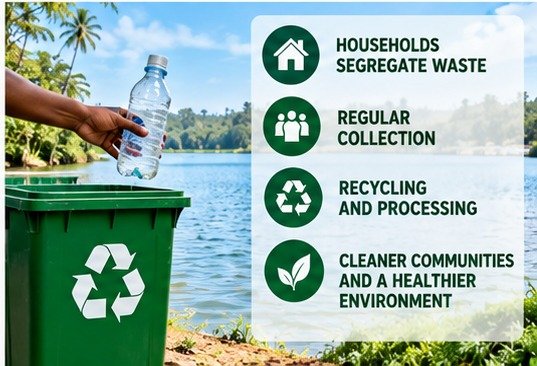
For all the infrastructure involved, one of the most important steps is remarkably simple: segregating waste at source. When households keep non-biodegradable waste separate from organic waste, collection and sorting become easier. It also gives recyclable material a better chance of being recovered instead of becoming contaminated or mixed with other waste.
This puts some responsibility directly in the hands of residents. The waste-management process does not begin when the collection worker arrives. It begins when someone decides which bin a plastic packet belongs in. That small decision, repeated across thousands of homes, can influence what happens to a much larger volume of waste.
Kerala’s experience also highlights an important shift in thinking. Instead of asking only who will take the waste away, communities are encouraged to think about what happens to the waste after it leaves the house. That change in awareness can be just as important as the physical collection system.
The Human Side of Waste Management
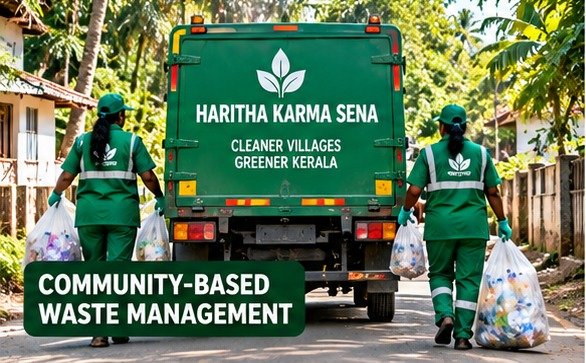
Waste management is often discussed in terms of bins, vehicles, recycling plants and regulations. But none of these can work without people. Haritha Karma Sena places workers at the centre of the collection process while creating a direct link between households and local government.
The result is a system that is closer to the community. Residents know when waste is collected, workers become familiar faces and local governments have a direct role in organising the service. It turns an environmental issue into something people encounter in their everyday lives.
The model also has a livelihood dimension. As a Kudumbashree-linked micro-enterprise initiative, Haritha Karma Sena connects waste management with local employment and community participation. The environmental challenge is therefore being addressed through a system that also creates a role for people within the community.
Why Villages Matter in the Plastic Conversation
Plastic waste is often associated with large cities, but villages face their own challenges. A discarded wrapper can find its way into a drain. From there, it can enter a stream or river. Waste dumped near a waterbody can eventually become part of a much larger environmental problem. For Kerala, this connection is particularly important because the state’s rivers, backwaters, wetlands and coastline are closely linked to community life.
A local waste-management system cannot solve every environmental problem, but it can help prevent everyday waste from becoming an environmental problem in the first place. When collection happens closer to where waste is generated, communities have a clearer connection with the process and local authorities have a more direct role in keeping it functioning.
What Can Other States Learn From Kerala?
Kerala’s approach does not have to be copied line by line by other states. India’s villages and towns have very different geographical, economic and infrastructure needs. A system designed for a coastal Kerala village may need to look very different in a Himalayan settlement, an agricultural district or a rapidly expanding city.
However, the principles behind the approach can be adapted. Other states can strengthen door-to-door collection, encourage segregation at source, develop village- and ward-level collection centres, support community-based waste workers and create stronger connections with authorised recycling and processing facilities. Local governments can also use technology to monitor collection, communicate with residents and identify gaps in service delivery.
The bigger lesson is that a waste-management system needs to function as a chain. Separating waste at home is important, but so is collecting it regularly. Collection matters, but so does sorting. Sorting matters, but there also needs to be a reliable destination for the recovered material. Every part of the chain has to work together.
The Plastic Problem Needs Everyday Solutions
Plastic pollution is not going to disappear through one programme or one campaign. Reducing unnecessary plastic use matters. Better product design, recycling systems, enforcement and investment in waste infrastructure matter too. Businesses, governments and consumers all have roles to play.
But large changes are often built from small, repeated actions. A household separates its waste. A worker collects it. A local facility sorts it. A recycling or processing unit receives it. The chain continues because each part of the system does its job.
That is where Kerala’s experience with Haritha Karma Sena becomes particularly relevant. It brings waste management closer to everyday life and shows how an environmental challenge can be addressed through local participation rather than being treated only as a distant infrastructure problem.
A Lesson That Begins at the Doorstep
The story of Haritha Karma Sena is ultimately not just a story about plastic. It is about what happens when an environmental challenge is brought closer to the people who experience it every day. Instead of treating waste as something that simply needs to disappear, the system creates a chain of responsibility around it.
Protecting nature does not always begin with a massive environmental campaign. Sometimes, it begins at the doorstep — with a household separating its waste and a community making sure that waste goes where it belongs.
For other states across India, Kerala’s experience offers an approach that can be adapted to local conditions: build the system close to communities, involve people in the process and make responsible waste management part of everyday life.
