
June 10: In a landmark moment for India’s infrastructure journey, the Zojila Tunnel Project achieved a major breakthrough on Tuesday, bringing the dream of seamless, all-weather connectivity between Jammu & Kashmir and Ladakh one step closer to reality.
📍जोजिला सुरंग पूर्वी पोर्टल, मीनामार्ग (कारगिल), लदाख
🇮🇳 भारत के 🛣️ इन्फ्रास्ट्रक्चर विकास के इतिहास में ऐतिहासिक दिन!
एशिया की सबसे लंबी सुरंग ‘जोजिला टनल’ परियोजना आज एक ऐतिहासिक क्षण की साक्षी बनी है। जोजिला के मुख्य सुरंग में आज जम्मू और कश्मीर केंद्र शासित प्रदेश के… pic.twitter.com/LuobDXNGIa
— Nitin Gadkari (@nitin_gadkari) June 9, 2026
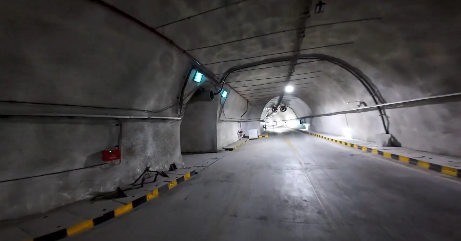
Union Minister for Road Transport and Highways Nitin Gadkari witnessed the historic breakthrough blast at the eastern portal of the tunnel in Minamarg, marking the successful connection of excavation work from both ends of the tunnel. The achievement comes six months ahead of schedule and represents a significant milestone in one of the country’s most challenging engineering projects.
Constructed at an altitude of more than 11,500 feet above sea level, the nearly 14-kilometre tunnel cuts through the rugged Himalayan terrain, where workers have braved extreme weather conditions, heavy snowfall, avalanches, and sub-zero temperatures to keep the project moving forward.
Describing the project as a lifeline for the people of Ladakh and Jammu & Kashmir, Gadkari said the tunnel will transform mobility, improve accessibility, and create new opportunities for economic growth in the region. He acknowledged the dedication of thousands of engineers and workers, many of whom belong to the local communities, whose efforts have made this breakthrough possible.
Once operational, the tunnel will provide uninterrupted connectivity between Srinagar and Ladakh throughout the year, eliminating the long-standing disruptions caused by heavy snowfall and harsh winter conditions at the Zojila Pass. Travel time across the stretch is expected to reduce dramatically, improving access to education, healthcare, tourism, trade, and essential services for residents of remote mountain communities.
For generations, winter closures of the Zojila Pass have isolated large parts of Ladakh from the Kashmir Valley, affecting daily life and economic activity. The tunnel is expected to change that reality by ensuring reliable transportation regardless of weather conditions.
Jammu & Kashmir Chief Minister Omar Abdullah described the development as the fulfillment of a long-cherished aspiration for the people of Ladakh. He noted that improved connectivity would significantly enhance opportunities for local residents while supporting tourism and access to critical services.
Beyond civilian benefits, the project holds immense strategic importance. The tunnel will strengthen connectivity to border regions and facilitate the efficient movement of personnel, supplies, and equipment, enhancing logistical capabilities in one of India’s most sensitive frontier areas.
Built using advanced tunnelling technologies to navigate fragile Himalayan geology, the project is a testament to Indian engineering expertise and determination. Despite facing multiple avalanche incidents and complex geological challenges, construction teams have maintained steady progress while achieving notable safety milestones.
The Rs 6,800-crore project, being executed by the National Highways & Infrastructure Development Corporation Limited (NHIDCL) with Megha Engineering & Infrastructure Limited as the construction partner, has completed nearly 85 percent of the work. Following the breakthrough, the project will enter the next phase of civil and systems installation works, with completion targeted for 2028.
Once opened, the Zojila Tunnel will stand among the world’s highest road tunnels and Asia’s longest bi-directional tunnel of its kind. More importantly, it will serve as a symbol of connectivity, resilience, and progress—bringing communities closer, boosting tourism and trade, and unlocking new possibilities for development across the Himalayan region.
The breakthrough marks not just an engineering achievement, but a transformative step toward integrating remote mountain regions with the rest of the country, ensuring that geography is no longer a barrier to growth and opportunity.