
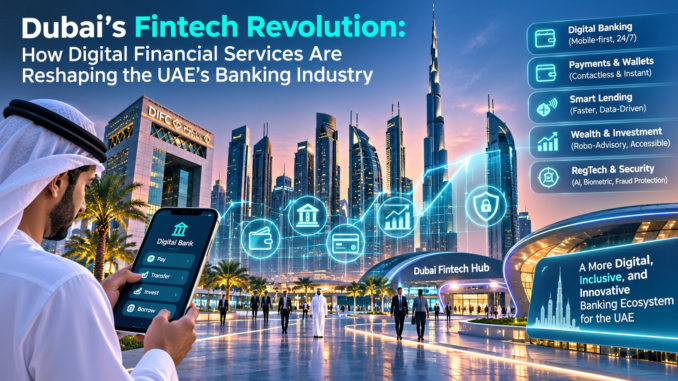
Dubai’s banking industry is undergoing a major transformation as digital financial services change how individuals and businesses manage their money. From mobile banking and instant payments to artificial intelligence (AI), open finance and digital currencies, technology is reshaping how financial institutions operate and serve customers.
The change goes beyond making banking transactions faster. It is influencing how customers open accounts, access loans, make payments and manage their finances. Businesses are also benefiting from digital financial solutions that can simplify payments, improve cash-flow management and support international transactions.
Dubai is playing an important role in this development. Its growing financial technology ecosystem, supported by the Dubai International Financial Centre (DIFC) and the UAE’s regulatory initiatives, is attracting fintech startups, international financial institutions and technology companies.
As the UAE continues to invest in digital infrastructure, traditional banks are rethinking their business models. The focus is shifting towards more connected, accessible and technology-driven financial services.
Dubai’s Fintech Ecosystem Is Growing
Dubai has become an attractive destination for financial technology companies looking to expand across the Middle East and international markets.
The Dubai International Financial Centre has played an important role in building this ecosystem by bringing together financial institutions, technology companies, startups and investors.
In November 2026, DIFC announced that its artificial intelligence, fintech and innovation ecosystem had crossed 2,000 firms. This milestone reflects the growing interest in Dubai as a destination for businesses developing financial technology solutions.
The ecosystem includes companies working in digital payments, financial software, wealth management technology, blockchain, regulatory technology and AI-powered financial services.
For traditional banks, the growing presence of these companies creates opportunities to introduce new technologies and improve existing services. For entrepreneurs and investors, Dubai offers access to financial institutions, international markets and a developing network of technology businesses.
What the Central Bank of the UAE’s Annual Report Reveals
The Central Bank of the UAE’s Annual Report 2025 provides important insights into the country’s progress in financial technology and digital banking.
Released in April 2026, the report highlighted several developments in the UAE’s financial sector. The number of licensed fintech companies reached 36, while the Central Bank advanced initiatives covering digital payments, international settlements and open finance.
One of the notable developments was the completion of the Digital Dirham as an official payment instrument, alongside the execution of its first government transactions.
The report also highlighted the activation of the Al Tareq open finance platform and the launch of Jisr, an initiative supporting international settlements.
These developments indicate that the UAE’s fintech transformation is extending beyond individual banking applications. It is increasingly supported by improvements in financial infrastructure, regulation and digital payment systems.
Digital Banking Is Changing Customer Expectations
Customers increasingly expect banking services to be available whenever they need them. Visiting a bank branch for routine transactions is becoming less necessary as mobile applications and online banking platforms offer convenient alternatives.
Banks in the UAE are responding by expanding their digital services and improving their mobile banking experiences.
Customers can increasingly open accounts, transfer money, monitor transactions, manage cards and apply for financial products through digital platforms.
A convenient application, quick transactions and reliable customer support are becoming important factors in attracting and retaining customers.
For financial institutions, the challenge is to provide a smooth digital experience while maintaining the security and reliability customers expect from banks.
Instant Payments Are Making Transactions Faster
The growth of digital payments is another important part of the UAE’s fintech transformation.
The Central Bank of the UAE has been modernising the country’s payment infrastructure through its National Payment Systems Strategy.
One significant development is Aani, the UAE’s instant payment platform. It enables individuals and businesses to transfer money within seconds, including outside conventional banking hours.
Customers can use convenient identifiers such as mobile numbers and email addresses instead of relying entirely on traditional bank account details.
For businesses, faster payments can improve collections, cash-flow management and the efficiency of everyday transactions.
The expansion of digital payment infrastructure is particularly relevant for retailers, service providers and smaller businesses that handle frequent transactions.
Open Finance Is Bringing Banking Services Together
Open finance is another important development in the UAE’s financial services industry.
It allows customers to securely share their financial information with authorised third-party providers, subject to their consent. This can help customers access connected financial services instead of managing every financial product through separate platforms.
The Central Bank’s Open Finance framework is intended to encourage competition, improve financial access and create opportunities for new digital services.
For customers, this could mean easier access to financial information, personalised services and more convenient payment options.
For banks, it creates opportunities to collaborate with fintech companies and develop services beyond traditional banking platforms.
The activation of the Al Tareq open finance platform, highlighted in the Central Bank’s Annual Report 2025, represents an important step in this direction.
Artificial Intelligence Is Accelerating Across Dubai’s Financial Sector
Artificial intelligence is becoming an important part of how banks manage operations and interact with customers.
Financial institutions are exploring AI applications to improve customer support, identify suspicious transactions, assess lending applications and automate repetitive tasks.
The scale of adoption is becoming increasingly evident in Dubai’s financial ecosystem.
According to the Dubai Financial Services Authority’s AI Survey 2026, released on November 2, 2026, 71% of surveyed DFSA-authorised firms reported using at least one form of artificial intelligence. This represents an increase from 52% in 2025 and 33% in 2024.
The survey also found that generative AI adoption reached 67% among respondents in 2026, compared with 48% in 2025.
However, the findings also highlight that adoption does not necessarily mean extensive deployment. Many companies are still testing or using AI in limited business functions.
THE INDEPENDENT REGULATOR OF FINANCIAL SERVICES
For the banking industry, some of the important applications include:
-
Customer support: AI-powered assistants can respond to routine enquiries and provide basic banking assistance.
-
Fraud prevention: AI systems can identify unusual transaction patterns and flag potentially suspicious activities.
-
Credit assessment: Advanced data analysis can help banks evaluate lending applications and understand borrower risk.
-
Personalised banking: Financial institutions can use customer information to offer more relevant services.
-
Operational efficiency: Automation can reduce the time spent on document processing and repetitive administrative work.
The adoption of AI is also creating new responsibilities for financial institutions. Data protection, algorithmic accountability, cybersecurity and proper human oversight will remain important as banks expand their use of these technologies.
Digital Currency Is Opening New Possibilities
Digital currencies and blockchain-based financial infrastructure are attracting growing attention across the UAE.
The Digital Dirham initiative is part of the Central Bank’s efforts to modernise payment systems and explore the potential of central bank digital currencies.
Unlike privately issued cryptocurrencies, a central bank digital currency represents digital money issued by a country’s central bank and operates within the national monetary and regulatory framework.
The Central Bank’s 2025 Annual Report confirmed that the Digital Dirham had achieved official payment-instrument status and that its first government transactions had been completed.
This is an important implementation milestone, but it should not be confused with widespread public adoption. Further development and integration will determine how extensively individuals and businesses use the currency.
Blockchain technology also has potential applications in trade finance, asset tokenisation and financial settlements.
These developments could improve the efficiency of financial transactions, although their wider adoption will depend on regulatory clarity, security and infrastructure readiness.
Fintech Is Improving Financial Access for Small Businesses
Small and medium-sized enterprises (SMEs) are among the businesses that could benefit significantly from the expansion of digital financial services.
Access to finance has traditionally been difficult for smaller businesses, particularly those without extensive credit histories or substantial assets to offer as collateral.
Digital lending platforms, online business banking and alternative credit assessment systems are creating additional ways for smaller businesses to explore financing options.
Other developments include digital business account opening, online invoice management, cash-flow monitoring and international payment solutions.
These services can reduce administrative work and make financial management more convenient.
Faster payment settlements can also help businesses manage working capital more effectively, particularly when dealing with suppliers and customers across international markets.
As Dubai continues to attract startups, entrepreneurs and international businesses, demand for accessible digital financial services is likely to grow.
Regulation and Cybersecurity Will Shape Fintech Growth
Technology alone cannot determine the success of digital banking. Customers and businesses must also feel confident that their money and financial information are protected.
The Central Bank of the UAE plays an important role in overseeing the country’s banking and payment systems while supporting responsible financial innovation.
Dubai also has its own financial regulatory ecosystem within DIFC, where the Dubai Financial Services Authority regulates financial services conducted within the centre.
As more financial transactions move online, banks must strengthen their systems against fraud, identity theft and cyberattacks.
The DFSA’s 2026 AI Survey also highlights the importance of governance as financial firms expand their use of artificial intelligence.
Financial institutions must ensure that AI systems are appropriately monitored and that third-party technology providers do not introduce unacceptable operational or data-security risks.
Maintaining customer confidence will be just as important as introducing new digital financial products.
What the Fintech Revolution Means for Traditional Banks
The growing influence of fintech is changing the competitive environment for traditional banks in the UAE.
Financial institutions are increasingly investing in technology, improving their digital platforms and working with specialised fintech companies to develop new services.
Rather than treating every fintech startup as a competitor, established banks are recognising the benefits of collaboration.
This transformation is influencing several aspects of banking:
Customer acquisition: Digital platforms allow banks to reach customers beyond their traditional branch networks.
Operating efficiency: Automation can reduce repetitive work and improve the speed of banking processes.
Product development: Partnerships with technology companies can help banks introduce new financial services.
Customer retention: Convenient digital experiences and personalised services can strengthen customer relationships.
International transactions: Modern payment infrastructure can make cross-border financial activities more efficient for businesses.
The future of banking in the UAE is therefore likely to involve greater collaboration between traditional financial institutions, fintech startups and technology providers.
Dubai’s Fintech Outlook for 2027
Dubai’s fintech industry is entering an important phase as the UAE continues to invest in digital infrastructure and financial innovation.
The expansion of DIFC’s innovation ecosystem, the development of open finance and improvements in payment systems are creating opportunities for further growth.
Several developments are worth watching in 2027.
Wider adoption of open finance: More financial institutions could introduce connected services that allow customers to manage multiple financial products through integrated platforms.
Growth of AI-powered banking: Banks are likely to explore additional applications of artificial intelligence in customer support, fraud prevention, credit assessment and operational management.
Expansion of digital payments: Instant payment services and mobile-based transactions could become increasingly important for consumers and businesses.
Development of the Digital Dirham: Further integration of digital currency infrastructure could influence how domestic and international payments are conducted.
More fintech investment: Dubai’s growing financial ecosystem could attract additional startups, technology companies and investors interested in the UAE and wider Middle Eastern markets.
However, the pace of development will depend on regulatory implementation, cybersecurity readiness, customer adoption and the ability of financial institutions to integrate new technologies into their operations.
Conclusion: Dubai Is Building the Future of Digital Banking
Dubai’s fintech revolution is changing how financial services are developed, delivered and accessed across the UAE. Digital banking, instant payments, artificial intelligence and open finance are moving the industry beyond conventional banking models towards a more connected financial ecosystem.
The Central Bank’s Annual Report 2025 and the DFSA’s AI Survey 2026 demonstrate that this transformation is supported by measurable developments in fintech licensing, payment infrastructure and artificial intelligence adoption.
For traditional banks, adapting to technological developments will be essential to remaining competitive. For fintech companies, Dubai offers an expanding environment in which innovative financial products can be developed and introduced to regional and international markets.
As the UAE advances its digital financial infrastructure, the next stage of growth will depend on balancing innovation with cybersecurity, regulatory compliance and customer confidence.
Dubai’s ambition is no longer limited to becoming a regional financial centre. Its growing fintech ecosystem is helping position the city as an important participant in shaping the future of digital banking.
