

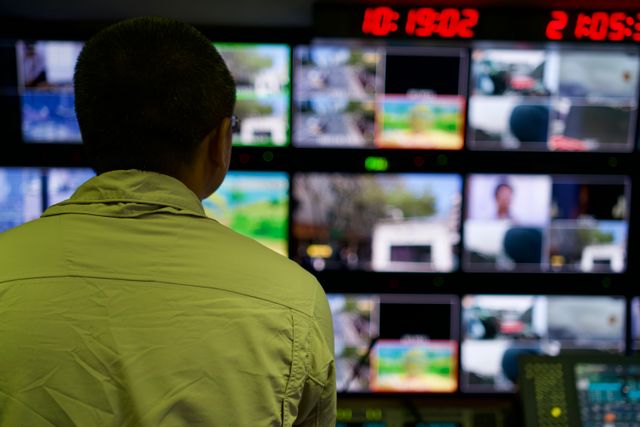
Businesses are replacing security guards with remote video monitoring because it typically costs 30 to 70 percent less while watching every corner of a property at once instead of one spot at a time. An operator sitting in a central station can see a person cross a fence line, speak to them through a site speaker within seconds, and hand police a live description, all before a guard on foot patrol would have finished the far side of his route.
The change is less about cameras getting cheaper (they did) and more about analytics getting good enough that nobody has to stare at a screen wall waiting for something to move. Software now separates a person from a raccoon, a tarp, or headlights sweeping a gate, so operators only look when something real happens. That single improvement is what made one person credibly covering dozens of sites possible.
What Remote Video Monitoring Costs Compared to a Guard Contract
Start with the guard number, because that is the benchmark every business already knows. Unarmed guards commonly bill between $22 and $40 an hour depending on the market and the shift, with armed coverage running higher. Nights and weekends only, around 80 hours a week, works out to roughly $9,000 to $14,000 a month for a single person at a single location, and full 24-hour coverage with relief pushes past $20,000.
Monitored video prices on a completely different axis. Fixed camera monitoring often falls somewhere between $300 and $900 per camera per month, and a mobile solar tower with connectivity, installation, and monitoring bundled typically runs $800 to $2,500 a month. A yard that needed two guards on opposite corners is frequently covered by six to eight well-placed cameras for less than one guard’s monthly invoice.
Timelines differ too. A permanent system at a building with power and network usually takes one to three days to install and commission, while a trailer-mounted unit is towed in and operational within an hour or two. That matters when a business is reacting to a break-in that happened Saturday night and cannot wait three weeks for a hardware order.
Why One Operator Sees More Than a Guard on Patrol
A patrol route is a rotation, and a rotation creates gaps. If the loop takes twenty minutes, any given corner is unobserved for nineteen of them, and anyone planning to take something has usually watched enough nights to know the timing. Cameras do not rotate. Every gate, container, and equipment cluster stays in view continuously.
Detection is where the technology earns its keep. Systems classify what they see as a human, a vehicle, or noise, and only escalate when a person crosses a defined perimeter or lingers in a zone that should be empty after hours. Industry experience suggests this reduces nuisance alerts dramatically compared to older pixel-based motion detection, which is exactly why one operator can hold responsibility for many sites without being buried by wind and weather triggers.
Then there is the response itself. A live voice-down naming what someone is wearing tends to end an incident immediately, and providers built around that model, wifieye among them, treat the spoken warning as the product rather than the recording. Research on crime prevention has repeatedly linked immediate, personalized intervention with far stronger deterrence than passive recording. A posted surveillance sign is background noise. A stranger describing your jacket over a speaker at 1 a.m. is not.
Which Industries Are Actually Making the Switch
The businesses moving fastest all share a profile: high-value assets sitting outdoors, long unoccupied hours, and too much acreage for one person to cover. Construction sites, equipment and laydown yards, auto dealerships, self-storage, scrap and recycling operations, utility substations, cannabis facilities, and distribution lots dominate the list. Many of them sit empty twelve to sixteen hours a day.
Sites with people flowing through them are a different story. Cameras cannot check a badge, unlock a gate, escort an employee to her car, or intervene physically, so hospitals, campuses, retail floors, and office lobbies still staff humans. What often happens there is a hybrid, with reception or a courtesy officer during business hours and monitored video taking the overnight shift.
Company size shapes the decision as much as industry does. A single-yard operator might only buy weekend and overnight coverage, keeping the monthly figure under $1,500. A regional business with fourteen locations gets something guards structurally cannot provide, which is one dashboard, one escalation procedure, and one consistent standard of attentiveness across every site instead of fourteen separate vendors with fourteen different definitions of alert.
How to Tell Real Monitoring From Cameras That Just Send Alerts
The most common mistake buyers make is confusing notification with monitoring. Plenty of systems push an alert to an app, which sounds similar on a quote sheet and behaves nothing alike at 3 a.m. when nobody is awake to open it. Real monitoring means staffed operators, a written escalation procedure, verification of the event, a live voice-down, and a call to police with a description of what the operator is watching right now.
Verification is worth asking about directly. Police departments across the country deprioritize unverified alarm calls because historical false alarm rates are very high, and an operator who can confirm a human on the property in real time changes how that dispatch gets ranked. Ask any provider how long it takes from event detection to voice-down, because anything much past 30 to 60 seconds gives someone room to finish and leave.
Check the physical constraints before you sign. Cell signal strength at that specific coordinate, sun exposure for solar units, mast height relative to stockpiles and containers that will block sightlines once material arrives, and what happens to recording when connectivity drops. Fourteen to thirty days of local retention is a reasonable baseline. The corner nobody accounted for in the coverage plan is usually the corner where a theft eventually happens.
Insurance deserves a call too. Carriers increasingly ask what protects a property outside working hours, and documented monitored coverage can influence premium or deductible conversations at renewal, particularly for equipment-heavy operations with prior claims. Get your broker’s answer in writing rather than assuming the discount exists.