

Renovating your home is about more than creating a better-looking kitchen, bathroom or living area. For Australian homeowners, a renovation can also be a chance to make the property cooler in summer, warmer in winter and more efficient throughout the year.
The best approach is to think beyond individual products. Instead of simply replacing an appliance or installing new windows, look at how your home’s insulation, ventilation, shading, heating, cooling, hot water and electricity systems work together.
Whether you own an older suburban house, a townhouse, a coastal property or a modern family home, the following energy-efficient home improvement ideas can help you plan a renovation that is practical and suited to Australian conditions.
1. Begin With an Energy Audit of Your Home
Before knocking down walls or choosing new appliances, find out where your home is performing poorly.
Pay attention to rooms that become extremely hot during summer, areas that remain cold during winter, unusually high electricity consumption and places where you can feel outside air entering.
Your assessment should include:
- Roof and ceiling insulation
- Wall and floor insulation
- Windows and doors
- Heating and cooling equipment
- Hot-water system
- Lighting
- Major appliances
- Solar potential
- Draughts and ventilation
Starting with the biggest problems can help you avoid spending money on improvements that have little effect on overall comfort.
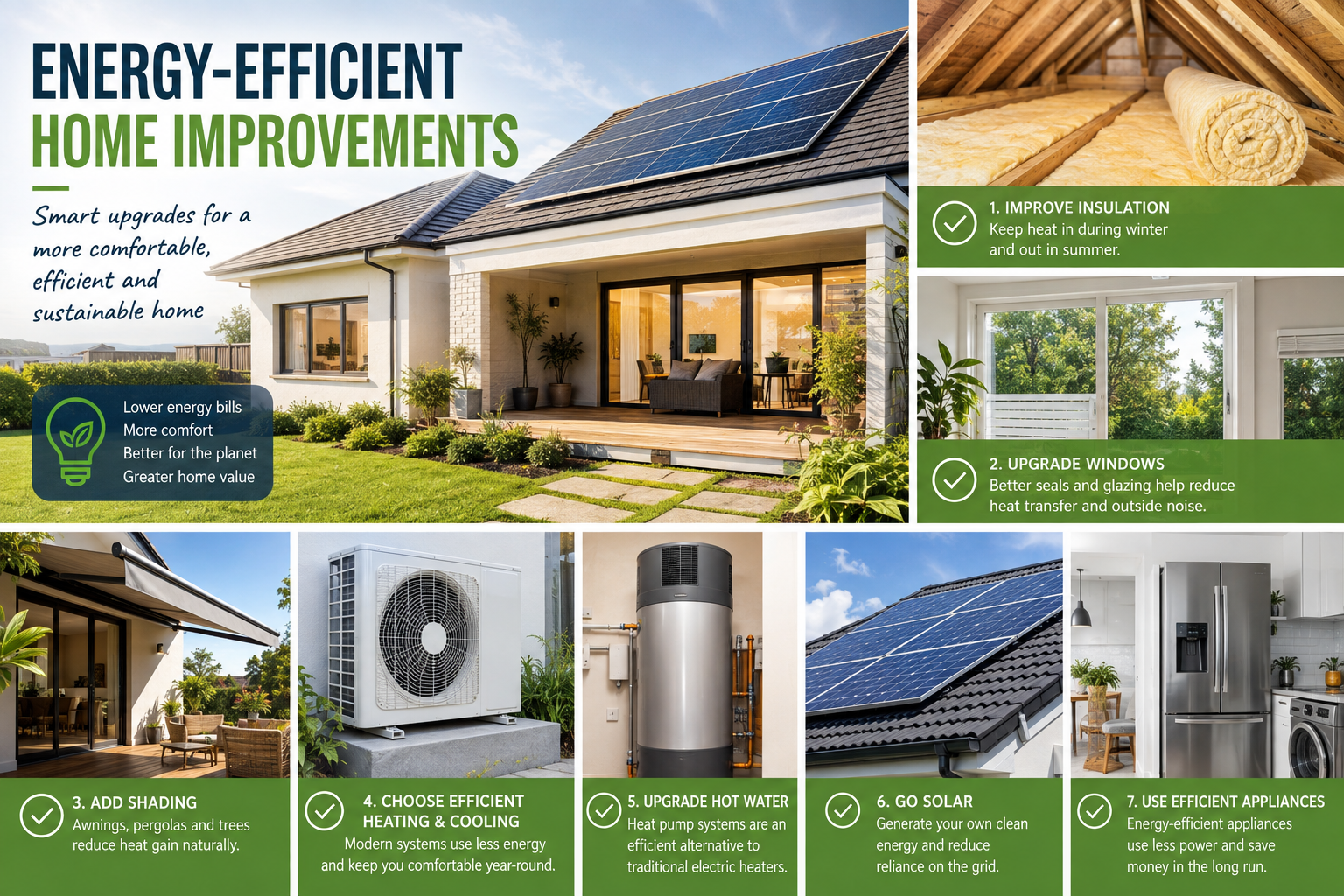
2. Improve Insulation Before Increasing Heating or Cooling
A home with poor insulation can lose heat in winter and gain unwanted heat during summer. This means your heating and cooling systems may have to work harder to maintain a comfortable temperature.
Check whether your ceiling, roof, walls and floors have suitable insulation for your property.
If you are opening walls or ceilings during a renovation, it may be a convenient time to inspect or improve insulation.
The right insulation depends on factors such as your climate, construction type and existing materials. Installation should also be handled carefully, particularly around electrical components and recessed lighting.
A well-insulated home can reduce the amount of energy needed to maintain comfortable indoor temperatures.
3. Deal With Draughts During Renovation
Small gaps around doors, windows and other parts of the building envelope can make a noticeable difference to comfort.
During renovation work, inspect areas such as:
- External doors
- Window frames
- Skirting boards
- Floorboards
- Service penetrations
- Older openings and gaps
Weather stripping, appropriate seals and other draught-control measures can help reduce unwanted air movement.
However, don’t simply seal every opening you can find. Homes still require suitable ventilation, and ventilation requirements around gas appliances should never be blocked without professional advice.
4. Make Windows Work Harder for Your Home
Windows influence how much heat enters and leaves a property.
If you are already replacing old windows, investigate options that improve thermal performance rather than choosing solely on appearance or purchase price.
Depending on your home, possibilities may include:
- Double glazing
- Low-emissivity glass
- Better window seals
- Thermally appropriate frames
- External blinds
- Awnings
- Quality internal window coverings
You don’t necessarily need to replace every window. First consider which windows receive the most direct sun or contribute most to heat loss.
Orientation matters too. A window facing one direction can have very different energy implications from a window facing another direction.
5. Use Shading to Reduce Summer Heat
Stopping excessive heat from entering the home can be more effective than trying to remove it after it has already entered.
External shading can be particularly useful for windows exposed to strong sunlight.
Depending on the property, options can include:
- Awnings
- External blinds
- Eaves
- Pergolas
- Shade structures
- Carefully positioned landscaping
Trees and other vegetation can also contribute to shading when selected and positioned appropriately.
When planning outdoor improvements, think about both summer heat and winter sunlight. A good design should complement the local climate rather than simply block sunlight all year.
6. Rethink Your Heating and Cooling System
Heating and cooling can be major contributors to household energy consumption.
If your existing system is old or inefficient, renovation may be the right time to investigate a replacement.
When comparing systems, consider:
- Energy-efficiency ratings
- The size of your home
- Room layout
- Your local climate
- How many rooms need conditioning
- Whether zoning is available
- Installation requirements
- Ongoing maintenance
Don’t automatically choose the largest system. Correct sizing is important, and improving insulation and shading first may reduce the amount of heating or cooling capacity your home needs.
Regular maintenance also matters. Dirty filters and poorly maintained equipment can reduce performance.
7. Look at Your Hot-Water System
Hot water is an easy area to overlook during a renovation.
If your existing system is old, inefficient or nearing replacement, compare modern alternatives before committing to another conventional system.
Heat-pump water heaters are one option Australian homeowners can investigate. They use electricity to move heat rather than generating heat directly in the same way as a conventional resistive electric element.
Before choosing one, consider:
- Household hot-water demand
- Available installation space
- Noise considerations
- Climate
- Electricity usage
- Solar generation
- Installation costs
- Maintenance requirements
A hot-water upgrade can become even more interesting when considered alongside a broader plan to electrify the home.
8. Consider Solar Before Finalising Your Renovation
If your property has suitable roof space, solar panels may be worth investigating.
Rather than treating solar as a standalone purchase, think about your home’s future electricity requirements.
For example, are you planning to add:
- A heat-pump hot-water system?
- More efficient electric appliances?
- An induction cooktop?
- An electric vehicle?
- A battery?
- Additional air conditioning?
Understanding future electricity demand can help you make a more informed solar decision.
Roof orientation, shading, available space, electricity consumption and local connection requirements should all be considered before selecting a system.
Obtain detailed quotes from appropriately qualified installers and compare the equipment, warranties, installation work and expected system performance rather than focusing only on the headline price.
9. Replace Old Appliances Strategically
A renovation doesn’t mean every appliance needs to be replaced.
Instead, prioritise appliances that are:
- Old
- Frequently used
- Expensive to operate
- Damaged
- Near the end of their expected service life
When comparing replacements, look beyond the purchase price.
An appliance that costs less initially may not be the cheapest option over many years if it consumes significantly more electricity.
Energy-rating information can help Australian households compare the efficiency of relevant appliances.
10. Upgrade Lighting While You Have the Walls Open
Renovation provides an excellent opportunity to rethink lighting.
LED lighting can provide an efficient alternative to older lighting technologies, while good design can reduce unnecessary lighting.
Consider creating separate lighting zones instead of connecting an entire room to one switch.
You could also consider:
- Motion sensors
- Timers
- Dimmers where compatible
- Smart controls
- Outdoor lighting controls
- Better use of natural daylight
The goal isn’t simply to install more lights. It is to create a lighting system that provides the right amount of light where and when it is needed.
11. Don’t Ignore Your Roof
Your roof plays a major role in the thermal performance of your home.
During a renovation, inspect the roof for issues that could affect comfort and energy efficiency.
Depending on the property, improvements might include:
- Better ceiling insulation
- Roof insulation
- Appropriate roof ventilation
- Reflective roofing materials
- Repairs to damaged areas
- Improved shading
The right solution depends heavily on your climate and existing roof design.
A renovation is also a good opportunity to consider whether your roof is suitable for solar panels and whether future equipment could affect its layout.
12. Plan Around Your Local Australian Climate
One of the biggest mistakes homeowners can make is assuming that an energy-efficient renovation looks the same everywhere in Australia.
It doesn’t.
A house in tropical northern Australia has different requirements from a property in Tasmania. A home in Perth can have different priorities from one in Melbourne or Brisbane.
Before choosing materials and systems, consider:
- Local temperatures
- Humidity
- Seasonal conditions
- Sun exposure
- Wind
- Rainfall
- House orientation
- Building construction
In hotter areas, shading, insulation, ventilation and efficient cooling may receive greater attention.
In cooler regions, insulation, draught management, glazing and efficient heating may become higher priorities.
13. Think About Passive Design
Passive design aims to make the building itself contribute to comfort rather than relying entirely on mechanical heating and cooling.
When planning a major renovation, consider:
- Window orientation
- Natural ventilation
- Solar access
- Shading
- Insulation
- Thermal mass
- Room layout
- Daylight
For example, improving the placement of windows or adding appropriate shading can influence how much sunlight and heat enter your home.
These decisions can be difficult to change later, which is why passive-design considerations are particularly valuable during major renovations.
14. Don’t Forget Ventilation and Indoor Air Quality
Improving airtightness can help reduce unwanted draughts, but your renovation should still provide suitable ventilation.
Bathrooms, kitchens and other moisture-producing areas need appropriate ventilation to help manage humidity.
If you are making significant changes to the building envelope, discuss ventilation requirements with a suitably qualified professional.
Energy efficiency shouldn’t come at the expense of a healthy indoor environment.
15. Research Available Government Assistance
Energy-efficiency upgrades can involve significant upfront costs, so check whether your state, territory or the Australian Government currently offers assistance that could apply to your project.
Programs and eligibility requirements can change, so don’t rely on an old article or renovation forum post.
Check official government information before including a rebate, discount or finance arrangement in your budget.
Also pay attention to requirements involving approved products, installers, property types or application deadlines.
16. Get Several Renovation Quotes
Don’t choose a contractor based solely on the cheapest quote.
For energy-focused improvements, compare exactly what each quote includes.
Ask about:
- Product specifications
- Installation method
- Labour
- Electrical work
- Removal of existing equipment
- Warranties
- Maintenance
- Expected completion time
- Any additional work that could affect the final price
A quote that initially appears more expensive may include important work that another contractor has excluded.
For specialist electrical, plumbing, gas or structural work, use appropriately licensed professionals.
17. Avoid the Most Common Energy Renovation Mistakes
A few mistakes can undermine an otherwise good renovation.
Buying products before understanding the problem
Don’t start with a product. Start with the problem you want to solve.
Focusing only on purchase price
Consider installation, energy consumption, maintenance and expected service life.
Improving one part of the home while ignoring another
For example, an efficient air conditioner may not deliver its full potential if the home has major heat gain through poorly shaded windows.
Forgetting future energy needs
Your electricity requirements may change as you add solar, electric appliances, batteries or an electric vehicle.
Ignoring professional installation
Energy-efficient products still depend on appropriate installation.
Assuming every home needs the same solution
Australian homes vary enormously in climate, construction and orientation.
A Practical Energy-Efficient Renovation Order
If you’re unsure where to start, use this as a general planning framework:
Step 1: Assess the property
Identify heat loss, heat gain, draughts and major energy users.
Step 2: Improve the building envelope
Look at insulation, windows, shading and draught control.
Step 3: Review heating and cooling
Once the building performs better, assess whether existing systems are still appropriate.
Step 4: Review hot water
Consider efficient replacement options when your current system needs upgrading.
Step 5: Assess solar
Calculate whether rooftop solar fits your electricity consumption and future plans.
Step 6: Replace inefficient appliances
Prioritise frequently used appliances nearing the end of their lives.
Step 7: Improve lighting and controls
Complete the smaller efficiency improvements as part of the renovation.
Energy-Efficient Renovation Checklist for Australian Homeowners
Before starting work, ask yourself:
- Have I identified the biggest sources of energy use?
- Have I checked the condition of my insulation?
- Have I looked for unnecessary draughts?
- Have I assessed my windows?
- Have I considered external shading?
- Is my heating and cooling system appropriately sized?
- Should I investigate a heat-pump hot-water system?
- Is solar suitable for my property?
- Which appliances actually need replacing?
- Can I improve lighting while renovating?
- Have I considered my local climate?
- Have I planned for future electricity needs?
- Have I checked current government assistance?
- Have I obtained multiple quotes?
- Are specialist jobs being completed by appropriately qualified professionals?
Frequently Asked Questions
What is the first energy-efficient improvement an Australian homeowner should consider?
Start by assessing the home’s overall performance. Insulation, draughts, windows, shading and heating or cooling should be reviewed before deciding which individual upgrade deserves priority.
Is insulation important for Australian homes?
Yes. Appropriate insulation can help reduce unwanted heat transfer and make indoor temperatures easier to manage. The most suitable insulation depends on the property’s construction and climate.
Should I install solar panels during a renovation?
Solar can be worth considering if your property has suitable roof space and your electricity consumption makes the investment appropriate. Consider future electricity needs before choosing the system size.
Are double-glazed windows worth the investment?
They can be useful where windows are a significant source of heat transfer, particularly when windows are already due for replacement. However, shading, sealing and other improvements may also provide value.
What is a good alternative to an old electric hot-water system?
A heat-pump water heater is one option worth investigating. Compare installation requirements, capacity, energy use, climate suitability and total costs before making a decision.
How can I make my home cooler without relying entirely on air conditioning?
Start by reducing heat entering the home. External shading, suitable insulation, efficient windows and appropriate ventilation can all contribute to summer comfort.
Do energy-efficient renovations increase property value?
They may improve a property’s appeal, comfort and operating performance, but the effect on resale value varies by property, location, buyer demand and the quality of the renovation. Homeowners should not assume that every energy upgrade will recover its full cost through resale value.
Are there government rebates for energy-efficient renovations in Australia?
Government and state or territory programs may be available, but eligibility and funding change over time. Check the relevant official government websites before making financial decisions based on a particular incentive.
Conclusion
An energy-efficient renovation doesn’t have to mean turning your home into a high-tech project filled with expensive equipment.
Often, the biggest opportunity is to make the home itself perform better.
Start with insulation, shading, windows and draught control. Then consider efficient heating and cooling, hot water, solar, appliances and lighting. Make decisions according to your property’s climate, construction, orientation and your household’s future needs.
Most importantly, plan before you purchase.
A thoughtful renovation can help create a home that is more comfortable, easier to manage and better prepared for Australia’s changing energy needs.
