
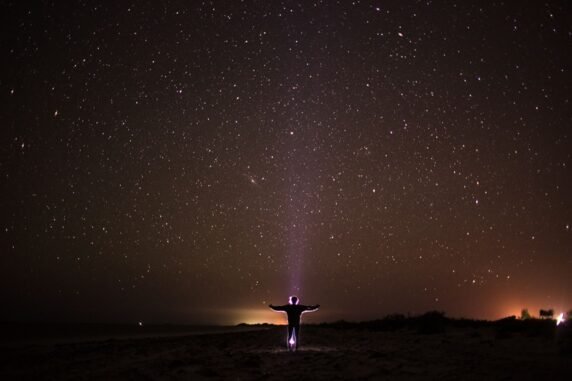
For decades, travellers have chased famous landmarks, beaches and bustling cities. Now, an increasingly popular travel experience is asking them to look in the opposite direction — up at the night sky.
Astrotourism is emerging as a distinctive form of experiential travel, with travellers seeking destinations where they can see stars, track constellations and experience celestial events away from urban light pollution. Booking.com’s Travel Predictions 2025 research found that 62% of travellers were considering visiting darker-sky destinations, while 72% expressed interest in uninterrupted “starbathing” experiences. The research surveyed more than 27,000 travellers across 33 countries and territories.
The numbers point to a broader shift in travel: darkness itself is becoming an attraction.
What Is Astrotourism?
Astrotourism refers to travel centred around experiencing the night sky and celestial phenomena. It can include stargazing, meteor-shower viewing, astrophotography, observing planets and travelling to destinations for events such as solar or lunar eclipses.
The concept overlaps with dark sky tourism, a broader category that can include moonlit hikes, night safaris and wellness experiences in locations with minimal artificial light.
The attraction is partly scientific, but it is also emotional. For travellers accustomed to brightly lit cities and constant digital stimulation, standing beneath a clear, star-filled sky can offer a rare sense of scale, quiet and connection with nature.
Why Are Travellers Chasing Dark Skies?
One of the biggest reasons is the growing scarcity of genuinely dark skies.
According to DarkSky International, 99% of the world’s population lives under night skies affected to some degree by artificial light, while 90% of people in Europe and North America live in locations where the Milky Way can no longer be seen.
This makes darkness increasingly valuable.
A remote desert, mountain region, rural landscape or island can provide something that many urban travellers cannot easily experience at home: a naturally dark night sky filled with visible stars.
Astrotourism therefore turns the absence of artificial light into part of the travel experience.
The Rise of Noctourism
Astrotourism is also benefiting from the wider rise of noctourism, which focuses on experiences after sunset.
Booking.com’s research found that 54% of travellers planned to increase their nighttime activities, while 42% preferred travelling to cooler destinations. The research linked some of this interest to rising daytime temperatures, encouraging travellers to shift activities towards evenings and early mornings.
This gives destinations an opportunity to rethink the traditional tourism timetable.
Instead of treating sunset as the end of the day’s activities, hotels and tourism operators can create experiences around the night — from guided stargazing and astronomy sessions to night walks and outdoor dining.
Dark Skies Are Becoming a Tourism Asset
As demand for unusual and immersive travel experiences grows, destinations with dark skies can gain a competitive advantage.
Deserts, high-altitude regions, forests, islands and rural communities can all potentially develop astrotourism experiences if they offer suitable viewing conditions and protect their nighttime environment.
Accommodation providers are also responding. Dark-sky-friendly hotels and resorts can offer observation decks, telescopes, astronomy programmes, panoramic windows and outdoor spaces designed for night-sky viewing.
The hospitality industry is increasingly treating the sky as part of the guest experience rather than simply the scenery outside a hotel.
Astrotourism Can Support Sustainable Tourism
The growth of dark-sky tourism also creates an opportunity to connect tourism with conservation.
Astrotourism can encourage destinations to reduce unnecessary artificial lighting while creating economic opportunities for local guides, accommodation providers, restaurants and community-based tourism businesses.
DarkSky International has developed Principles of Responsible Astrotourism, which emphasise responsible lighting, environmental protection, support for local communities, respect for local cultures, compliance with regulations and sustainable economic development. The principles were developed with input from dark-sky experts, researchers, astronomers and tourism professionals.
This is particularly important because the growth of astrotourism could create its own environmental pressures if sensitive locations become overcrowded.
The Dark Side of Dark-Sky Tourism
The popularity of a previously niche experience can create a paradox.
If too many travellers converge on a small number of famous dark-sky locations, the resulting traffic, construction, waste and artificial lighting could undermine the very environment visitors have come to experience.
DarkSky International warns that tourism can degrade natural landscapes and place pressure on local communities if growth is poorly managed. Its responsible astrotourism principles specifically call for protecting natural environments and considering the wellbeing of residents.
For destinations, the objective should therefore not simply be to attract more visitors. It should be to develop tourism while preserving natural darkness.
What Astrotourism Means for Hotels
Hotels and resorts have an opportunity to turn this trend into a distinctive hospitality offering.
Rather than simply advertising a “beautiful location”, properties can build experiences around the night sky. These could include:
- Guided stargazing sessions
- Astronomy talks and workshops
- Telescope access
- Astrophotography experiences
- Meteor-shower viewing
- Moonlit nature walks
- Dark-sky-friendly outdoor lighting
- Accommodation designed around unobstructed sky views
The experience can also complement wellness travel. Quiet surroundings, fewer distractions and time spent outdoors after dark can position stargazing as part of a broader slow-travel or nature-based holiday.
Astrotourism Fits the Experience Economy
The rise of astrotourism reflects a larger transformation in what travellers value.
Instead of simply collecting destinations, many travellers are increasingly looking for experiences they can remember, photograph and share. Astrotourism offers several layers at once: adventure, nature, science, photography, wellness and discovery.
Importantly, it can also make an ordinary landscape feel extraordinary.
A remote field may not have a famous monument or attraction, but under a clear sky filled with stars, it can become the centrepiece of an entire travel experience.
The Future of Dark-Sky Travel
Astrotourism is moving from a specialist interest towards a broader travel trend because it addresses several consumer desires simultaneously: escaping crowds, connecting with nature, seeking unique experiences and spending more time outdoors at night.
The Booking.com research provides a strong indication of this demand, with nearly two-thirds of surveyed travellers considering darker-sky destinations.
But the future of astrotourism will depend on how destinations respond to that demand. Protecting darkness must remain as important as promoting it.
The next generation of travel experiences may therefore be defined not only by what destinations build, but also by what they preserve.
In a world increasingly illuminated by cities, dark skies are becoming a rare luxury — and for a growing number of travellers, they are worth travelling for.
