
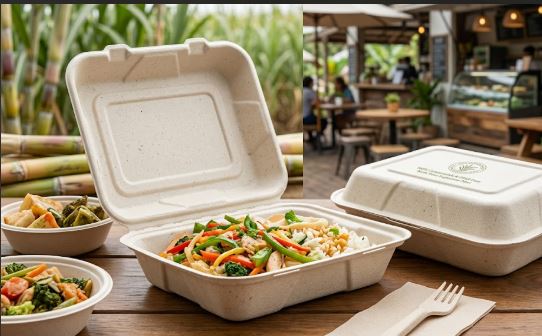
A takeaway meal may last only a few minutes, but the packaging it comes in can remain in the environment for years. As consumers and businesses look for better alternatives to conventional plastic and chemical-heavy food containers, an unlikely material is gaining attention — sugarcane fibre.
Known as bagasse, this fibrous material is left behind after sugarcane is crushed to extract its juice. Instead of being treated simply as agricultural waste, it can be turned into plates, bowls, trays, cups and food boxes, giving it a useful second life.
The idea is simple: use what is already available from agriculture and turn it into practical everyday products.
From farm residue to food packaging
Sugarcane is widely cultivated for sugar production, generating large quantities of fibrous residue. Bagasse can be processed and moulded into different shapes, making it suitable for food-service applications.
Its growing popularity comes from its ability to combine functionality with a more natural material base. Food boxes made from bagasse can be lightweight, stackable and convenient for restaurants, caterers, delivery services and consumers.
For people ordering food at home or carrying lunch to work, packaging needs to do more than look sustainable. It must be strong enough to hold food, comfortable to handle and capable of dealing with moisture, sauces and oils.
That practical side is one reason plant-fibre packaging is becoming increasingly visible in everyday food consumption.
Why PFAS-free packaging matters
The conversation around sustainable packaging is also moving beyond plastic. Consumers are paying greater attention to the chemicals that may be used to give food containers properties such as resistance to grease, water and heat.
One group that has attracted particular attention is PFAS — per- and polyfluoroalkyl substances. These are man-made chemicals used in a wide range of products because they can resist heat, oil and water. Some PFAS are highly persistent in the environment and certain members of the group have been associated with potential health concerns.
This has increased interest in food packaging designed without intentionally added PFAS, particularly for products that come directly into contact with food.
However, being labelled “PFAS-free” does not by itself guarantee that a product is suitable for every purpose. Food-contact safety depends on the materials used, manufacturing standards, testing and whether the product is designed for its intended use.
For consumers, the bigger shift is clear: packaging is increasingly being viewed not just as something that carries food, but as part of the overall food experience and safety conversation.
Convenience without ignoring the planet
The biggest challenge for any alternative to conventional packaging is convenience.
People want takeaway containers that do not leak, collapse or become difficult to handle. Restaurants need packaging that can withstand transportation and different types of food. Businesses also want materials that can support their sustainability goals without making everyday operations unnecessarily complicated.
Bagasse offers an interesting balance because it is made from a renewable agricultural resource and can be moulded into practical food-service products.
Its plant-based origin also gives brands an opportunity to reduce their dependence on conventional plastic-based packaging, particularly for short-use applications such as takeaway meals and catering.
What happens after the meal?
Sustainable packaging does not end when the food is eaten.
Bagasse products are often promoted for compostability, but disposal conditions matter. A product labelled compostable may require specific commercial or industrial composting facilities to break down effectively. Simply throwing it anywhere does not guarantee that it will quickly disappear.
This is why better packaging needs to be supported by better waste-management systems.
Consumers can make more informed choices by checking whether a product is suitable for food contact, whether credible safety or compostability certifications are available and what disposal method is recommended.
A small change with a wider impact
The rise of bagasse reflects a broader change in the way people think about everyday consumption. Sustainability is no longer limited to large environmental projects. It is increasingly becoming part of ordinary decisions — what we eat, what we buy and what happens to the products we use after we are finished with them.
For businesses, the shift can also create an opportunity to rethink packaging as part of their brand identity. A food company that reduces unnecessary plastic, chooses responsibly designed materials and communicates disposal information clearly can make sustainability more visible to its customers.
Bagasse is not a complete answer to the world’s packaging challenge, and no single material can solve the waste problem on its own. But turning sugarcane residue into useful food containers demonstrates how agricultural by-products can become valuable resources.
From a sugarcane field to a restaurant counter and finally to a takeaway table, the journey of bagasse shows how an everyday material can be given a new purpose.
The future of packaging may not simply be about replacing one material with another. It could be about designing products that are practical, safer for their intended use and more responsible from production to disposal.
