
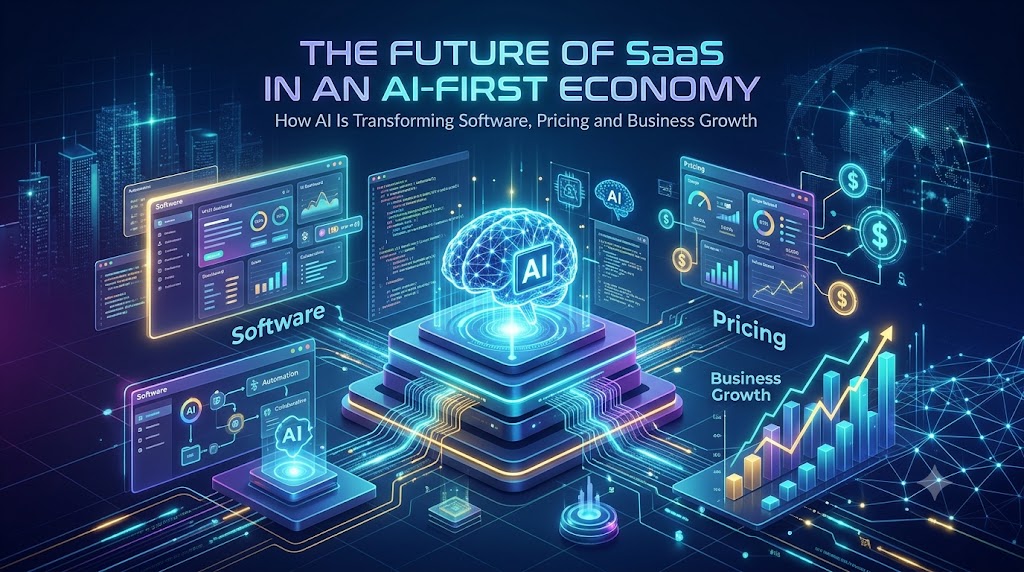
The Software-as-a-Service (SaaS) industry is approaching a defining moment as artificial intelligence reshapes how businesses use software, manage operations and create value. What once centred on cloud-based applications, recurring subscriptions and employee-driven workflows is evolving towards intelligent platforms that can analyse information, automate tasks and execute complex business processes.
The rise of AI agents, generative AI and intelligent automation is changing customer expectations. Businesses increasingly want software that does more than store data or display dashboards. They want solutions that can turn information into action, reduce manual workloads and deliver measurable improvements in productivity.
This shift is creating new opportunities for SaaS companies while challenging traditional business models. Subscription pricing, software development, customer retention and profit margins are all coming under pressure as providers adapt to the economics of AI.
For software companies and enterprise customers alike, the future of SaaS will depend on how effectively artificial intelligence can translate technological innovation into sustainable business growth.
How AI Is Redefining the Traditional SaaS Business Model
Traditional SaaS platforms allow businesses to access applications through the cloud without maintaining extensive software infrastructure. Companies typically pay recurring fees to use customer relationship management (CRM), enterprise resource planning (ERP), accounting, marketing and human resource management tools.
Although this model has supported predictable revenue and scalable distribution, many applications still depend on employees to enter information, navigate dashboards and initiate individual tasks.
AI-first SaaS platforms are beginning to change this relationship. By integrating artificial intelligence into existing workflows, software providers can help customers automate routine activities, generate insights and complete tasks with fewer manual steps.
For example, a traditional CRM system records customer interactions and tracks sales opportunities. An AI-enabled platform can also summarise conversations, identify follow-up requirements, prepare customer communications and update records.
Similarly, financial software can move beyond reporting transactions to identifying discrepancies, preparing reconciliations and flagging exceptions for review.
The commercial opportunity lies in transforming software from a collection of digital tools into an intelligent system that helps businesses achieve specific operational goals.
AI Agents Are Taking SaaS Beyond Automation
One of the most important developments in the future of SaaS is the emergence of AI agents capable of coordinating multiple tasks across connected applications.
Unlike conventional automation, which generally follows predefined rules, AI agents can be designed to interpret objectives, retrieve relevant information and perform authorised actions through business software.
This creates opportunities for more connected workflows across sales, finance, customer service, procurement and logistics.
For instance, an AI agent could receive a customer order, check inventory availability, verify payment status and coordinate the next steps with the relevant business systems. Exceptions could be directed to employees rather than handled automatically.
This evolution is encouraging a broader shift towards services-as-software, where customers increasingly evaluate technology based on the work it completes rather than the number of features or user accounts it provides.
For SaaS providers, this could create new revenue streams through automated services, specialised AI assistants and end-to-end workflow solutions. However, success will depend on reliability, secure integrations and clear limits on autonomous decision-making.
The Shift from Per-User Subscriptions to AI-Based Pricing
Pricing is becoming a critical strategic question for SaaS companies operating in an AI-first economy.
The traditional per-user subscription model offers predictable recurring revenue. However, AI services introduce variable costs because each task may require computing resources, model inference, data processing and third-party services.
As a result, SaaS providers are exploring pricing structures that better reflect customer usage and the value delivered.
Usage-based pricing allows customers to pay according to consumption, while hybrid models combine a fixed subscription with additional charges for AI capabilities. Outcome-based pricing links fees to defined results, such as completed transactions or successfully processed workflows, where outcomes can be measured reliably.
These approaches offer flexibility but also introduce challenges. Customers need transparent billing and predictable costs, while providers must ensure that pricing covers the expense of delivering AI services.
For enterprise buyers, understanding the total cost of AI-powered software will become increasingly important. Subscription fees alone may not capture the full cost of usage, integration, training and ongoing management.
The SaaS companies best positioned to benefit will be those that align pricing with customer value while maintaining sustainable operating economics.
AI Costs and Profit Margins: A New Challenge for SaaS Companies
Artificial intelligence creates opportunities to expand revenue, but it can also make software more expensive to operate.
Traditional cloud software often benefits from relatively low incremental distribution costs as the customer base expands. AI-powered services may incur additional expenses for model inference, computing infrastructure, data processing, security and system monitoring.
These costs can increase with usage, particularly when products rely on expensive models or perform complex tasks repeatedly. Consequently, a growing customer base does not automatically translate into stronger profitability.
SaaS companies must understand the economics of each AI feature, including the cost of completing a task, the revenue generated and the level of human intervention required.
Providers can improve efficiency by selecting appropriate AI models for different workloads, reducing unnecessary computation, optimising infrastructure and designing workflows that avoid repetitive processing.
They must also consider customer retention, support costs and the long-term value of each account.
The central challenge is to scale AI adoption without allowing delivery costs to grow faster than revenue. Sustainable profitability will depend on disciplined product development, efficient infrastructure and pricing that reflects the actual cost of service.
Will AI Reduce Demand for Traditional Software Licences?
The growth of AI-powered development tools is encouraging businesses to reconsider the balance between buying commercial software and building customised solutions internally.
AI coding assistants and specialised agents can help technical teams develop applications, connect business systems and automate repetitive processes. This may place pressure on software products that offer relatively standard features without strong differentiation.
However, building an internal application involves more than writing code. Businesses must also manage maintenance, cybersecurity, regulatory requirements, system integration, technical support and future upgrades.
Established SaaS platforms continue to offer advantages through mature infrastructure, specialised capabilities and ongoing product development. Their long-term competitiveness will depend on how well they integrate AI into these strengths.
Rather than eliminating software subscriptions altogether, AI could make enterprise software purchasing more selective. Customers may favour providers that offer secure, integrated solutions with demonstrable business value over products that primarily provide access to basic features.
For SaaS businesses, differentiation will increasingly depend on domain expertise, proprietary workflows, dependable data access and the ability to solve complex customer problems.
How SaaS Companies Can Build a Competitive Advantage
The transition to an AI-first economy requires established software companies to rethink product strategy, investment priorities and organisational structure.
Simply adding a chatbot to an existing application may not be enough to retain customers if competitors offer more capable automation or deliver better outcomes.
SaaS leaders should identify which customer problems can be solved more effectively through AI and develop products around those needs. This may involve introducing intelligent assistants, automating repetitive workflows or connecting previously separate applications.
A practical strategy is to strengthen the core software business while developing dedicated teams to test new AI products and business models. The established business can continue generating recurring revenue, while specialised teams explore new opportunities without unnecessarily disrupting existing services.
However, innovation should remain connected to customer demand and commercial performance. AI initiatives need clear objectives, measurable milestones and a realistic understanding of development and operating costs.
Companies that combine established customer relationships with effective AI integration may be better positioned to build differentiated products and protect long-term revenue.
Data Security and Trust Will Shape SaaS Adoption
As AI becomes more deeply integrated into enterprise software, customers will increasingly evaluate providers on security, reliability and governance.
AI agents may access customer records, financial information, employee data and confidential business documents. Poorly controlled access or incorrect automated actions could expose sensitive information or disrupt operations.
SaaS providers must therefore implement strong access controls, data protection measures, activity monitoring and testing procedures. High-impact actions should require appropriate human approval, while customers should understand how their information is processed and which external services are involved.
Reliability is equally important. AI systems can produce inaccurate results, misinterpret instructions or struggle with incomplete information. Business-critical applications need mechanisms to detect errors, escalate exceptions and recover from failures.
For enterprise customers, these safeguards are not merely technical requirements. They are essential considerations when selecting software for sensitive or mission-critical operations.
In an increasingly competitive SaaS market, trust and dependable performance could become as important as product innovation.
What the AI-First SaaS Economy Means for Enterprise Customers
The evolution of SaaS offers businesses an opportunity to improve productivity, reduce manual work and reconsider overlapping software subscriptions. AI-powered applications may help organisations coordinate processes more efficiently and gain greater value from existing business data.
However, adopting new technology requires careful evaluation. Businesses should determine whether an AI-enabled platform improves processing times, reduces errors, enhances customer service or lowers the total cost of operations.
They should also assess integration requirements, data portability, security arrangements, pricing transparency and the risk of becoming overly dependent on a single provider.
A gradual implementation strategy can help organisations test new capabilities before committing to a wider transformation. By comparing pilot results with existing processes, businesses can establish whether the technology delivers sufficient commercial value.
The objective should not be to adopt AI for its own sake, but to use it where it improves business performance.
The Future of SaaS: Intelligent Software and Sustainable Growth
The future of Software-as-a-Service will be shaped by a shift from selling access to applications towards delivering intelligent, connected and measurable business outcomes.
AI agents could transform how software manages workflows, while new pricing models may change how customers pay for digital services. At the same time, computing expenses, security requirements and competitive pressures will challenge SaaS companies to rethink their approach to profitability and growth.
For software providers, the priority will be to develop useful AI capabilities, maintain customer trust and ensure that innovation produces sustainable revenue. For enterprise customers, the focus will be on selecting solutions that deliver measurable improvements without introducing unnecessary costs or operational risks.
Traditional SaaS will continue to play an important role, but customer expectations are evolving. Businesses increasingly want software that not only supports their employees but also helps complete work, solve problems and improve decisions.
Companies that combine the reliability of established software with the adaptability of artificial intelligence will be better positioned to compete in the AI-first economy. Ultimately, the future of SaaS will belong to providers that turn AI capabilities into practical business value, stronger customer relationships and sustainable long-term growth.
