
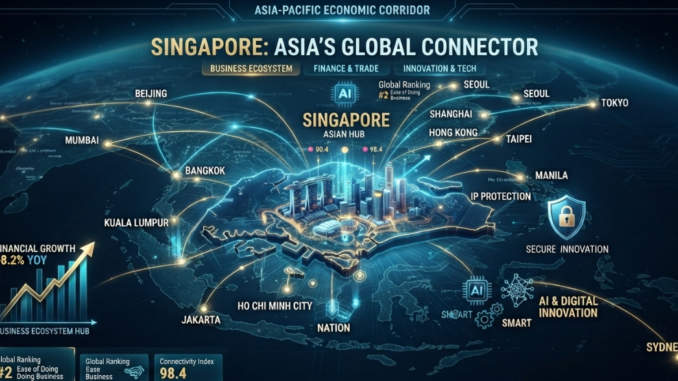
Oct 31: Singapore has become an important centre for companies looking to establish or strengthen their presence in the Asia-Pacific region. Its connectivity to major Asian markets, developed financial sector, skilled workforce and modern infrastructure make it an attractive location for businesses planning international expansion.
The country’s economic performance continues to support this position. Singapore recorded year-on-year economic growth of 5.4% in the third quarter of 2026, according to advance estimates from the Ministry of Trade and Industry.
Investment activity also reflects continued interest from global businesses. In 2025, Singapore’s Economic Development Board (EDB) secured S$14.2 billion in fixed asset investment commitments and S$8.9 billion in total business expenditure commitments. The projects are expected to support approximately 15,700 jobs over the following five years.
These developments highlight Singapore’s growing importance as a location for regional management, advanced manufacturing, technology development and international business services.
Why Global Businesses Are Expanding into Singapore
Strategic Connectivity to Southeast Asia
For companies entering Asian markets, Singapore offers access to a region with diverse and expanding commercial opportunities. Its location makes it convenient to coordinate business activities across Indonesia, Malaysia, Thailand, Vietnam and the Philippines.
Rather than managing each market independently, companies can establish a central team in Singapore to oversee regional planning, financial operations, partnerships and distribution strategies.
This arrangement can be particularly useful for businesses that want to expand across Southeast Asia while maintaining consistent management and operational standards.
The wider ASEAN market also offers opportunities in digital services, consumer products, manufacturing, infrastructure and logistics. Singapore’s position within this network makes it a practical starting point for businesses exploring regional growth.
A Business Environment Built on Stability
Entering a foreign market involves more than identifying customers. Companies must also consider regulations, contracts, taxation, intellectual property protection and the reliability of public institutions.
Singapore’s established legal system and transparent regulatory framework offer international businesses a relatively predictable environment in which to operate.
Its efficient administrative processes and established corporate services sector can also help companies manage incorporation, compliance and other business requirements.
For organisations overseeing operations in several countries, this consistency can be valuable when making long-term investment and management decisions.
Access to International Financial Services
Singapore’s financial ecosystem is another major attraction for international businesses. The country supports a broad range of financial activities, including commercial banking, wealth management, insurance, investment services and financial technology.
Companies establishing regional operations can access banking institutions, investment networks, legal advisers and corporate finance specialists.
This is particularly relevant for businesses managing international payments, cross-border transactions, regional cash flows and investment activities.
The presence of established financial institutions also creates opportunities for fintech startups and technology providers developing solutions for businesses and consumers.
Skilled Professionals and Digital Infrastructure
Singapore’s workforce includes professionals across engineering, finance, technology, research and management. This talent base supports companies that require specialised expertise to manage regional operations or develop new products and services.
The country’s digital infrastructure is another advantage. Businesses operating in software, cloud computing, cybersecurity and data-driven services can benefit from an environment that supports technology adoption and digital operations.
However, competition for experienced professionals can be intense. Companies should evaluate salary expectations, recruitment requirements and work-pass regulations when preparing their expansion plans.
Key Industries Creating Business Opportunities in Singapore
Singapore’s investment environment is closely connected to industries that require specialised skills, advanced infrastructure and long-term research capabilities.
Artificial Intelligence and Digital Technology
Artificial intelligence is creating new opportunities across enterprise software, cybersecurity, cloud services, data analytics and business automation.
Companies developing digital products can use Singapore as a base to work with regional clients, research organisations and technology partners.
Demand for AI infrastructure is also influencing other industries, particularly semiconductor manufacturing, data management and advanced computing.
For technology businesses, the opportunity extends beyond developing AI products. There is growing demand for companies that can help organisations integrate digital tools into their everyday operations.
Semiconductor Manufacturing and Advanced Industries
Singapore has an established presence in semiconductor production and advanced manufacturing. These industries require specialised engineering capabilities, precision equipment, technical expertise and reliable supply chains.
The country’s 2025 investment commitments underline the importance of this sector. Manufacturing-related projects accounted for approximately S$12.1 billion of the S$14.2 billion in fixed asset investment commitments secured by EDB.
Semiconductors, biomedical manufacturing, precision engineering and aerospace are among the areas supporting industrial investment.
As demand for advanced electronics increases, opportunities may extend to component suppliers, engineering firms, industrial automation providers and specialised business services.
Financial Technology and Digital Payments
The financial services sector provides opportunities for businesses developing payment systems, financial software, compliance solutions and digital banking technologies.
Singapore’s established financial institutions and investor networks create an environment where technology companies can explore partnerships and develop services for regional customers.
Fintech businesses can also use the country to build relationships with banks, financial service providers and companies seeking more efficient digital solutions.
Logistics, Shipping and Supply Chain Services
Singapore’s established port and airport infrastructure supports its position in international trade and logistics.
Companies involved in freight management, shipping, warehousing, distribution and supply chain technology can use the country to coordinate regional operations.
Businesses are also paying greater attention to supply chain visibility, inventory management and operational efficiency. This creates opportunities for technology providers offering digital logistics platforms and automation solutions.
For companies serving multiple Southeast Asian markets, Singapore can provide a central location for managing international trade activities.
Pharmaceuticals, Biotechnology and Medical Technology
Life sciences and healthcare manufacturing are also important parts of Singapore’s high-value industrial ecosystem.
Companies involved in pharmaceuticals, biotechnology, medical equipment and healthcare research can benefit from access to specialised professionals, research facilities and established manufacturing capabilities.
These industries require long-term investment and technical expertise, making Singapore relevant to companies seeking a location for research, product development and regional management.
Why Singapore Is Attractive for Regional Headquarters
Singapore’s role as a regional headquarters location is one of its most significant advantages for international companies.
A regional headquarters can oversee several functions, including financial planning, marketing, business development, compliance, research and strategic decision-making.
However, companies do not necessarily need to locate all their operations in Singapore. A more flexible approach is to distribute activities across Southeast Asia according to cost, infrastructure, workforce availability and market requirements.
For example, a company could manage regional leadership, finance and research from Singapore while locating selected manufacturing or distribution activities in Malaysia or Indonesia.
Developments such as the Johor-Singapore Special Economic Zone could further strengthen cross-border business opportunities between Singapore and Malaysia. Cooperation in areas such as manufacturing, logistics and investment may provide companies with additional options for structuring their regional operations.
This model allows businesses to combine Singapore’s established corporate environment with the operational capabilities of neighbouring markets.
What Singapore’s Investment Commitments Reveal
The investment figures reported by EDB offer an indication of the types of business activities attracting international interest.
During 2025, Singapore secured:
- S$14.2 billion in fixed asset investment commitments.
- S$8.9 billion in total business expenditure commitments.
- Approximately 15,700 expected jobs over the following five years.
- An estimated S$18 billion in annual value added when the committed projects are realised.
Manufacturing contributed significantly to fixed asset investment commitments, reflecting interest in capital-intensive industries and advanced production facilities.
Business expenditure commitments also highlight demand for headquarters activities, professional services and research and development.
Together, these figures suggest that Singapore is attracting companies interested in both physical industrial investment and knowledge-intensive business operations.
It is important to distinguish these commitments from completed investments. The figures represent planned projects and expected future activity rather than money already fully spent.
Challenges Businesses Must Evaluate Before Entering Singapore
Singapore offers several advantages, but establishing operations there requires careful financial and strategic planning.
The cost of office space, employee compensation and business services can be higher than in several neighbouring markets. Companies that depend on large workforces or extensive physical facilities may need to examine whether every function should be based in Singapore.
Access to specialised talent is another consideration. Businesses in technology, engineering and financial services may face competition when recruiting experienced professionals.
Regulatory compliance also requires attention. Companies operating across Southeast Asia must understand the different tax systems, employment regulations and market requirements in each country.
Before entering the market, businesses should:
- Define whether Singapore will serve as a headquarters, sales office, research centre or operational base.
- Prepare a realistic estimate of staffing, infrastructure and compliance costs.
- Identify suitable partners and customers in their target markets.
- Consider whether manufacturing, warehousing or other functions should be located elsewhere in Southeast Asia.
- Develop a regional expansion strategy based on individual market conditions.
A clear operating model can help businesses benefit from Singapore’s strengths without unnecessarily increasing their costs.
Business Opportunities for SMEs and Startups
Singapore’s international business network is not limited to large multinational corporations. Small businesses and startups can also explore opportunities by providing services to companies operating across the region.
Areas such as software development, cybersecurity, digital marketing, business automation, logistics technology and professional consulting offer potential opportunities.
Startups may also benefit from Singapore’s access to investors, research institutions, business accelerators and established corporate networks.
For SMEs based outside Singapore, the country can provide an entry point into Southeast Asian markets. However, businesses should first identify their customer base, understand local purchasing requirements and assess the commercial viability of establishing a presence.
Digital services can offer another route to regional expansion. Businesses may be able to serve Singapore-based and ASEAN clients through partnerships or remote delivery models before committing to a permanent office.
Conclusion: Singapore’s Continuing Importance in Asia-Pacific Business Expansion
Singapore’s position as a business hub is supported by a combination of regional connectivity, financial services, skilled professionals, digital infrastructure and an established investment environment.
Its ability to attract projects across advanced manufacturing, technology, research and headquarters operations demonstrates the range of activities that international companies can develop from the country.
Nevertheless, rising operating expenses, talent competition and differences between Southeast Asian markets will influence how businesses plan their expansion.
Companies that approach Singapore as part of a wider regional strategy may be better positioned to balance business stability with operational flexibility. By placing management and high-value functions in Singapore while building partnerships and operations across neighbouring markets, international businesses can create a more adaptable presence in Asia-Pacific.
As regional trade, technology investment and cross-border business activity continue to evolve, Singapore is likely to remain an important location for companies seeking opportunities across Southeast Asia.
