
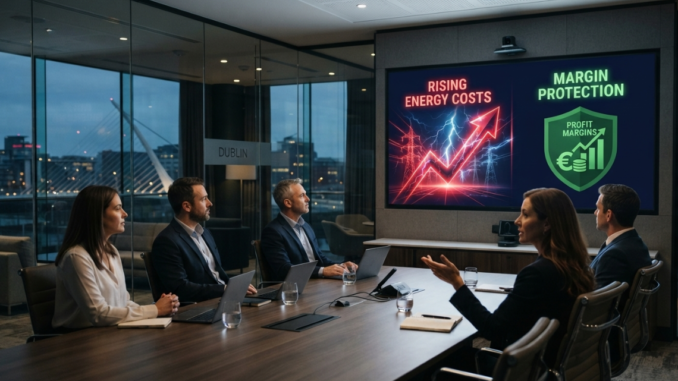
Oct 31: Energy expenditure is becoming a significant concern for businesses across Ireland. From manufacturers and retailers to hotels, restaurants and logistics companies, higher electricity and fuel costs are putting pressure on operating budgets. As businesses prepare for 2027, controlling energy consumption will be an important part of protecting profitability and maintaining competitiveness.
The challenge is not limited to fluctuations in electricity and gas prices. Network charges, equipment requirements, transportation expenses and wider operating costs also influence how much businesses spend on energy. Companies that rely heavily on electricity or gas may find it increasingly difficult to absorb these expenses without reviewing their operations.
However, businesses do not have to depend entirely on lower energy prices to improve their financial position. Better procurement decisions, energy-efficient equipment, renewable energy investments and government support can help reduce long-term exposure to rising costs.
Why Energy Costs Remain a Concern for Irish Businesses
Energy is a necessary operating expense for almost every industry, but its impact differs depending on the size and nature of a business. A manufacturing facility may require substantial electricity to operate machinery, while a hotel needs continuous energy for heating, lighting, kitchens and guest facilities.
Irish resident enterprises spent approximately €16.3 billion on energy purchases in 2024, with electricity and natural gas accounting for around 58% of this expenditure. The scale of spending highlights how closely energy costs are linked to business operations.
The outlook also requires careful attention. The Central Bank of Ireland’s third-quarter 2026 projections anticipate energy-price inflation of 5.8% in 2027. Its wholesale electricity price assumptions for 2027 were also revised upwards by 15.3% compared with the previous bulletin.
These figures are economic projections rather than a guarantee that every business will experience an equivalent increase in its electricity bill. Actual costs will depend on supplier agreements, consumption levels, contract structures and other charges. Nevertheless, they indicate why businesses should prepare their budgets with energy-price uncertainty in mind.
Ireland’s Business Electricity Prices Compared with the EU
Electricity costs are particularly important when assessing Ireland’s competitiveness as a place to operate a business.
According to SEAI’s comparable business energy price data for the first half of 2025, the average electricity price for businesses in Ireland was 24.27 cents per kWh. The corresponding EU-27 average was 17.87 cents per kWh.
This puts Ireland’s average business electricity price approximately 36% above the EU average for the period.
For businesses with substantial electricity requirements, the difference can influence production costs, pricing decisions and investment plans. Companies competing with suppliers in markets where electricity is cheaper may face additional pressure to improve efficiency.
The figures are national averages and should not be treated as individual supplier quotations. Actual business prices vary according to consumption bands, contract terms and the components included in the bill.
Which Industries Are Most Exposed to Rising Energy Expenses?
The effect of higher energy prices is not uniform across the Irish economy. Businesses with energy-intensive processes or long operating hours may face greater financial pressure.
Manufacturing and industrial production
Manufacturing businesses depend on electricity and gas for machinery, processing, refrigeration, heating and production lines. Even a relatively small increase in the cost per unit of energy can have a substantial effect when consumption is high.
Investing in efficient machinery, monitoring equipment performance and reducing unnecessary downtime can help manufacturers manage their energy requirements.
Hospitality and food services
Hotels, restaurants, cafés and other hospitality businesses use energy throughout the day. Heating, ventilation, kitchen equipment, refrigeration and laundry facilities contribute to their operating expenses.
Reviewing equipment settings, maintaining refrigeration systems and improving heating controls can help reduce avoidable consumption without affecting customer experience.
Retail and commercial properties
Lighting, air conditioning, heating and refrigeration are major energy requirements for many retail outlets and commercial buildings. Businesses operating several locations may find that small improvements at individual sites produce meaningful savings across the wider organisation.
LED lighting, automated controls and regular equipment maintenance can improve efficiency.
Transport and logistics
Fuel and electricity expenses affect delivery companies, warehouse operators and transport businesses. Changes in energy prices can influence distribution costs and the final price of goods and services.
Route planning, fleet maintenance and improved warehouse energy management can help control expenditure.
Agriculture and food processing
Agricultural operations and food-processing facilities rely on energy for irrigation, refrigeration, storage, processing and machinery. Businesses in these sectors can benefit from reviewing equipment usage and identifying opportunities to adopt more efficient technologies.
Practical Ways Businesses Can Protect Profit Margins in 2027
Reducing energy expenditure requires more than asking employees to switch off lights. Businesses need a clear understanding of where energy is being consumed and which improvements can deliver measurable financial benefits.
1. Review Electricity and Gas Contracts
Businesses should regularly examine their energy agreements rather than automatically renewing existing contracts.
Comparing supplier quotations, checking contract renewal dates and reviewing fixed and variable pricing arrangements can help identify more suitable options. Companies should also examine standing charges, contract exit conditions and other bill components before making a decision.
Smaller businesses may benefit from comparing standard commercial tariffs, while larger organisations with substantial consumption could explore negotiated contracts and more detailed procurement arrangements.
2. Conduct an Energy Audit
An energy audit can help identify equipment, processes and facilities that consume more energy than necessary.
Businesses should examine electricity usage across lighting, heating, cooling, machinery and refrigeration. Reviewing consumption at different times of the day can also reveal opportunities to reduce waste.
The findings can help management prioritise improvements according to their expected cost, savings and payback period.
3. Upgrade to Energy-Efficient Equipment
Older machinery and heating systems may consume more electricity or gas than modern alternatives. Replacing inefficient equipment can reduce operating costs over time.
Depending on the business, improvements could include:
- Energy-efficient motors and production equipment.
- LED lighting systems.
- Modern heating and cooling controls.
- High-efficiency refrigeration units.
- Automated building management systems.
- Improved insulation and ventilation.
Businesses should compare the upfront investment with projected savings before selecting an upgrade.
4. Explore Solar Energy and Other Renewable Options
Solar photovoltaic systems can help businesses generate part of their own electricity and reduce dependence on energy purchased from the grid.
The financial benefits depend on factors such as roof suitability, installation costs, electricity consumption and the proportion of generated power used on-site. Businesses should assess these factors before committing to an installation.
Solar thermal systems and heat pumps may also offer opportunities for organisations with suitable heating and hot-water requirements.
5. Improve Everyday Energy Management
Operational changes can deliver savings without requiring a major capital investment.
Businesses can introduce energy monitoring, switch off equipment when it is not required, adjust heating and cooling schedules and maintain machinery regularly. Manufacturers may also review production schedules to reduce unnecessary energy consumption during idle periods.
Assigning responsibility for monitoring energy use can make these improvements more consistent.
What Could a 10% Reduction in Energy Consumption Mean for a Business?
Even a modest improvement in energy efficiency can make a noticeable difference to annual operating expenses.
Consider a business with an annual energy bill of €100,000. If it reduces its energy consumption by 10%, it could potentially save around €10,000 over a year, assuming energy prices and other relevant bill components remain unchanged.
If the business initially earns an operating profit of €200,000, this saving would represent an amount equal to 5% of its original operating profit.
This is an illustrative calculation rather than a guaranteed saving. Actual results will depend on the proportion of the bill linked to consumption, fixed charges, taxes, tariff changes and the effectiveness of the improvements.
The example nevertheless demonstrates why energy efficiency should be considered a financial management priority rather than simply an environmental initiative.
Government Grants That Can Support Business Energy Upgrades
Financial assistance can make energy-efficiency improvements more accessible, particularly for smaller companies that may not have large investment budgets.
The Sustainable Energy Authority of Ireland (SEAI) and other government-supported programmes provide funding opportunities for eligible businesses.
Some relevant schemes and supports include:
Non-Domestic Microgeneration Grant
SEAI announced a temporary enhancement to its Non-Domestic Microgeneration Grant, increasing support to as much as 45% of eligible project costs for a nine-month period. The scheme is intended to encourage businesses to invest in small-scale renewable electricity generation, including solar PV.
Business Energy Upgrades Scheme
Eligible businesses may be able to access increased grant support for selected technologies, including heat pumps and solar thermal systems. The enhanced grant rate announced by SEAI is up to 45% of eligible costs for the specified measures.
Energy Efficiency Grant for SMEs
The Energy Efficiency Grant is designed to help qualifying small and medium-sized businesses invest in energy-saving equipment. Eligible applicants may receive funding covering up to 75% of approved costs, subject to a maximum grant of €10,000.
Published eligibility conditions include having no more than 50 employees, operating for at least six months, meeting the required revenue threshold, completing the Green for Business programme and having a recent energy audit conducted by an SEAI auditor.
Business Energy Upgrade Grant – Rapid Approval
This support route covers a range of potential business upgrades, which may include solar PV, solar thermal, heat pumps, insulation, pumps, automatic controls, ventilation improvements and heat recovery systems. The grant amount and approval conditions depend on the business and the proposed measures.
Businesses should review the latest scheme guidance, application requirements and eligible expenditure before making investment decisions. Grant rates, availability and conditions may change, and companies should confirm whether different supports can be combined.
How Small Businesses Can Manage Energy Costs Differently
Large organisations may have dedicated procurement teams and greater negotiating power when dealing with energy suppliers. Smaller businesses often have fewer resources and less flexibility to absorb unexpected increases.
For SMEs, the starting point should be understanding current consumption and identifying improvements that do not require significant investment. Reviewing supplier contracts, reducing unnecessary operating hours and upgrading high-use equipment can provide a practical starting point.
Businesses considering larger projects should assess available grants and financing options before proceeding. A phased approach can also help spread investment costs while allowing companies to measure the results of each improvement.
Larger manufacturers and energy-intensive organisations may require a more detailed strategy involving long-term procurement, on-site renewable generation, energy storage, automated monitoring and production planning.
Regardless of business size, decisions should be based on actual consumption data and realistic financial projections.
Preparing Irish Businesses for the Energy Outlook in 2027
Energy prices are likely to remain an important factor in business planning as Ireland moves towards 2027. Although individual companies cannot control wholesale market movements, they can take steps to reduce their exposure to unnecessary consumption and unpredictable costs.
The difference between Ireland’s average business electricity price and the EU average also reinforces the importance of improving operational efficiency. Businesses that delay upgrades may continue to face higher running costs, while those that invest in better equipment and energy management can strengthen their long-term cost position.
For Irish companies, protecting profit margins will require a combination of careful purchasing, practical efficiency measures, suitable technology investments and effective use of available government support.
Energy management should therefore become a regular part of financial planning, not an exercise undertaken only when electricity bills increase. Businesses that understand their consumption and act early will be better placed to manage costs, maintain competitiveness and build more resilient operations in 2027.
