
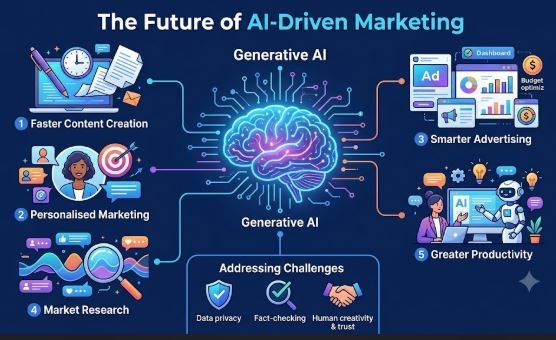
Generative AI is reshaping the American marketing industry by changing how businesses create content, understand customers, develop advertising campaigns and make marketing decisions. What once required large teams, lengthy production schedules and significant budgets can now be accomplished faster with AI-powered tools. From small businesses and startups to established enterprises, companies across the United States are increasingly using generative AI to improve marketing efficiency, reach customers more effectively and strengthen their competitive position.
The growing adoption of this technology is not simply about automating routine tasks. It is changing the way marketing strategies are developed, campaigns are managed and business growth opportunities are identified.
How Generative AI Is Changing Marketing Operations
1. Faster Content Creation and Lower Marketing Costs
Content production is one of the most visible areas where generative AI is making a difference. Businesses can use AI tools to develop advertising copy, social media posts, email campaigns, blog articles, product descriptions and promotional material within a shorter time.
For small businesses and startups, this offers a significant advantage. Companies with limited marketing budgets can produce more content without depending entirely on large creative teams or expensive external agencies. Marketing professionals can also spend less time on repetitive drafting and more time improving campaign quality, brand positioning and customer engagement.
2. Personalised Marketing and Better Customer Engagement
American businesses are increasingly focusing on personalised customer experiences. Generative AI helps marketers develop messages and promotional campaigns based on customer interests, shopping behaviour, browsing patterns and previous interactions.
For example, an online retailer can create different product recommendations and promotional messages for customers with different preferences. Similarly, financial service providers, travel companies and subscription-based businesses can tailor their communication to specific customer groups.
This approach helps businesses make their marketing more relevant, improve customer engagement and build stronger relationships with their audiences.
3. Smarter Advertising and Campaign Management
Generative AI is also changing how companies plan and manage digital advertising. Marketing teams can generate multiple versions of advertisements, headlines, product images and calls to action before launching a campaign.
By comparing campaign performance, businesses can identify which messages and creative formats attract more attention and generate better responses. This allows marketers to make quicker adjustments and allocate advertising budgets more effectively.
For companies investing heavily in digital advertising, better campaign management can help reduce wasted spending and improve the return on marketing investment.
4. Better Market Research and Customer Insights
Understanding customer expectations is essential for business growth. Generative AI can analyse large volumes of customer feedback, online reviews, survey responses and support conversations to identify common concerns, changing preferences and emerging market trends.
These insights help businesses understand why customers choose certain products, what influences their purchasing decisions and where existing services may be falling short.
For startups entering competitive markets, this information can support product development, pricing decisions and marketing strategies. Established businesses can use it to identify new customer segments and improve existing offerings.
5. Greater Productivity for Marketing Teams
Generative AI is gradually changing the responsibilities of marketing professionals. Instead of spending most of their time on repetitive content and administrative work, employees can use AI assistants to support research, creative development, campaign planning and performance analysis.
This is creating opportunities for smaller teams to manage a wider range of marketing activities. However, human expertise remains important for strategic decisions, creative direction, brand communication and understanding customer emotions.
How Different Business Sectors Can Benefit
Generative AI is not limited to advertising agencies or technology companies. Its applications are expanding across several industries.
- Retail and E-commerce: Businesses can create product descriptions, personalised promotions, shopping recommendations and customer communication to improve online sales and customer retention.
- Banking and Financial Services: Financial institutions can use AI to develop customer education material, personalise service communication and support marketing research, while maintaining appropriate data protection and regulatory controls.
- Healthcare: Healthcare organisations can prepare patient education content, improve service communication and develop targeted awareness campaigns. All health-related information requires appropriate professional review.
- Real Estate: Property businesses can create listing descriptions, promotional campaigns, virtual marketing material and location-specific content to attract potential buyers and tenants.
- Travel and Hospitality: Hotels, travel agencies and tourism companies can develop personalised travel promotions, destination content and customer engagement campaigns based on traveller interests.
- Manufacturing and B2B Services: Manufacturers and business service providers can use generative AI to prepare product information, technical marketing material, sales presentations and targeted communication for potential clients.
These applications demonstrate how generative AI can support both customer-facing activities and internal business operations.
Business Impact: New Opportunities for Companies and Startups
The growing use of generative AI is creating a new environment for the American marketing industry. One major benefit is the ability to achieve more with existing resources. Businesses can reduce the time required for content development, improve campaign productivity and manage multiple marketing channels more efficiently.
For startups and small businesses, the technology can lower some of the traditional barriers to entering competitive markets. Entrepreneurs can develop promotional campaigns, build their online presence and communicate with potential customers without immediately investing in large marketing departments.
It is also creating opportunities for specialised service providers. AI-powered marketing agencies, content development firms, automation consultants, creative studios and customer analytics companies can develop new services for businesses looking to modernise their marketing operations.
Another important development is the growing demand for professionals who understand both marketing and AI technology. Skills in AI-assisted content creation, data analysis, campaign optimisation, digital advertising and brand strategy are becoming increasingly valuable.
Challenges Businesses Need to Address
Despite its advantages, generative AI also presents challenges that businesses cannot ignore. AI-generated content may contain inaccurate information, lack originality or fail to reflect a company’s identity and communication style. Publishing unverified material can damage brand credibility and weaken customer trust.
Data privacy and copyright are other important concerns. Businesses must be careful about the customer information they share with AI platforms and ensure that their use of generated text, images and other creative material follows applicable rules and licensing requirements.
There is also a risk of excessive dependence on automation. When several companies use similar tools and prompts, their marketing content can begin to look repetitive. Human creativity, industry knowledge and editorial oversight remain essential to producing meaningful communication.
For American businesses, responsible AI adoption should therefore include clear usage policies, data protection measures, fact-checking procedures and human review of important marketing decisions.
The Future of AI-Driven Marketing in the United States
Generative AI is moving marketing beyond traditional content production towards more connected, responsive and customer-focused business strategies. Companies that combine AI capabilities with human creativity and sound business planning will be better positioned to adapt to changing consumer expectations.
The biggest opportunity is not simply producing more advertisements or social media posts. It is using technology to understand customers, make better decisions, improve operational efficiency and create measurable business value.
As adoption expands across industries, generative AI is likely to become an important part of everyday marketing operations in the United States. Businesses that approach it strategically, rather than treating it as just another automation tool, can gain a stronger competitive advantage while building more effective and lasting customer relationships.
