
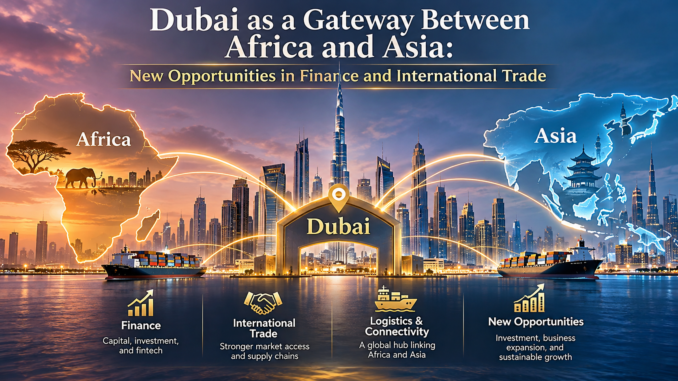
Nov 12: Dubai is becoming an important meeting point for businesses looking to expand between Africa and Asia. Its location, international transport links and established financial sector are making it easier for companies to explore new markets, build partnerships and manage cross-border trade.
The growing relationship between the two regions is creating opportunities for businesses across several industries. Asian manufacturers are looking at Africa’s expanding demand for machinery, technology, infrastructure equipment and consumer products. African companies, meanwhile, are seeking access to Asian suppliers, investment, technology and distribution networks.
Dubai offers a practical base for bringing these business interests together. With established ports, airports, free zones and financial institutions, the emirate can help companies manage trade operations and connect with partners across different markets.
Beyond the movement of goods, this growing relationship is also creating opportunities in trade finance, banking, fintech, logistics and international investment.
UAE’s Growing International Trade Strengthens Dubai’s Position
The UAE’s expanding trade activity highlights its growing importance in international commerce.
According to figures released by the UAE government on 8 November 2026, the country’s non-oil foreign trade reached AED 2.945 trillion during the first nine months of 2026, an increase of 10.1% compared with the same period in 2025.
Non-oil exports reached AED 706 billion, registering growth of 21.6%. Imports stood at AED 1.661 trillion, while re-exports totalled AED 578 billion.
The growth in exports and re-exports reflects the importance of the UAE’s international trade networks. Businesses are using the country to source products, manage distribution and connect with buyers and suppliers across different regions.
For companies based in Dubai, this creates opportunities in freight management, warehousing, sourcing, international payments and trade-related financial services.
The UAE’s Comprehensive Economic Partnership Agreements (CEPAs) are also helping strengthen its commercial relationships with international markets. These agreements aim to improve market access, reduce trade barriers and encourage investment between participating countries.
Why Dubai Is Becoming an Important Link Between Africa and Asia
Dubai’s location gives businesses an advantage when managing trade between Asian manufacturing centres and African markets. Its infrastructure makes this connection more practical for companies handling international shipments and regional distribution.
Jebel Ali Port, Jebel Ali Free Zone (Jafza), Dubai International Airport and the wider logistics network support the movement of goods through sea and air routes.
The Dubai Logistics Corridor connects Jebel Ali Port, Jafza and Al Maktoum International Airport, allowing businesses to coordinate different stages of their supply chains.
For Asian exporters, Dubai can serve as a distribution base for reaching African customers. African businesses can use the emirate to connect with Asian manufacturers, suppliers, financial institutions and international buyers.
This creates opportunities for freight forwarders, distributors, sourcing companies and logistics providers. Businesses also need customs assistance, warehousing, insurance and inventory management when operating across borders.
As trade between Africa and Asia grows, demand for these supporting services could increase.
Dubai’s Financial Sector Opens New Opportunities for International Business
Moving goods between countries is only one part of international trade. Businesses also need access to finance, reliable payment systems and banking services that can support transactions across different currencies and regulatory environments.
Dubai’s financial sector is becoming an important part of this process.
The Dubai International Financial Centre (DIFC) has developed into a major financial centre serving businesses across the Middle East, Africa and South Asia. Its community includes banks, investment firms, asset managers, insurance providers, fintech companies and professional services organisations.
DIFC’s 2025 annual results, released in February 2026, recorded 8,844 active companies, including 2,525 new active registrations during the year. The centre also reported 1,677 AI and fintech-focused organisations, representing 35% growth in 2025.
This expanding ecosystem creates opportunities for businesses involved in cross-border trade. Banks can provide working capital, letters of credit and foreign-exchange services, while fintech companies can develop solutions for international payments and financial management.
Investment firms and asset managers can also explore opportunities involving businesses and infrastructure projects across emerging markets.
For companies entering unfamiliar markets, access to experienced financial partners can make it easier to manage transactions and assess commercial risks.
Africa’s Trade Finance Gap Creates Opportunities for Dubai
Although trade between Africa and Asia offers considerable potential, access to finance remains a challenge for many African businesses.
Importers and exporters need working capital, trade credit, foreign-exchange facilities and reliable payment systems to complete international transactions. Smaller companies can find it particularly difficult to secure the financing required to participate in larger supply chains.
The African Development Bank’s report, Trade Finance Supply in Africa: Post-COVID Trends and Emerging Opportunities, released on 28 May 2026, highlights the scale of this problem.
The report estimates that unmet demand for trade finance in Africa ranged between US$74 billion and US$92 billion in 2024. The lower estimate represented approximately 5.4% of the continent’s total merchandise trade value.
It also found that commercial banks intermediated an average of 23% of Africa’s total trade between 2020 and 2024, compared with 40% during 2011–2019.
Foreign-exchange liquidity shortages were identified as the primary constraint to trade finance growth by 36% of surveyed banks. Only 28% of surveyed banks reported using digital tools or platforms for their trade finance operations.
These findings point to an opportunity for financial institutions and fintech companies operating in Dubai.
Banks and trade finance providers can explore partnerships with African financial institutions and businesses that need access to international markets. Services such as export financing, letters of credit, foreign-exchange facilities and supply chain finance could help address some of these requirements.
Fintech companies can also develop digital solutions that make payments and trade documentation easier to manage.
For Dubai-based financial institutions, the opportunity is to build commercially sustainable partnerships that support African businesses while accounting for country, currency and credit risks.
The findings also highlight why financial services need to grow alongside transport infrastructure. Shipping routes can connect markets, but businesses still need reliable financing and payment systems to complete transactions.
Financial Partnerships and Fintech Are Expanding Dubai’s Role
Dubai’s efforts to strengthen its international financial position received further attention during the inaugural Dubai Future Finance Week, held from 2 to 6 November 2026.
The event brought together financial institutions, regulators, investors and technology companies to discuss developments in banking, fintech, private markets, digital assets and Islamic finance.
According to DIFC’s announcement on 9 November, the event generated more than 80 partnerships covering corporate innovation, enterprise AI adoption, digital assets, cross-border technology corridors and Islamic finance.
For businesses involved in Africa-Asia trade, these developments are relevant because international transactions increasingly depend on technology and efficient financial systems.
Digital payment solutions, improved transaction processes and partnerships between financial institutions can help companies manage business across different countries.
Fintech companies may also find opportunities in trade documentation, payment processing, supply chain tracking and financial management.
New Shipping Connections Could Support Africa-Asia Trade
Reliable shipping connections are essential for businesses moving goods between Asian manufacturing centres and African markets. Freight costs, delivery times, port capacity and supply chain reliability can all influence the competitiveness of international trade.
DP World’s China Africa Link, announced in November 2026 and scheduled to begin in late November, is one development to watch. The weekly shipping service is designed to strengthen maritime connectivity between Chinese ports and important markets in East and Southern Africa.
The development reflects growing demand for more direct shipping connections between Asia and Africa.
Dubai’s established logistics network could create opportunities for shipping companies, freight forwarders, distributors and supply chain operators supporting these trade flows.
Companies operating from the emirate can provide freight coordination, inventory management, customs assistance and regional distribution services.
For exporters and importers, improved shipping connectivity could make it easier to plan deliveries, manage stock and reach new customers. The commercial benefits will depend on freight capacity, route economics, port efficiency and demand.
South-South Trade Creates Further Opportunities for Dubai
Another development shaping international commerce is the growing importance of trade between developing economies, commonly known as South-South trade.
DMCC’s Future of Trade 2026 report, titled Rebuilding Through Rupture, examines how global commerce is changing amid supply chain diversification, technological developments, tariff uncertainty and the energy transition.
For Dubai, this shift creates opportunities to connect businesses that are looking beyond traditional trade routes.
African demand for machinery, vehicles, infrastructure equipment, consumer products and technology can benefit Asian manufacturers. At the same time, African agricultural commodities, minerals and other resources remain important to Asian supply chains.
Dubai can help bring these commercial relationships together by providing access to sourcing networks, financing, logistics providers and international business partners.
Commodity traders, sourcing companies and distributors can use the emirate as a base to build relationships with suppliers and buyers across both regions.
Business Opportunities Across Finance, Logistics and International Trade
Dubai’s position between Africa and Asia is creating opportunities across several industries.
Trade finance and banking: Importers and exporters need working capital, letters of credit, foreign-exchange services and reliable payment solutions. Banks with cross-border capabilities can support companies managing transactions across different markets.
Logistics and supply chain management: Growing trade creates demand for freight forwarding, warehousing, inventory management, customs assistance and multimodal transportation. Companies offering integrated logistics services can support exporters, importers and distributors.
Commodity trading: Businesses dealing in metals, agricultural products, energy and industrial commodities can use Dubai’s trading ecosystem to connect suppliers, buyers and financing partners.
Technology and fintech: Digital payments, trade documentation platforms and supply chain tracking solutions can make international business more efficient. Fintech companies that understand the requirements of importers and exporters could find opportunities in this market.
Professional and business services: Companies entering new markets often need legal, tax, compliance, consulting and market-entry support. This creates opportunities for professional services firms with regional expertise.
Investment and wealth management: As businesses expand across emerging markets, demand for investment advisory, private capital and asset management services may also increase.
These opportunities are closely connected. A company setting up a distribution operation in Dubai, for example, may need banking facilities, insurance, logistics support, legal advice and digital payment services.
What Could Drive Dubai’s Africa-Asia Business Corridor Forward?
Dubai’s long-term role as an international trade gateway will depend on how effectively it helps businesses manage cross-border operations.
Trade agreements will remain important. The UAE’s expanding CEPA network is designed to improve market access and encourage stronger commercial relationships with participating countries.
Infrastructure investment will also matter. Better port facilities, airport connectivity, logistics technology and customs processes can make the movement of goods more efficient.
Financial innovation is equally important. Digital payment systems, fintech platforms and trade finance solutions could make international transactions easier, particularly for smaller companies seeking to enter new markets.
However, businesses should also consider the challenges. Differences in customs regulations, currency volatility, political and economic risks, infrastructure gaps and payment delays can complicate trade between African and Asian markets.
Companies using Dubai as a regional base will need reliable local partners, an understanding of market-specific regulations and a careful assessment of commercial risks.
Dubai’s Growing Role in the Future of International Trade
Dubai’s emergence as a gateway between Africa and Asia reflects a wider change in global commerce. Businesses are looking for new markets, more resilient supply chains and financial partners that can support operations across multiple regions.
The UAE’s non-oil foreign trade reaching AED 2.945 trillion during the first nine months of 2026, the expansion of DIFC’s financial ecosystem and new shipping connections between China and Africa all demonstrate the growing importance of international connectivity.
The African Development Bank’s findings on the continent’s trade finance gap add another dimension to this opportunity. Stronger financial partnerships and accessible funding solutions will be important if more African businesses are to participate in international supply chains.
For international companies, Dubai offers access to logistics infrastructure, financial services, investment networks and business support that can help coordinate expansion across emerging markets.
As trade relationships between Africa and Asia deepen, opportunities could increase in banking, trade finance, fintech, logistics, commodity trading and professional services. Companies that understand both markets and develop strong regional partnerships will be better positioned to benefit.
For businesses looking to enter these markets, international visibility and effective communication will also be important. Shreyas Webmedia Solutions can support companies through strategic digital marketing, business communication and media visibility initiatives as they pursue international opportunities.
