
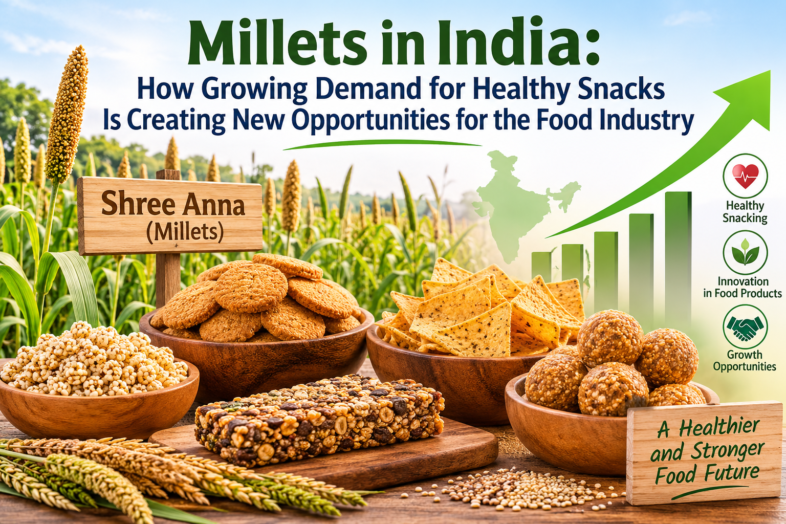
Nov 06: Millets are gaining renewed attention in India as consumers explore healthier alternatives to conventional snacks. Once associated primarily with traditional diets and rural food habits, millets are increasingly appearing in modern food products, including millet chips, cookies, breakfast cereals, energy bars, crackers and ready-to-eat snacks.
This shift is creating opportunities for food manufacturers, startups, nutrition brands, retailers and agricultural businesses. Government promotion, growing awareness of millet-based nutrition and changing snacking preferences are also contributing to the category’s expansion.
The growing use of millets in packaged snacks is particularly significant because it connects India’s traditional food crops with the fast-evolving convenience food market. Beyond everyday consumption, millet-based products are also finding their way into festive and corporate gift hampers, opening another potential market for food brands.
PM Modi’s Role in Bringing Millets into the Mainstream
Prime Minister Narendra Modi has been a prominent advocate of promoting millets, which are referred to as Shree Anna in the government’s public messaging. His efforts have focused on positioning these traditional grains as an important part of India’s nutrition, agricultural and food-processing priorities.
A major milestone came when India proposed the observance of 2023 as the International Year of Millets at the United Nations, which was subsequently adopted. The initiative helped bring international attention to millet cultivation, consumption and trade.
At the Global Millets (Shree Anna) Conference in March 2023, Modi highlighted the potential of millets to support small farmers, strengthen rural livelihoods and expand the market for processed food products. He also called for greater participation from food companies and startups, and discussed the importance of incorporating millets into public food programmes.
The government’s approach has since extended beyond awareness campaigns to supporting cultivation, processing, product development and marketing.
Government Incentives Are Supporting Millet-Based Food Products
One important policy measure is the Production Linked Incentive Scheme for Millet-Based Products (PLISMBP), designed to encourage food manufacturers to introduce millets into ready-to-eat and ready-to-cook products.
The scheme has an outlay of ₹800 crore. According to the Ministry of Food Processing Industries, ₹793.27 crore had been approved for 29 applicants, including eight large companies and 21 small and medium enterprises. The ministry also reported that sales of millet-based products by approved beneficiaries increased from ₹35 crore in 2020–21 to ₹814 crore in 2024–25.
The PM Formalisation of Micro Food Processing Enterprises (PMFME) scheme is another important support mechanism. It provides assistance to micro food-processing businesses, including millet-based enterprises, and supports branding, packaging, quality control and market access.
As of 31 December 2025, 4,612 micro food-processing enterprises working with millet products had received approval for assistance under the scheme, with subsidies totalling ₹91.20 crore.
These initiatives could help smaller manufacturers move beyond local sales and develop packaged products for wider domestic and international markets.
How Millets Are Entering India’s Snack Market
The growing use of millets in snacks reflects a shift in how traditional grains are being processed and marketed. Food companies are experimenting with familiar snack formats to make millet-based products more accessible to consumers.
Some emerging product categories include:
-
Millet chips and puffs: Made using ragi, jowar and bajra, these products offer alternatives to conventional potato- and corn-based snacks.
-
Millet biscuits and cookies: Ragi, bajra and other millet flours are being incorporated into sweet and savoury bakery products.
-
Roasted millet snacks: Popped, puffed and roasted grains are being positioned as convenient options for everyday snacking.
-
Energy bars and nutrition bites: Millets are combined with nuts, seeds, dates and jaggery to create portable snack products.
-
Millet crackers and namkeen: Traditional savoury snack formats are being adapted with millet-based ingredients.
-
Breakfast and ready-to-eat products: Millet flakes, breakfast mixes and instant preparations are gaining attention among consumers looking for convenient food choices.
Research institutions are also contributing to product innovation. ICAR’s Central Institute of Agricultural Engineering in Bhopal has developed a range of millet-based products, including jaggery biscuits, roasted snacks, millet chikkis and traditional sweets. The institute has reported that some products have already been commercialised through industry partnerships.
India’s Millet Production Creates a Strong Foundation for Growth
India’s position as a leading millet producer gives the food-processing industry access to a substantial domestic agricultural base. According to the Agricultural and Processed Food Products Export Development Authority (APEDA), India’s millet production was estimated at 18.59 million tonnes in 2024–25.
Rajasthan, Maharashtra, Karnataka and Uttar Pradesh are among the major producing states. Bajra, jowar and ragi remain important crops, alongside smaller varieties such as foxtail, kodo and barnyard millet.
The availability of different varieties allows manufacturers to experiment with ingredients, flavours and product formats. It also creates opportunities to connect farmers with food processors through procurement partnerships, farmer producer organisations (FPOs) and local processing units.
For farmers, increased demand from the packaged food industry could create additional markets beyond traditional grain sales. However, stable procurement arrangements and fair pricing will be important to ensure that the benefits reach agricultural producers.
Opportunities for Startups and Food Manufacturers
The growing millet-snack category presents opportunities across India’s food and agriculture value chain.
Startups can develop products targeting consumers looking for convenient snacks with familiar Indian ingredients. Established food companies can expand their portfolios by introducing millet-based versions of popular products, while small manufacturers can focus on regional recipes and locally sourced grains.
Some promising business opportunities include:
-
Healthy snacking brands: Developing millet chips, cookies, crackers and roasted snacks.
-
Food processing: Setting up facilities for cleaning, grading, milling, puffing and packaging millets.
-
Ingredient innovation: Creating millet flour blends and ready-to-use ingredients for bakeries and food manufacturers.
-
Traditional food products: Modernising laddoos, chikkis, savoury mixes and regional millet-based recipes.
-
Retail and e-commerce: Building distribution channels for millet snacks through supermarkets, specialty stores and online platforms.
-
Exports: Developing packaged millet products for international consumers interested in alternative grains and convenient foods.
The opportunity is not limited to premium urban markets. Affordable products, regional distribution and smaller pack sizes could help manufacturers reach a broader consumer base.
Millet-Based Snacks Enter India’s Festive and Corporate Gifting Market
The growing interest in healthier food choices is beginning to influence India’s festive and corporate gifting market. Millet-based snacks are emerging as an alternative addition to conventional gift hampers, which traditionally feature sweets, chocolates, dry fruits and packaged treats. Products such as ragi cookies, jowar crackers, roasted bajra snacks, millet chikkis and energy bars are offering gifting companies and food brands new ways to diversify their collections.
This trend could create additional demand during Diwali, New Year, weddings, corporate celebrations and employee appreciation programmes. Businesses can curate customised hampers featuring millet-based snacks alongside nuts, seeds, traditional sweets and other locally sourced products. For companies looking to introduce wellness-oriented gifts, these assortments provide an opportunity to combine contemporary presentation with traditional Indian ingredients.
Corporate gifting companies can also collaborate with regional food brands and small manufacturers to develop customised snack boxes and festive collections. Attractive packaging, product variety, shelf life and affordability will be important considerations when positioning millet-based products in the premium gifting segment.
The development also opens another distribution channel for millet-based food startups, women-led enterprises, farmer producer organisations and local food-processing businesses. Instead of depending entirely on supermarket shelves and online grocery platforms, manufacturers can explore bulk corporate orders, festive gift collections and customised hampers.
As Prime Minister Narendra Modi’s promotion of Shree Anna continues to bring attention to India’s traditional grains, their inclusion in gift hampers could help make millets more familiar to consumers. Beyond everyday snacking, gifting may become another avenue through which millet-based products reach households, workplaces and business networks.
Consumer Awareness and Taste Will Determine Market Growth
Despite growing interest in millets, wider adoption will depend on more than nutritional awareness. Taste, texture, price, convenience and availability will influence whether consumers make millet snacks a regular part of their diets.
Manufacturers must therefore focus on product quality rather than relying entirely on health-related marketing. A millet-based snack needs to deliver an enjoyable eating experience while offering a clear ingredient and nutritional proposition.
There is also a need for transparent labelling. Consumers should be able to understand the millet content, ingredients, serving size and nutritional information. Products marketed as healthier alternatives must also pay attention to salt, sugar, oil and overall nutritional composition.
Millets can contribute valuable nutrients and dietary fibre, but the nutritional quality of a finished snack depends on its complete formulation and processing method.
Challenges Facing India’s Millet-Based Snack Industry
The sector has considerable potential, but several issues could influence its expansion.
First, millet varieties differ in taste, texture, processing requirements and availability. Manufacturers need consistent raw material supplies and suitable processing technologies to maintain product quality.
Second, millet-based products can face pricing challenges when compared with established mass-market snacks. Processing, packaging, distribution and consumer education can add to production costs.
Third, the category needs stronger branding and wider retail availability. Consumers may be interested in trying millet snacks but are less likely to purchase them regularly if products are difficult to find or significantly more expensive than alternatives.
Food companies must also ensure compliance with food safety and labelling requirements. Building consumer trust through quality control and transparent communication will be essential for long-term growth.
The Future of Millet Snacks in India
India’s millet movement is gradually moving from agricultural awareness and traditional consumption towards product innovation and commercialisation. The growing presence of millet-based snacks demonstrates how traditional crops can be adapted to modern food preferences.
Government initiatives associated with Shree Anna, the International Year of Millets and food-processing incentives have helped create greater visibility for the category. Meanwhile, research institutions, startups and established manufacturers are exploring new ways to incorporate millets into everyday food products.
The emergence of millet-based gift hampers adds another dimension to this evolving market. By bringing traditional grains into festive celebrations, corporate gifting and premium food collections, manufacturers can explore additional revenue channels while introducing these products to new consumers.
Prime Minister Narendra Modi’s advocacy has helped bring millets into wider public and policy discussions. The next phase of growth will depend on how effectively this awareness translates into regular consumer demand, stronger processing infrastructure and sustainable market opportunities for farmers.
As India’s packaged food industry continues to explore healthier and more diverse ingredients, millet-based snacks could become an increasingly visible segment. Their long-term success, however, will depend on a combination of affordability, taste, product quality, innovation and reliable supply chains.
