
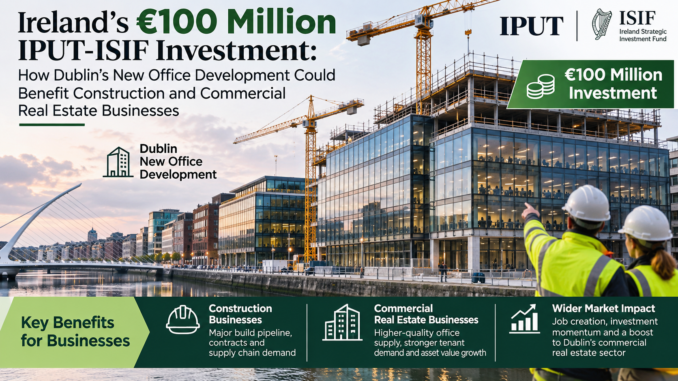
Nov 17: Ireland’s commercial real estate sector is receiving a significant boost following a €100 million investment commitment from the Ireland Strategic Investment Fund (ISIF) into IPUT Real Estate. The funding will support the redevelopment of 29 Earlsfort Terrace in Dublin, marking the first phase of a broader €500 million office development programme aimed at expanding the city’s premium commercial workspace.
Announced on November 2, 2026, the investment highlights renewed institutional confidence in Dublin’s prime office market. It also creates potential opportunities for construction companies, engineering firms, architecture practices, building material suppliers and commercial property service providers.
As businesses continue to seek modern, sustainable and well-connected office environments, the project could contribute to a new phase of activity across Ireland’s construction and commercial real estate industries.
Understanding the €100 Million IPUT-ISIF Investment
The €100 million commitment will be provided by ISIF as new equity in IPUT Real Estate to fund the development of 29 Earlsfort Terrace in Dublin 2.
The project forms part of IPUT’s wider €500 million investment plan to expand its Grade A+ office portfolio. The company’s development pipeline also includes the redevelopment of The Charlotte Building on Harcourt Street.
Together, the two planned office developments have planning permission for approximately 350,000 square feet of office space.
IPUT has also confirmed that it has appointed a main contractor for 29 Earlsfort Terrace, with construction expected to begin before the end of 2026.
The investment builds on an established relationship between the two organisations. ISIF previously participated as an anchor investor, alongside CBRE Investment Management, in IPUT’s Nexus Logistics Fund, which secured €115 million in a capital raise in 2025.
According to IPUT, the company raised more than €400 million in new equity during 2026 and recently secured €300 million in revolving credit facilities from ABN AMRO, Bank of Ireland and ING.
This combination of institutional investment and financing activity reflects continued interest in high-quality commercial property assets in Dublin.
How the Development Could Benefit Ireland’s Construction Industry
The redevelopment of 29 Earlsfort Terrace could generate opportunities across several segments of Ireland’s construction ecosystem. Although the €100 million investment is intended to fund the development rather than represent a direct allocation to individual suppliers, the construction phase could create demand for specialist contractors and supporting businesses.
1. Opportunities for Construction Contractors
Large-scale office redevelopment projects require coordination between main contractors, subcontractors and specialist service providers.
Civil engineering companies, structural contractors, electrical specialists, plumbing businesses and interior fit-out providers could find opportunities as the development progresses.
The appointment of a main contractor is an important step towards construction commencement. It also signals the potential for a wider network of suppliers and service providers to participate in the project.
For smaller construction businesses, opportunities may emerge through subcontracting arrangements, specialist installations and project-related services.
2. Demand for Sustainable Building Materials
Commercial property developers are increasingly focusing on energy efficiency, building performance and sustainability.
The redevelopment of prime office properties provides opportunities for businesses supplying energy-efficient glazing, insulation, ventilation systems, low-carbon construction materials and smart building technologies.
Companies specialising in sustainable building solutions could benefit from the growing emphasis on creating workplaces that meet modern environmental and operational requirements.
For Ireland’s building materials industry, projects of this nature also highlight the importance of innovation and the ability to supply materials that support higher-performance commercial buildings.
3. Engineering and Smart Building Technology
Modern office developments increasingly depend on integrated building systems to improve energy management, security, connectivity and workplace efficiency.
This creates potential demand for mechanical and electrical engineering firms, building automation specialists, cybersecurity providers and companies offering intelligent energy management systems.
As commercial tenants place greater emphasis on workplace technology, suppliers that can integrate digital infrastructure with building operations could become increasingly important to the commercial construction market.
How Dublin’s Office Market Could Benefit
The investment also comes at a time when demand for premium office accommodation is becoming an important consideration for Dublin’s commercial property market.
According to IPUT, demand for high-quality, well-equipped workplaces from international and domestic businesses continues to outpace the availability of prime office space.
The company’s existing portfolio includes 30 prime assets covering more than two million square feet in Dublin city centre. Its development strategy aims to address the shortage of modern office accommodation while attracting businesses seeking strategically located workplaces.
Several business segments could benefit from this market activity.
1. Commercial Property Management
New office developments create demand for property management, facilities management, maintenance and building operations services.
Companies offering integrated property management solutions could benefit from the need to maintain modern commercial buildings and provide efficient services to corporate tenants.
2. Office Interior and Workspace Design
The growing preference for flexible and collaborative workplaces could create opportunities for interior designers, office furniture manufacturers, workplace consultants and fit-out companies.
Businesses offering modular office layouts, ergonomic furniture, acoustic solutions and energy-efficient lighting may find opportunities as developers and tenants look to improve workplace functionality.
3. Commercial Leasing and Real Estate Advisory
Additional Grade A office space could also support activity among commercial property agents, leasing consultants, valuation specialists and real estate advisory firms.
As new developments enter the market, businesses will need support with tenant acquisition, property valuations, lease negotiations and investment planning.
The availability of modern office space could also strengthen Dublin’s appeal to international companies evaluating expansion opportunities in Ireland.
Why International Businesses Continue to Matter to Dublin’s Office Market
Dublin remains an important European business location, particularly for companies operating in technology, financial services, professional services and international business operations.
For these organisations, access to modern office infrastructure, skilled talent, transport connectivity and established business networks can influence decisions about where to establish or expand operations.
The development of 29 Earlsfort Terrace could contribute to this business environment by adding premium office accommodation in Dublin 2.
The wider implications extend beyond the property market. More commercial office capacity could support business expansion, professional employment and demand for services such as corporate facilities management, IT infrastructure, workplace security and commercial maintenance.
However, the actual impact will depend on construction timelines, tenant demand, leasing activity and broader economic conditions.
IPUT’s €500 Million Development Pipeline Signals Longer-Term Opportunities
The €100 million ISIF commitment is particularly significant because it forms part of a larger development strategy rather than an isolated property transaction.
IPUT’s planned €500 million office development programme includes 29 Earlsfort Terrace and The Charlotte Building on Harcourt Street. The two developments have planning permission for a combined 350,000 square feet.
The company intends to follow the approach established at Wilton Park, its 600,000-square-foot Dublin office development, which accommodates international businesses including EY, LinkedIn and Stripe.
This approach places emphasis on sustainable workplaces, modern amenities and people-centred design.
For construction and real estate businesses, the wider pipeline could offer opportunities extending beyond the initial development.
Potential areas of activity include:
-
Construction and specialist contracting.
-
Sustainable building materials and energy-efficient systems.
-
Commercial architecture and engineering.
-
Office interiors and workplace technology.
-
Property management and facilities services.
-
Commercial leasing and real estate consultancy.
The scale of the proposed programme could also encourage specialist suppliers to strengthen their capabilities to serve institutional property developers.
What the Investment Means for Ireland’s Commercial Real Estate Outlook
The partnership between IPUT and ISIF reflects the importance of institutional capital in supporting large-scale commercial property development.
For Ireland, investment in modern office infrastructure can help address the availability of premium workspace while supporting the country’s attractiveness to international businesses.
It also demonstrates how public investment capital can work alongside private property developers to advance projects with wider economic relevance.
Nevertheless, the expansion of office supply will need to be supported by sustained occupier demand. Businesses are increasingly evaluating workplace costs, flexibility, sustainability and the long-term value of physical office space.
Consequently, developers and construction companies will need to focus on buildings that offer more than additional floor space. Energy performance, digital connectivity, employee facilities and efficient building operations are likely to remain important considerations.
Conclusion: A New Opportunity for Dublin’s Construction and Property Businesses
Ireland’s €100 million IPUT-ISIF investment represents an important development for Dublin’s commercial real estate market. By supporting the redevelopment of 29 Earlsfort Terrace, the funding will help advance IPUT’s wider €500 million office development strategy.
For construction contractors, engineering companies, building material suppliers and commercial property service providers, the project could create opportunities across multiple stages of development and building operations.
More broadly, the investment highlights the role of modern office infrastructure in supporting business expansion and attracting international investment.
As Dublin continues to develop its premium commercial property portfolio, companies offering sustainable construction solutions, advanced building technologies and integrated workplace services could be well positioned to benefit from the next phase of Ireland’s real estate development.
