
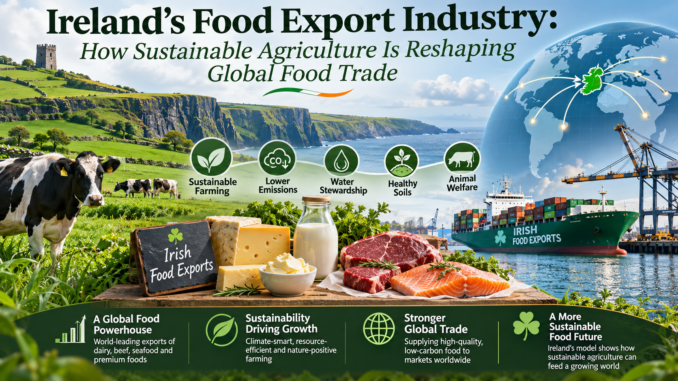
Nov 16: Ireland has established a strong position in international food markets, particularly in dairy, beef, seafood and prepared food products. However, as global buyers become more conscious of how food is produced, sourced and packaged, the country’s agricultural industry is facing new expectations.
Today, producing high-quality food is only part of the equation. Farmers and food manufacturers are also expected to improve resource efficiency, reduce environmental impacts and provide greater transparency across their supply chains.
For Ireland, this shift is creating opportunities to strengthen its international reputation while adapting to changing trade requirements. From sustainable dairy production to recyclable packaging and digital traceability, environmental responsibility is becoming an increasingly important part of the country’s food export strategy.
Ireland’s Food Exports Reach a Record €19 Billion
Ireland’s food, drink and horticulture exports reached a record €19 billion in 2025, representing a 12% increase compared with the previous year, according to Bord Bia’s Export Performance and Prospects 2025–2026 report.
Dairy remained the country’s largest export category, with overseas sales increasing by 14% to €7.3 billion. Meat and livestock exports rose by 18% to just over €5 billion, while prepared consumer foods increased by 9% to €3.6 billion. Seafood exports also grew by 9% to €635 million.
The European Union accounted for €7.1 billion, or 37% of total exports. The United Kingdom remained Ireland’s largest individual export market, with sales reaching €6.7 billion. International markets outside the EU and UK contributed approximately €5.2 billion.
These figures underline the importance of international trade to Ireland’s agri-food industry. However, higher prices, particularly for beef and dairy, also contributed to the increase in export value. This means future growth will depend on more than market demand. Productivity, production costs, product quality and the ability to meet changing buyer expectations will also matter.
How Sustainable Agriculture Is Changing Irish Food Production
Sustainability is becoming an important consideration for Irish farmers and food manufacturers.
Agricultural businesses are exploring ways to maintain production while making better use of land, water, energy and other resources. The objective is to reduce environmental pressures without compromising the quality and reliability of Irish food products.
Some of the key areas receiving attention include:
- Lower-emission farming: Improving livestock management, fertiliser application and manure management to reduce greenhouse gas emissions.
- Soil health: Adopting better land management practices to maintain soil fertility and support long-term productivity.
- Water management: Improving nutrient management and protecting water quality.
- Renewable energy: Exploring solar power and energy-efficient equipment for farms and processing facilities.
- Biodiversity: Protecting hedgerows, habitats and other natural features that support agricultural ecosystems.
These developments are particularly important for Ireland’s dairy and beef industries, which account for a significant share of its food exports.
For farmers, however, adopting sustainable practices must also make commercial sense. Investments in new technologies, equipment and production methods need to support farm productivity and income while delivering measurable environmental improvements.
Origin Green Is Helping Irish Food Businesses Strengthen Their Sustainability Credentials
One of Ireland’s best-known initiatives in this area is Origin Green, a sustainability programme operated by Bord Bia.
The programme brings together farmers, food manufacturers, retailers and foodservice businesses to encourage measurable improvements across the food supply chain.
Rather than relying on broad environmental claims, Origin Green focuses on setting sustainability targets and monitoring progress in areas such as emissions, energy consumption, water management, waste reduction and responsible sourcing.
Bord Bia reports that the programme works with more than 77,000 farmers and over 350 Irish food and drink companies.
Its approach includes sustainability measurement at farm and company levels. Participating farms are assessed through relevant Bord Bia quality assurance and sustainability schemes, while food manufacturers develop sustainability plans that are independently verified.
For international buyers, this type of measurement can provide useful information when evaluating suppliers and their production practices.
However, participation in Origin Green should not automatically be interpreted as a guarantee that every individual product is certified sustainable. Its broader purpose is to encourage participating businesses to measure, monitor and improve their sustainability performance.
Irish Food Companies Are Making Sustainability a Business Priority
The shift towards sustainable food production is not limited to government initiatives. Established Irish food businesses are also incorporating environmental and responsible business practices into their commercial strategies.
Ornua, Ireland’s largest dairy exporter and the company behind the Kerrygold brand, provides one example. In 2024, the company introduced its Common Ground environmental, social and governance strategy, covering three areas: Planet, People and Products.
In May 2025, Ornua was recertified with the Business Working Responsibly Mark by Business in the Community Ireland. The recognition followed an independent assessment of its responsible business practices, governance and sustainability performance.
For an international dairy exporter, such initiatives are relevant because sustainability increasingly extends beyond the farm. Processing operations, sourcing, packaging, business practices and relationships with suppliers all contribute to the overall performance of the supply chain.
Kerry Group offers another example of how Irish food businesses are addressing environmental priorities. Its 2025 Annual Report, under the Beyond the Horizon sustainability strategy, reported a 52% reduction in Scope 1 and Scope 2 emissions compared with its 2017 baseline, alongside a 10% reduction in Scope 3 emissions compared with its 2022 baseline.
The company also reported progress in water efficiency and responsible sourcing.
These examples show how sustainability is becoming part of business planning and operational management. For exporters, demonstrating measurable progress can support discussions with customers who increasingly want information about the environmental performance of their suppliers.
Teagasc’s Roadmaps Support the Future of Irish Agriculture
Research and innovation will play an important role in helping Ireland’s agricultural industry adapt.
Teagasc, the country’s Agriculture and Food Development Authority, supports farmers and food businesses through research, education and advisory services.
Its Teagasc Road Map Series 2030 – Overview of Irish Agriculture and Food, published in February 2026, examines the future direction of several agricultural sectors, including dairy, beef, sheep, pigs, tillage, horticulture, forestry and food.
The roadmaps consider market developments, sustainability priorities, production challenges and future opportunities.
They also highlight the importance of international markets to Ireland, with more than 85% of agricultural production exported.
For farmers and food businesses, these roadmaps offer useful insight into how changing market requirements, environmental priorities and new production methods could influence future decisions.
The focus is not simply on producing more food, but on building an agricultural industry that can remain productive and competitive over the long term.
New EU Packaging Rules Could Affect Irish Food Exporters
Sustainable agriculture is only one part of the transition taking place across the food industry. Packaging is also becoming an important consideration for businesses selling products in international markets.
A significant development for Irish exporters is the European Union’s Packaging and Packaging Waste Regulation (PPWR), which began applying on 12 August 2026.
The regulation establishes common requirements for packaging placed on the EU market, with the broader objective of reducing packaging waste, improving recycling and supporting a circular economy.
One immediate consideration for food businesses is the restriction on food-contact packaging containing per- and polyfluoroalkyl substances (PFAS) above specified limits.
Further requirements will be introduced in stages. These include harmonised packaging labels from 2028 and additional measures relating to recyclability, recycled plastic content and packaging waste reduction from 2030.
For Irish food exporters, this creates a practical business consideration. Companies supplying dairy products, meat, seafood, beverages and prepared foods may need to review their packaging materials, supplier arrangements and compliance processes.
It also creates opportunities for packaging manufacturers, material science companies and technology providers developing recyclable, reusable and lower-impact packaging solutions.
Businesses that prepare early may be better positioned to manage compliance costs and respond to evolving customer requirements.
Why Global Food Buyers Are Paying More Attention to Sustainability
International food buyers are increasingly interested in understanding how products are sourced, processed and transported.
Retailers, food manufacturers and foodservice companies need reliable information about their suppliers, including product origin, traceability and environmental performance.
For Irish exporters, this means that product quality and competitive pricing increasingly need to be supported by transparent production practices.
There are several ways this could benefit the country’s food industry.
Better supply-chain transparency: Traceability systems can help buyers understand where products originate and how they move through the supply chain.
Stronger business relationships: Consistent quality, reliable deliveries and credible sustainability information can help exporters build lasting relationships with international customers.
Product differentiation: Verified information about production methods and quality assurance can help Irish food businesses communicate their strengths in competitive markets.
Changing buyer requirements: Suppliers that can provide reliable evidence of their practices may be better prepared to respond to evolving procurement and sourcing expectations.
However, sustainability alone does not guarantee higher export prices or access to international markets. Irish producers must continue to compete on product quality, pricing, logistics and regulatory compliance.
Technology Is Creating New Opportunities for Irish Agribusinesses
The move towards sustainable food production is also opening up opportunities for technology companies and agricultural service providers.
Farmers and food processors are increasingly exploring digital tools that can help them monitor operations, manage resources and make better-informed decisions.
Some emerging business opportunities include:
- Precision agriculture: Technologies that help farmers apply fertilisers and other inputs more efficiently.
- Farm management software: Digital platforms for tracking production, recording performance and managing compliance.
- Livestock monitoring: Connected devices and data analytics that support animal monitoring and farm management.
- Renewable energy solutions: Solar installations and energy management systems for farms and food processing facilities.
- Food traceability: Digital tools that help businesses track products from farms to processing facilities and export destinations.
- Sustainable packaging: New materials and packaging technologies that help food manufacturers respond to environmental and regulatory requirements.
- Food waste management: Technologies that help processors reduce waste and make better use of agricultural by-products.
For startups and established technology companies, Ireland’s agri-food sector offers opportunities to develop solutions for real challenges across farming, processing, packaging and distribution.
Businesses that can combine technology with practical improvements in productivity and sustainability could become valuable partners to farmers and food manufacturers.
What Does This Mean for Ireland’s Position in Global Food Trade?
Ireland’s international food trade depends on its ability to maintain product quality, supply reliability and competitive pricing.
Its established dairy, beef and prepared food sectors provide a strong foundation. However, international competition, climate pressures and changing consumer expectations mean that traditional strengths alone may not be enough.
Sustainable agriculture can help exporters respond to these developments by improving resource efficiency, supporting traceability and providing more transparent information about production practices.
The growing importance of packaging regulations also means that exporters must look beyond the farm and consider the entire product journey, from raw material sourcing to processing, packaging and distribution.
For international buyers, the ability to assess sustainability alongside product quality, price and delivery reliability is becoming an increasingly relevant part of supplier selection.
The Road Ahead
Ireland’s food export industry is entering a period in which agricultural sustainability and international competitiveness are becoming closely connected.
The record €19 billion export performance in 2025 demonstrates the strength of the sector. At the same time, initiatives such as Origin Green, company-level sustainability programmes and the Teagasc Road Map Series 2030 show how the industry is preparing for changing environmental and commercial expectations.
New EU packaging requirements add another dimension, making sustainability relevant not only to agricultural production but also to food processing, packaging and export compliance.
The transition will require continued investment in agricultural research, farm-level improvements, technology and supply-chain transparency.
For Irish farmers, food manufacturers and exporters, sustainability is no longer just an environmental consideration. It is becoming an important part of building resilient businesses and maintaining a strong position in international markets.
As global food trade continues to evolve, Ireland’s ability to combine agricultural expertise, product quality and measurable sustainability improvements could help shape the next chapter of its food export industry.
