
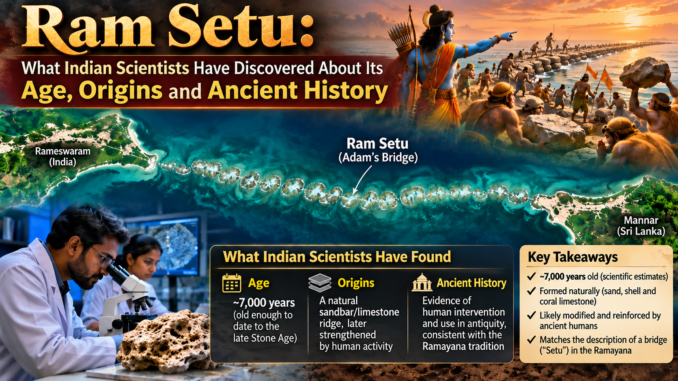
Nov 13: Ram Setu, the fascinating chain of shoals connecting India and Sri Lanka, is attracting renewed attention from travellers, historians and scientists. Associated with the Ramayana and the journey of Lord Rama to Lanka, this geographical formation has long been an important part of India’s cultural and religious heritage.
Also known as Adam’s Bridge, Ram Setu is now drawing interest for another reason: scientific investigations into its geological origins, underwater structure and possible connection with ancient human activity.
Could this formation be older than the Egyptian pyramids? What have Indian scientists discovered through modern satellite technology? And why are there continuing efforts to protect Ram Setu?
These questions are adding a new dimension to travel around Rameswaram, where visitors can explore not only an important pilgrimage destination but also a fascinating landscape shaped by geography, history and cultural traditions.
Ram Setu: A Unique Geographical Formation Between India and Sri Lanka
Ram Setu, also known as Adam’s Bridge, is a chain of shallow sandbanks and submerged reef-like formations extending between Pamban Island near Rameswaram in Tamil Nadu and Mannar Island in Sri Lanka.
The formation is approximately 48 kilometres long according to commonly cited geographical descriptions, although a 2024 scientific study examined a roughly 29-kilometre stretch between Dhanushkodi and Talaimannar.
According to the Ramayana, Lord Rama’s army, led by Nala, constructed a bridge across the sea to reach Lanka in search of Sita. This association has made Ram Setu an important destination of religious and cultural interest.
Its unusual geographical structure has also attracted researchers interested in understanding how the formation developed and how changing sea levels and marine processes influenced the region.
For travellers visiting Rameswaram, the surrounding landscape offers an opportunity to experience a destination where mythology, coastal geography and natural beauty come together.
Is Ram Setu Older Than the Egyptian Pyramids?
One of the most widely discussed questions about Ram Setu concerns its possible age.
The Great Pyramid of Giza in Egypt was constructed approximately 4,500 years ago, around 2600 BCE. Claims that Ram Setu could be significantly older have generated considerable public interest.
However, establishing the age of a geological formation is different from dating a monument constructed by humans.
Scientists need to examine the age of the rocks, coral deposits and sediments, determine when the formation developed and investigate whether archaeological evidence of human construction exists.
At present, no conclusive scientific evidence establishes that Ram Setu is a human-built structure older than the Egyptian pyramids.
Its geological history, however, remains an important subject for further investigation. This makes the region particularly interesting for travellers who enjoy exploring destinations with connections to ancient history and ongoing scientific discoveries.
What Have Indian Scientists Discovered About Ram Setu?
Scientific investigations have gradually improved the understanding of Ram Setu’s underwater structure. Two research developments are particularly important.
Geological Survey of India Investigations
The Geological Survey of India (GSI) conducted investigations around Mandapam, Rameswaram, Dhanushkodi and Adam’s Bridge during 2003–2004 and 2004–2005.
A Rajya Sabha response from the Ministry of Earth Sciences dated March 19, 2018, highlighted several findings.
The investigations identified Rameswaram Island as a coral island estimated to be approximately 125,000 years old. Researchers also examined sandy islands associated with Adam’s Bridge, identifying marine shells and different sediment compositions.
Drilling at Old Dhanushkodi provided information about geological events extending approximately five million years into the past.
The GSI also clarified that its investigations had not identified evidence of man-made structures in the examined seabed and subsurface areas.
These findings help explain the geological evolution of the region, although they do not establish the age of Ram Setu as a human-built structure.
NASA Satellite Technology Provides New Insights
A significant development came in June 2024, when Indian researchers published a study in the peer-reviewed journal Scientific Reports, part of the Nature portfolio.
The study, titled Physical Features of Adam’s Bridge Interpreted from ICESat-2 Based High-Resolution Digital Bathymetric Elevation Model, used measurements from NASA’s ICESat-2 satellite mission.
Researchers analysed approximately 200,000 laser-return measurements to develop an underwater elevation model with a spatial resolution of 10 metres.
The findings revealed several interesting characteristics:
- Adam’s Bridge is largely submerged beneath shallow and super-shallow waters.
- Approximately 99.98% of its calculated volume lies below mean sea level.
- Its estimated overall volume is approximately one cubic kilometre.
- The formation shows variations in underwater slopes and seabed elevation.
The research offers a more detailed understanding of the physical structure of Adam’s Bridge and demonstrates how satellite technology can support marine and geographical investigations.
However, the study did not establish that the formation was constructed by humans or determine its age in relation to the Ramayana.
Exploring Rameswaram: Places to Visit Around Ram Setu
For travellers interested in discovering Ram Setu, Rameswaram offers several attractions that combine religious tourism, coastal landscapes and historical significance.
1. Dhanushkodi: Where the Land Meets the Sea
Dhanushkodi is among the most fascinating places to visit near Ram Setu. Located at the southeastern end of Rameswaram Island, this coastal destination is known for its dramatic meeting of waters, sandy stretches and remains of an abandoned settlement.
The town was devastated by the 1964 cyclone, leaving behind the ruins of its railway station, church and other buildings.
Today, Dhanushkodi attracts travellers interested in photography, coastal landscapes and history. It is also one of the closest accessible locations from which visitors can experience the geographical setting of Adam’s Bridge.
2. Ramanathaswamy Temple: An Important Pilgrimage Destination
The Ramanathaswamy Temple is one of the most significant religious attractions in Rameswaram.
Dedicated to Lord Shiva, the temple is renowned for its elaborate corridors, impressive architectural features and sacred water tanks known as theerthams.
Its association with the Ramayana makes it an important stop for pilgrims exploring the religious history connected with Lord Rama’s journey.
The temple also attracts visitors interested in traditional Dravidian architecture and India’s historic pilgrimage routes.
3. Pamban Bridge: A Remarkable Engineering Landmark
The Pamban Bridge is another attraction that adds to Rameswaram’s tourism appeal.
The historic railway bridge connects mainland India with Rameswaram Island and offers impressive views of the surrounding sea.
The newer Pamban rail bridge has added another engineering attraction to the region. Travellers interested in infrastructure, engineering and coastal photography can include the area in their itinerary.
4. Gulf of Mannar Marine National Park: Discovering Marine Biodiversity
The Gulf of Mannar Marine National Park is an important ecological attraction near the Ram Setu region.
The area is known for its marine biodiversity, coral reefs, seagrass beds, mangroves and diverse marine species.
Its ecological importance makes it particularly relevant to discussions about Ram Setu’s conservation.
Travellers interested in marine ecosystems can explore authorised visitor activities and interpretation facilities, subject to local regulations and conservation restrictions.
5. APJ Abdul Kalam Memorial
The Dr APJ Abdul Kalam National Memorial is another destination worth including in a Rameswaram itinerary.
Dedicated to India’s former President and renowned scientist Dr APJ Abdul Kalam, the memorial showcases aspects of his life, achievements and contributions to science and technology.
It provides an educational experience for families, students and visitors interested in India’s scientific achievements.
How to Plan a Rameswaram and Ram Setu Trip
Rameswaram can be explored through a combination of religious tourism, coastal sightseeing and visits to nearby historical attractions.
A suggested two-day itinerary could include:
| Day | Places to explore |
|---|---|
| Day 1 | Ramanathaswamy Temple, Pamban Bridge and Dr APJ Abdul Kalam Memorial |
| Day 2 | Dhanushkodi, coastal viewpoints and authorised Gulf of Mannar visitor attractions |
Best time to visit: October to March is generally a comfortable period for exploring Rameswaram and its surrounding coastal attractions.
How to reach:
- By air: Madurai Airport is a commonly used airport for reaching Rameswaram.
- By train: Rameswaram Railway Station connects the island with several Indian cities.
- By road: Rameswaram is connected to mainland Tamil Nadu through the Pamban road bridge.
Important travel note: Ram Setu is largely submerged, and visitors cannot freely walk across the formation to Sri Lanka. Access to Dhanushkodi’s coastal areas can also be subject to weather, safety and local administration restrictions. Check local travel advisories before visiting.
How Ram Setu Could Influence India’s Heritage Tourism Industry
Ram Setu offers an interesting opportunity for India’s tourism industry because its appeal extends beyond religious travel.
The growing interest in its scientific origins could encourage a broader form of tourism that combines history, education, geography and cultural exploration.
Several opportunities could emerge:
- Educational tourism: Schools and universities could develop learning visits focusing on marine geography, satellite research and India’s cultural history.
- Religious tourism: Rameswaram could attract additional visitors interested in exploring locations associated with the Ramayana.
- Scientific tourism: Greater public awareness of geological research could encourage interest in India’s marine and coastal science.
- Local businesses: Hotels, restaurants, transport operators and travel agencies could benefit from responsible tourism development.
- Heritage interpretation: Museums, educational centres and guided experiences could explain the scientific and cultural history of the region.
Such opportunities would need to be developed with careful attention to marine conservation and local environmental regulations.
Conclusion
Ram Setu remains one of India’s most fascinating destinations where cultural traditions, geographical features and modern scientific research intersect.
Although claims that the formation is older than the Egyptian pyramids have not been conclusively established, Indian scientists have used geological investigations and advanced satellite technology to improve the understanding of its underwater structure.
For travellers, the surrounding Rameswaram region offers much more than a pilgrimage experience. From the coastal landscape of Dhanushkodi and the architecture of Ramanathaswamy Temple to Pamban Bridge and the Gulf of Mannar’s marine ecosystem, the destination provides a diverse travel experience.
As interest in Ram Setu continues, Rameswaram has the potential to attract a wider audience of heritage enthusiasts, researchers and domestic and international travellers. Preserving its cultural significance and sensitive coastal environment will be important to ensuring that future generations can continue to explore this remarkable part of India’s history.
