
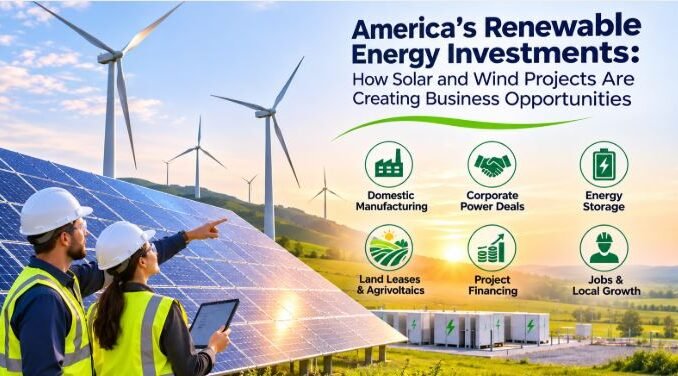
The United States is experiencing a major transformation in the way it produces and consumes electricity. Growing demand for reliable power, increasing investment in clean energy and the expansion of domestic manufacturing are creating new opportunities across the solar and wind industries.
For businesses, this transition represents much more than an environmental initiative. It is opening new markets in manufacturing, engineering, energy storage, construction, land development, project financing and electricity supply. Although challenges such as grid connection delays and changing government policies remain, renewable energy is becoming an important part of America’s economic and industrial future.
A Growing Market with Strong Business Potential
The growth of solar and wind power has been significant. According to the U.S. Energy Information Administration, wind and utility-scale solar generated approximately 17% of U.S. electricity in 2025. When small-scale solar generation is included, their combined contribution rises to around 19%, exceeding coal’s share of electricity generation.
This growth is creating demand for equipment, infrastructure, skilled workers and specialist services. It is also encouraging businesses to explore new ways of producing, purchasing and managing electricity.
For entrepreneurs and investors, the opportunity is not limited to building large solar farms or wind projects. A wide range of supporting businesses can participate in the expanding renewable energy supply chain.
Domestic Manufacturing: Building a New Industrial Opportunity
One of the most promising areas is domestic manufacturing. Solar panels, inverters, battery systems, wind turbines, steel structures, electrical equipment and power-control technologies all require extensive manufacturing and supply networks.
The expansion of these industries is creating opportunities for manufacturers, component suppliers, transport companies, engineering firms and industrial service providers.
A 2026 industry report by the American Clean Power Association estimated that more than 825 clean-energy manufacturing facilities across the United States support approximately 216,000 jobs and contribute around $31 billion annually to the country’s GDP. The report projects that the manufacturing network could grow to more than 950 facilities by 2030, supporting approximately 374,000 jobs and contributing around $55 billion to GDP.
These figures demonstrate how renewable energy investment can support industrial development, employment and local economic activity.
Corporate Electricity Demand: A Growing Market for Clean Power
Electricity demand is increasing as businesses expand their operations, digital infrastructure develops and data centres require more power. For many companies, securing reliable and competitively priced electricity has become an important business priority.
This creates opportunities for renewable energy developers and electricity suppliers through long-term Power Purchase Agreements, commonly known as PPAs. Under these arrangements, businesses can agree to purchase electricity from renewable energy projects over a specified period.
For project developers, PPAs can provide greater revenue certainty and help attract financing. For corporate customers, they can support long-term energy planning, reduce exposure to electricity price fluctuations and contribute to sustainability commitments.
Energy consultants, project advisers and financial professionals can also benefit by helping businesses evaluate electricity requirements, negotiate contracts and manage energy procurement.
Energy Storage: Turning Renewable Power into a More Reliable Supply
Solar and wind power depend on weather conditions and are not available at the same level throughout the day. Solar generation, for example, is strongest during daylight hours, while electricity demand may remain high into the evening.
Battery energy storage is therefore becoming an essential part of the renewable energy business ecosystem.
Large battery systems can store electricity when supply is available and release it when demand increases. This creates opportunities for battery manufacturing, installation, maintenance, software development and energy management services.
Businesses can also explore technologies that help balance electricity supply, improve grid performance and manage energy consumption more efficiently.
As renewable energy capacity expands, storage is likely to become an increasingly important investment area.
Landowners and Farmers: Creating New Sources of Income
Solar and wind development can also generate economic opportunities for rural communities and landowners.
Farmers with suitable land may earn additional income by leasing portions of their property for renewable energy projects. Wind farms can sometimes operate alongside agricultural activities, while carefully designed solar installations can allow livestock grazing or selected agricultural uses.
This approach, known as agrivoltaics, offers the possibility of combining electricity generation with farming.
However, landowners should carefully evaluate lease duration, payment arrangements, land restoration responsibilities, access rights and the impact on existing agricultural activities before entering into agreements.
When planned responsibly, renewable energy projects can bring investment, infrastructure improvements and employment opportunities to rural areas.
The Supporting Business Ecosystem
The renewable energy market creates opportunities well beyond power generation itself.
Engineering and construction companies can develop project infrastructure. Equipment suppliers can manufacture and distribute electrical components. Specialist contractors can provide installation and maintenance services. Financial institutions can arrange project loans and investment structures.
There is also growing potential for businesses involved in energy audits, project monitoring, land assessment, regulatory compliance, grid-management software and technical consulting.
Small and medium-sized enterprises can participate by supplying materials, providing local services or developing specialist solutions for larger projects.
This wider ecosystem makes renewable energy an attractive sector for businesses with different levels of investment capacity and technical expertise.
Understanding the Risks Before Investing
Despite its growth potential, renewable energy is not a risk-free business.
One of the biggest challenges is connecting new projects to the electricity grid. According to Lawrence Berkeley National Laboratory’s 2026 interconnection report, more than 2,060 gigawatts of generation and storage capacity were actively seeking grid connection at the end of 2025.
However, a project appearing in an interconnection queue does not mean it will necessarily be constructed. Projects may face lengthy technical studies, expensive grid upgrades, financing difficulties and regulatory delays. For projects built in 2025, the median time from submitting an interconnection request to commercial operation exceeded five years in regions with available data.
Policy uncertainty is another important consideration. Changes in tax incentives, permitting requirements, trade rules and energy regulations can affect project costs and expected returns.
Businesses should therefore evaluate grid access, equipment costs, customer demand, financing conditions and regulatory requirements before committing significant capital.
A strong business plan should include realistic construction timelines, contingency funding and a clear strategy for managing operational risks.
A Positive Outlook for Business and Communities
America’s investment in solar and wind energy is creating a broader economic transformation. It is supporting manufacturing, generating employment, attracting investment and encouraging innovation across multiple industries.
The greatest opportunities may belong not only to companies developing large renewable energy projects, but also to the many businesses supplying equipment, services, technology, finance and infrastructure.
For communities, these investments can bring new employment, additional income for landowners and greater economic activity. For businesses, they offer opportunities to enter emerging markets and develop services that will remain important as electricity demand changes.
The transition will require careful planning, reliable infrastructure and stable investment conditions. Yet the long-term direction is clear: energy is becoming a major area of industrial innovation and business development.
Renewable energy is no longer just about producing cleaner electricity. It is about building new industries, creating meaningful employment and developing lasting business opportunities for America’s future.A
