
Dalal Street Takes a Breather After Four-Week Rally: IT Shines as Banking, Metals and Media Drag Markets Lower
Mumbai, Nov 28: Indian equity markets ended the week on a cautious note, bringing a pause to their four-week winning streak as investors turned increasingly selective amid global uncertainties, elevated crude oil prices and widespread profit-booking. Despite a strong midweek recovery, selling pressure in banking, metal and other heavyweight stocks prevented benchmark indices from sustaining their gains.
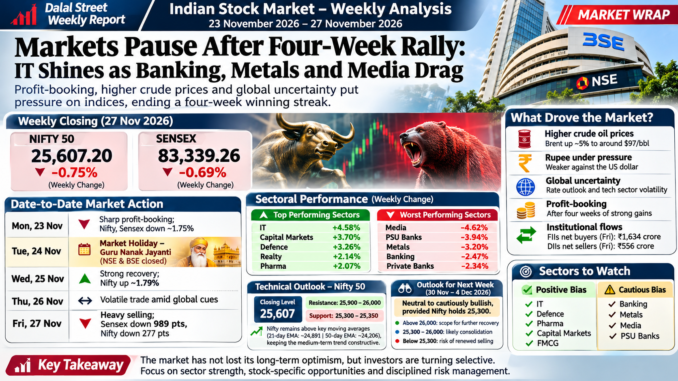
For the week ended Friday, 27 November 2026, the Nifty 50 declined 0.75% to close at 25,607.20, while the BSE Sensex slipped 0.69% to settle at 83,339.26. The weekly decline came after a nearly 15% rally in the previous four weeks, suggesting that investors were increasingly inclined to lock in profits rather than chase valuations at elevated levels.
A Four-Day Trading Week Marked by Volatility
Trading activity during the week was shaped by sharp swings in investor sentiment. On Monday, 23 November, domestic markets witnessed significant selling pressure, with the Nifty and Sensex falling approximately 1.75%, as investors booked profits following the recent rally.
On Tuesday, 24 November, the Indian stock exchanges remained closed on account of Guru Nanak Jayanti (Gurpurab), resulting in a shortened four-session trading week.
Markets reopened on Wednesday, 25 November, with an impressive recovery. The Nifty advanced approximately 1.79%, supported by renewed buying interest in financial, FMCG and select heavyweight stocks. However, the recovery proved insufficient to reverse the week’s overall losses.
On Thursday, 26 November, markets remained sensitive to global developments and sector-specific movements. Selling pressure resurfaced on Friday, 27 November, when the Sensex declined 989 points to close at 83,339.26, while the Nifty shed 277 points to finish at 25,607.20.
The week’s price action reflected a familiar market dynamic: investors remained interested in equities but increasingly unwilling to overlook global risks and stretched short-term valuations.
IT Emerges as the Strongest Sector; Media Takes the Biggest Hit
Sectoral performance remained sharply divided, highlighting the importance of selective investing in the current market environment.
The Nifty IT index emerged as the week’s strongest performer, gaining 4.58%, supported by buying interest in major technology stocks. Capital Markets followed with a 3.70% advance, while the Defence index gained 3.26%. Realty and Pharma also delivered relatively resilient performances, rising 2.14% and 2.07%, respectively.
On the other hand, the Media sector was the biggest laggard, declining 4.62%. PSU Banks fell 3.94%, while Metal stocks lost 3.20%. Banking and Private Banking indices also remained under pressure, declining 2.47% and 2.34%, respectively. Auto stocks slipped 2.04%.
The divergence between sectors suggests that investors are favouring companies and industries demonstrating relative strength while reducing exposure to segments facing valuation concerns or weaker market sentiment.
What Drove the Market Weakness?
Several domestic and international factors influenced market sentiment during the week.
One of the biggest concerns was the rise in crude oil prices. Brent crude climbed approximately 5% during the week to around $97 per barrel, raising concerns about India’s import bill, inflation and the broader macroeconomic outlook.
Currency movements also remained important, with the rupee facing pressure against the US dollar. Meanwhile, uncertainty surrounding global interest rates, geopolitical developments and international technology valuations added to investor caution.
Interestingly, foreign institutional investors continued to provide support through equity purchases. On Friday, FIIs were net buyers of approximately ₹1,634 crore, while domestic institutional investors recorded net selling of around ₹556 crore. Nevertheless, institutional buying was unable to offset the broader selling pressure.
Technical Outlook: Nifty at an Important Junction
From a technical perspective, the Nifty 50 closed at 25,607.20, remaining above its key moving averages. The index was trading above its 21-day EMA of approximately 24,891 and its 50-day EMA of approximately 24,206, indicating that the broader medium-term trend remained constructive despite recent volatility.
For the coming sessions, the 25,300–25,350 zone will be an important immediate support area. A sustained move below this range could increase downside pressure, with the next significant support emerging around 24,850–24,900.
On the upside, the 25,900–26,000 range is likely to act as an important resistance zone. A decisive breakout above this level could restore bullish momentum and improve the prospects of another upward move.
Sector Outlook: Where Could Investors Find Opportunities?
Looking ahead, IT, Defence, Pharma and Capital Markets are among the sectors worth monitoring, given their relative strength during the week.
IT stocks may continue attracting attention, although global technology-sector developments and earnings expectations will remain important considerations. Defence companies could benefit from continued interest in the domestic manufacturing and defence-capex themes.
Pharmaceutical stocks may offer relatively defensive exposure during periods of uncertainty, while Capital Markets companies could remain sensitive to trading activity, market participation and financial-sector developments.
Conversely, investors may need to exercise greater caution in Metals, Media and PSU Banking until clearer signs of recovery emerge.
Outlook for 30 November – 4 December 2026
As markets enter the final trading sessions of November and the beginning of December, investors are likely to remain focused on global economic developments, crude oil prices, institutional fund flows and the Reserve Bank of India’s upcoming monetary policy decision.
The overall outlook for the coming week appears neutral to cautiously bullish, provided the Nifty manages to defend its immediate support zone.
A sustained recovery above 26,000 could improve sentiment, whereas a decisive breach of 25,300 may trigger another round of selling.
The market’s next move will depend less on broad-based optimism and more on whether earnings visibility, institutional participation and global economic conditions can provide a convincing foundation for the next leg of the rally.
The Bigger Picture
The week of 23–27 November offered an important reminder that even a strong market rally is rarely a one-way journey. While the recent correction has interrupted the upward momentum, the broader technical structure remains relatively healthy.
For investors, the immediate priority should be discipline rather than excitement. Sector rotation, stock-specific opportunities and careful attention to valuations may prove more rewarding than aggressive positioning.
The message from Dalal Street is clear: the market has not necessarily lost its long-term optimism, but it is demanding stronger conviction before moving higher.
