
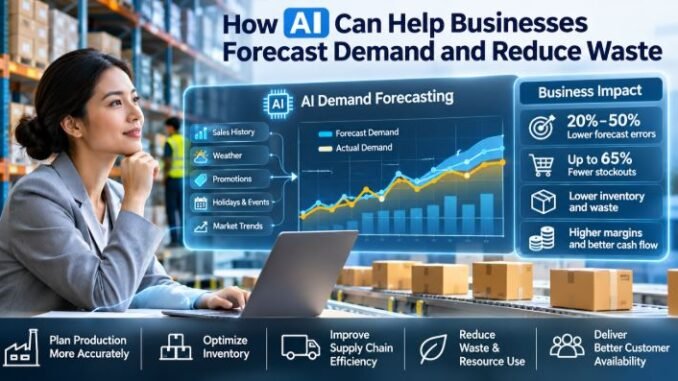
In business, the cost of getting demand wrong is rarely limited to excess stock or an empty shelf. It can affect cash flow, profitability, customer confidence, production schedules and the wider efficiency of an organisation. For companies operating in increasingly competitive and unpredictable markets, the ability to anticipate what customers will need—and when they will need it—has become a significant commercial advantage.
This is where artificial intelligence is beginning to change the way businesses approach demand planning.
Traditionally, forecasting has relied heavily on historical sales figures, seasonal trends and the experience of planning teams. While these remain valuable inputs, they do not always capture the speed or complexity of modern markets. Consumer preferences can shift quickly, weather conditions can influence purchasing patterns, promotional campaigns can create sudden demand spikes, and supply chain disruptions can alter the availability of products.
AI offers businesses a more dynamic approach. By analysing large volumes of information from multiple sources, it can identify patterns, recognise emerging trends and generate forecasts that respond more effectively to changing market conditions.
From Historical Data to Commercial Intelligence
The real value of AI-driven forecasting lies not simply in its ability to process more data, but in its capacity to connect information that might otherwise remain disconnected.
Sales records, inventory movements, pricing changes, promotional activity, public holidays, weather patterns and broader market indicators can be analysed together to build a more comprehensive picture of demand. This allows businesses to move beyond the limitations of conventional forecasting models and make decisions based on a wider range of commercial signals.
For a retailer, this could mean identifying a likely increase in demand before a seasonal sales period. For a manufacturer, it could help align production volumes with anticipated orders. In the food and beverage sector, more accurate predictions can support better purchasing decisions and reduce the risk of perishable goods remaining unsold.
The commercial implication is significant: businesses gain greater visibility into what they may need, where they may need it and how much inventory they should hold.
Protecting Margins Through Better Inventory Management
Inventory is one of the most important areas where forecasting accuracy can influence financial performance.
Holding too much stock ties up working capital, increases storage and handling costs, and creates the risk of products becoming obsolete or unsellable. Holding too little can result in missed sales, delayed deliveries and dissatisfied customers. Both situations carry a financial cost.
AI-powered forecasting can help businesses strike a more informed balance between availability and inventory investment. By identifying demand patterns and adjusting predictions as new information becomes available, these systems can support more disciplined replenishment decisions.
For businesses with large product portfolios or multiple distribution locations, this can be particularly valuable. Inventory can be allocated more strategically, reducing the likelihood of excess stock in one location while another experiences shortages.
Consider a business carrying ₹2 crore in inventory. If improved planning enables it to reduce average inventory levels by 10% without compromising service levels, approximately ₹20 lakh in working capital could be released. This is not automatically an increase in profit, but it may strengthen liquidity and create room for investment in other business priorities.
Reducing Waste Is Also a Financial Strategy
Waste reduction is often discussed in the context of sustainability, but for businesses it is equally an issue of cost control and resource productivity.
In industries dealing with perishable goods, inaccurate forecasts can result in products expiring before they are sold. In manufacturing, excess production can lead to unnecessary material consumption, storage requirements and disposal costs. In logistics, poor demand visibility can contribute to inefficient transportation and emergency shipments.
More responsive forecasting can help organisations plan purchasing, production and distribution with greater precision. Rather than relying exclusively on fixed schedules, businesses can adjust operational decisions as demand signals evolve.
The result can be a more efficient use of materials, energy, labour, warehouse capacity and transportation resources. Over time, these improvements can support both stronger margins and more responsible resource management.
Faster Decisions in an Unpredictable Market
One of the limitations of traditional forecasting is that it can become outdated quickly. A forecast prepared weeks in advance may no longer reflect market conditions when purchasing or production decisions are made.
AI-enabled demand sensing can help address this challenge by incorporating newer information and identifying changes in demand patterns. Businesses can receive earlier indications of potential shortages, unexpected demand increases or weakening sales trends.
This does not eliminate uncertainty. Rather, it gives decision-makers more time and better information with which to respond.
For leadership teams, the benefit extends beyond supply chain operations. More reliable demand visibility can inform budgeting, workforce planning, procurement negotiations, pricing decisions and revenue projections. Forecasting therefore becomes part of a wider management discipline rather than a task confined to the inventory or operations department.
Turning Forecasting into a Competitive Capability
The organisations most likely to benefit from AI forecasting are those that view it as a business transformation initiative, not simply a technology upgrade.
Successful implementation begins with reliable data. Inconsistent product records, incomplete sales information and disconnected systems can undermine even sophisticated forecasting models. Businesses must also define the decisions they want forecasting to improve, whether that means reducing excess inventory, improving product availability, lowering waste or strengthening production planning.
A measured approach is often more effective than attempting a large-scale transformation immediately. Companies can begin with a product category, business unit or supply chain process, establish performance benchmarks and assess the results before expanding the system.
Equally important is the role of people. AI can identify patterns and generate recommendations, but commercial decisions still require context, experience and accountability. Managers must understand why a forecast has changed, assess unusual market developments and recognise situations where historical data may no longer be a reliable guide.
The objective is not to remove human judgement from planning. It is to give decision-makers better tools with which to exercise it.
The Business Case for Predictive Planning
As operating costs rise and customer expectations continue to evolve, businesses are under pressure to improve efficiency without compromising service quality. Demand forecasting is becoming an important part of that equation.
The benefits of AI will vary by industry, data quality, implementation maturity and the complexity of operations. Nevertheless, the commercial opportunity is clear: better forecasting can help reduce avoidable costs, improve inventory productivity, protect sales opportunities and support more disciplined resource allocation.
For business leaders, the question is no longer simply whether demand can be predicted more accurately. It is whether the organisation is equipped to translate better predictions into better decisions.
Companies that make this shift can build more responsive operations, use capital more effectively and reduce the waste associated with uncertainty. In a market where margins are closely watched and operational resilience matters, the ability to anticipate demand may become one of the defining capabilities of a well-managed business.
