

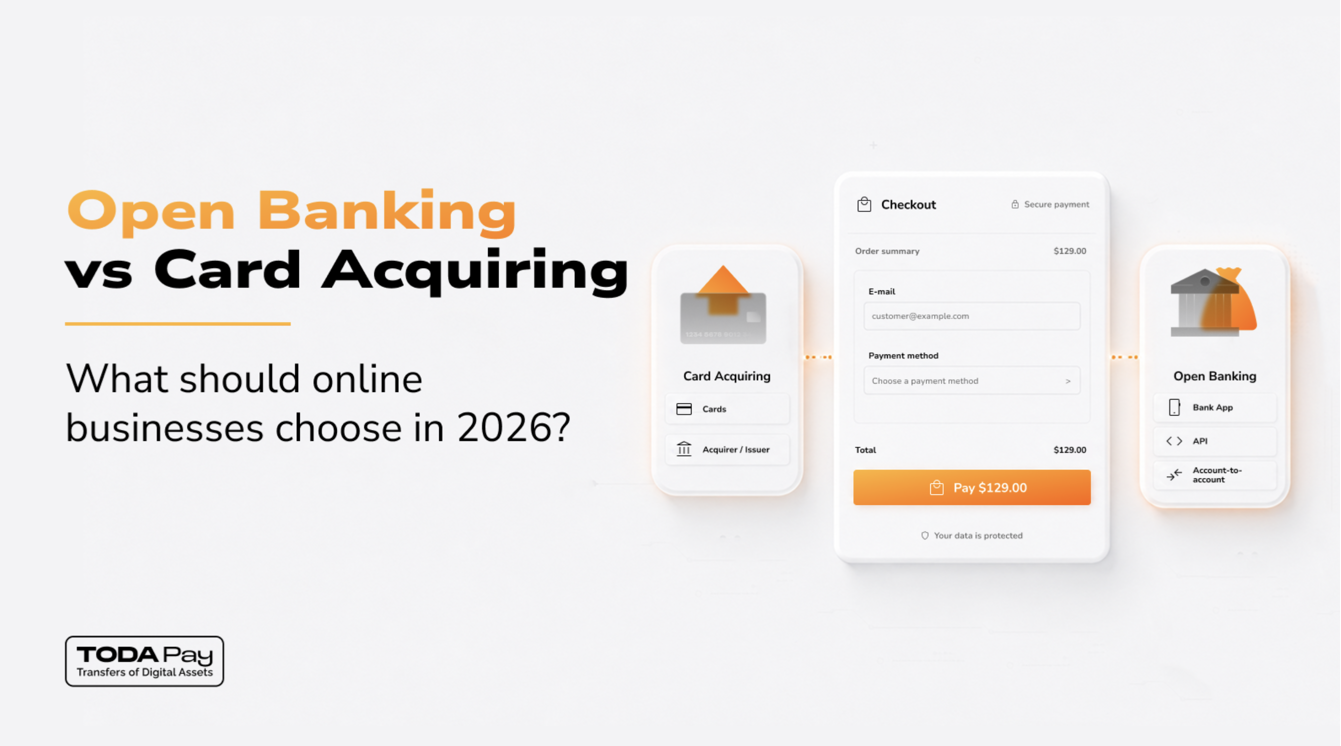
Three years ago, choosing a payment method for an online business came down to one question: Visa or Mastercard? Today the landscape has fundamentally changed. Open Banking Payment has evolved from a niche European regulatory experiment into a genuine alternative to card acquiring, processing hundreds of billions of euros annually.
For merchants navigating this shift, the real question is no longer ‘which method?’ — it’s ‘how do I use both intelligently?’
Specialised PSPs like TODA Pay are building the infrastructure that makes this possible.
Open Banking doesn’t replace cards. It unlocks a
segment of buyers who prefer bank-direct payments — and captures
revenue that card-only infrastructure may leave
behind.
How Open Banking Payment Works
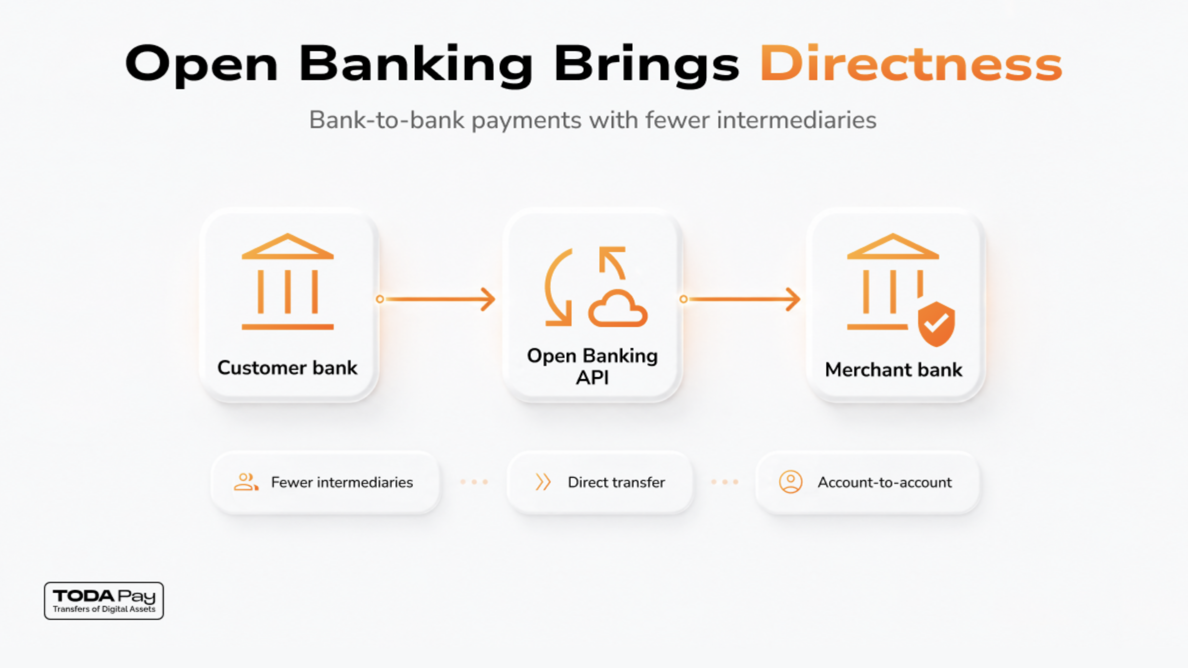
The mechanics are straightforward: the buyer selects their bank in the payment interface, authorises the transfer in their banking app, and funds arrive at the merchant directly — without card networks, without i intermediary gateways. Technically this is an A2A (account-to-account) transaction conducted through APIs standardised by PSD2 in Europe and equivalent regulatory frameworks globally.
TODA Pay’s Open Banking solution connects to PSD2-compliant banks across EU markets, enabling instant or near-instant deposit confirmation with a user experience that integrates directly into local mobile banking apps.
Key Differences at a Glance
- Merchant fee: Open Banking — 0.1–0.3% (fixed); Cards — 1.5–3.5%
(interchange + markup) - Settlement speed: OBP — instant or T+1; Cards — T+2 to T+5
- Chargeback exposure: OBP — substantially lower than card
processing (A2A transfers are generally irreversible under
PSD2-governed flows; specific outcomes may vary by jurisdiction and
dispute type); Cards — up to 1% of turnover - Audience coverage: OBP — banking-active users; Cards —
universal, broader demographic - Mobile conversion: OBP — can be meaningfully higher via deep
link into banking app for mobile-first users; Cards —
UX-dependent
Who Open Banking Is Best For
Open Banking delivers the greatest value for high-frequency businesses with recurring payments: subscription SaaS platforms, iGaming operators, forex trading platforms, and digital content services. It is especially well-suited for fraud-sensitive niches: since the payer authenticates through their own bank with multi-factor verification, fraud probability is reduced relative to card-not-present transactions.
For fintech companies and payment providers, Open Banking also opens access to a segment of users who prefer not to enter card details online. Research from several European market studies suggests this group is substantial among digital-native users in mature EU markets, though exact figures vary by country and demographic.
When Card Acquiring Remains Essential
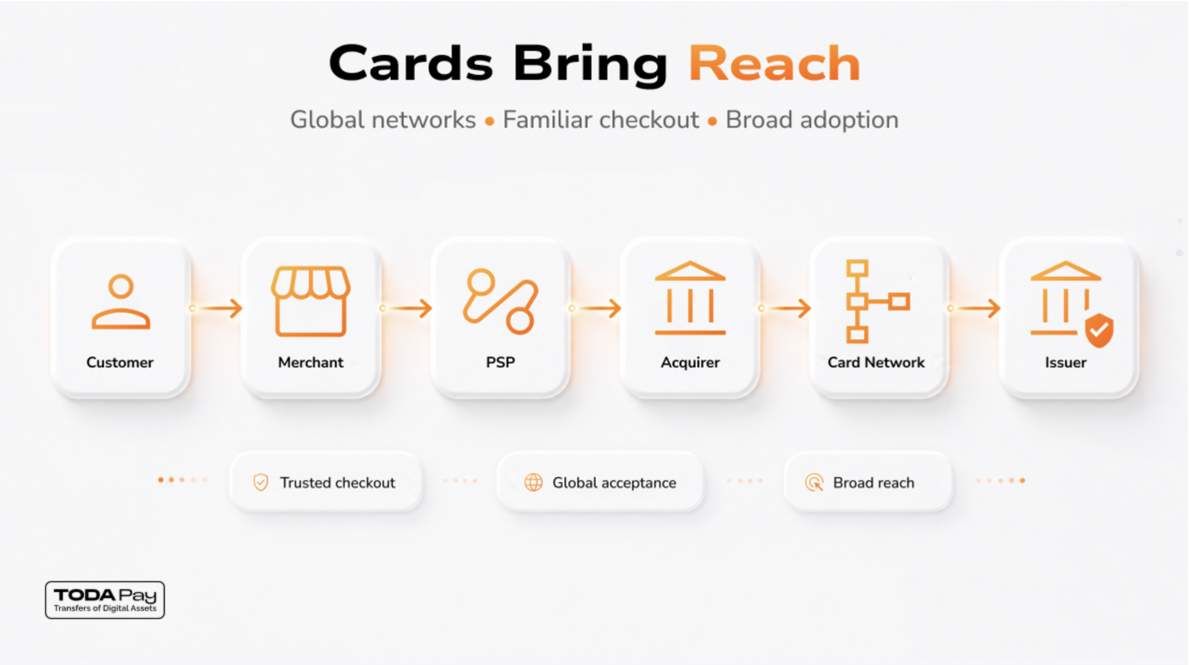
Open Banking does not replace cards entirely. Cross-border transactions outside the SEPA zone, markets with low mobile banking penetration, one-time guest checkouts — cards retain unmatched reach in these scenarios. Additionally, older demographics remain more comfortable with the familiar card payment flow.
For global merchants, the answer is not either/or. It is both, intelligently orchestrated.
The Hybrid Strategy: Why Smart Merchants Use Both
The most effective approach is payment orchestration: a system that automatically presents the buyer with the optimal payment method based on their region, device, and transaction history. A user from Poland on mobile sees BLIK or Open Banking first. A user from Brazil sees a local e-wallet. A user from the US sees Visa/Mastercard.
TODA Pay implements this logic within its payment orchestration architecture — combining Open Banking, APM
(alternative payment methods), and card acquiring under a single integration. Merchants don’t choose between methods; they offer all of them through one API connection.
Real-World Impact on Conversion
The financial case for hybrid payments is clear for many merchant profiles. As an illustrative example: a merchant
processing $500,000 per month who shifts 30% of transactions from card to Open Banking could save approximately $4,500–$9,000 monthly in processing fees — depending on their current blended card rate and the applicable OBP fees for their markets. Actual savings will vary.
On the conversion side, reducing payment friction for mobile-first users can support improved deposit completion rates. The specific impact depends on the user base, mobile penetration, and existing checkout UX. For iGaming operators, improvements to FTD (first-time depositor) rates have direct downstream effects on player lifetime value.
Choosing the Right Provider
When evaluating a PSP for hybrid payment capabilities, verify: the number of Open Banking bank connections in your target markets, whether APM integration is live or merely listed, settlement currency options (EUR, USD, USDT), and the quality of analytics available per payment method.
A provider like TODA Pay surfaces per-method performance data in a unified dashboard, enabling merchants to continuously optimise their payment mix based on actual acceptance and conversion data.
Final Thoughts
For online businesses with monthly volume above $50,000, transitioning to a hybrid payment approach can deliver measurable financial returns within the first month, depending on the merchant’s current payment mix and target markets. The key is selecting a PSP partner capable of supporting both Open Banking and card acquiring with a single integration, unified analytics, and responsive support with clearly defined SLAs. That combination —
not the method itself — is what drives sustained conversion improvement.
About TODA Pay: TODA Pay (todapay.com) is a Payment Service Provider combining Open Banking, Alternative Payment Methods, and card acquiring under a single API. Operating under MSB licences, TODA Pay serves high-risk and high-volume merchants across Europe, Canada, Australia, and emerging markets.
DISCLOSURE: This content is produced in partnership with TODA Pay (todapay.com). All factual claims have been verified against publicly available data and company-provided information.