
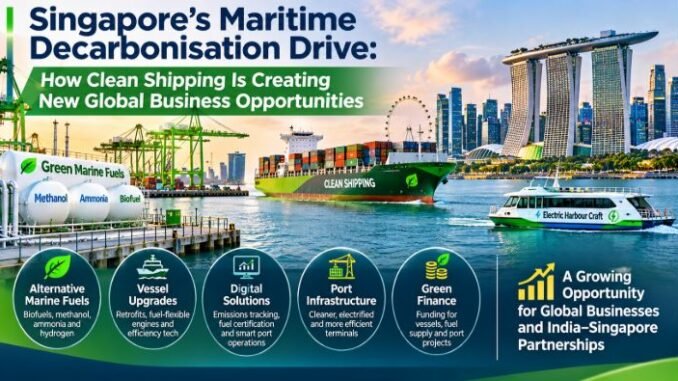
The global shipping industry is entering a period of profound change, and Singapore is determined to turn that transformation into a commercial advantage. As one of the world’s leading maritime and bunkering hubs, the city-state is investing in cleaner fuels, smarter port operations and next-generation shipping technologies to prepare for a lower-carbon future. This shift is creating opportunities well beyond the traditional maritime sector, opening new markets for energy companies, engineering firms, technology providers, financial institutions and infrastructure investors. For businesses across Asia, particularly in India, Singapore’s growing network of green shipping partnerships could offer an important gateway into the emerging clean maritime economy.
From Global Shipping Hub to Green Maritime Business Centre
Singapore’s maritime success has been built on its ability to connect international markets efficiently. Its strategic location along major shipping routes, sophisticated port infrastructure and extensive network of maritime services have made it an essential centre for global trade.
But the next chapter of that success may look very different. As shipping companies face increasing pressure to reduce emissions, the demand for cleaner fuels, energy-efficient vessels and environmentally responsible port operations is growing. Singapore sees an opportunity to lead this transition rather than simply respond to it.
The scale of its maritime industry provides a considerable advantage. Singapore handled approximately 44.66 million twenty-foot equivalent units (TEUs) of container throughput in 2025, while vessel arrival tonnage reached around 3.22 billion gross tonnes. Marine fuel sales also reached a record 56.77 million tonnes, including 1.95 million tonnes of alternative marine fuels.
These figures highlight the commercial potential of the transition. Singapore already has the shipping customers, infrastructure and industry relationships needed to develop new maritime energy markets. The challenge now is to make cleaner shipping commercially practical for vessel operators.
For shipowners, this is not simply an environmental decision. Changing fuels or upgrading vessels involves significant capital expenditure, operational adjustments and questions about long-term fuel availability. Businesses that can help solve these challenges stand to benefit from the industry’s changing investment priorities.
Government Incentives Give Green Shipping a Commercial Push
One of the biggest barriers to adopting cleaner maritime technologies is cost. Shipowners may be interested in reducing emissions, but investment decisions ultimately depend on affordability, operational reliability and expected returns.
Singapore is addressing this challenge through its refreshed Maritime Singapore Green Initiative, supported by an additional S$50 million commitment. The programme encourages greener ships, cleaner port operations, harbour craft development and maritime innovation.
Under its Green Ship Programme, qualifying Singapore-registered vessels can receive concessions of up to 100% on initial registration fees and annual tonnage taxes during the programme period ending 31 December 2027. Eligible vessels calling at Singapore may also qualify for port-dues concessions, subject to the relevant environmental requirements.
For shipowners, these measures can help reduce some of the costs associated with adopting cleaner technologies. For equipment manufacturers, engineering companies and fuel suppliers, they create a more supportive environment in which to develop and market new solutions.
The wider message for the business community is that environmental performance is becoming increasingly connected to competitiveness. Companies that invest in practical emissions-reduction measures today may be better prepared for future customer expectations and regulatory requirements.
A Long-Term Blueprint Is Creating Demand for New Infrastructure
Singapore’s Maritime Singapore Decarbonisation Blueprint sets out an ambitious direction for reducing emissions from port terminals and domestic maritime operations.
The blueprint targets at least a 60% reduction in absolute emissions from port terminals by 2030, compared with 2005 levels, followed by net zero by 2050. For domestic harbour craft, it aims for a 15% reduction in absolute emissions by 2030 against a 2021 baseline, with further reductions towards 2050.
Achieving these goals will require significant changes to the way ports and vessels operate. Traditional equipment will need to become more energy-efficient, alternative-fuel infrastructure will need to expand, and digital systems will play a greater role in managing maritime operations.
This creates opportunities for businesses involved in port electrification, charging infrastructure, renewable-energy integration, marine engineering, vessel retrofitting and emissions-monitoring technology.
The investment potential extends beyond individual projects. A port adopting alternative fuels, for example, will also need storage facilities, specialist handling equipment, safety systems, fuel certification and digital monitoring. Each new development can generate demand for a wider network of suppliers and service providers.
For investors, this interconnected market is particularly important. The strongest opportunities may emerge not from a single technology but from the supporting infrastructure that allows an entire clean-shipping ecosystem to operate.
Alternative Marine Fuels: The Next Big Business Opportunity
Fuel is at the heart of shipping’s decarbonisation challenge. International vessels consume enormous quantities of energy, and moving away from conventional marine fuels will require reliable alternatives that can be supplied across major trading routes.
Singapore’s established bunkering industry gives it a natural advantage in developing this market. However, the future is unlikely to depend on one universal fuel. Different vessels and routes will require different solutions.
Biofuels are attracting interest because certain blends can be used in existing vessels, subject to fuel specifications and vessel compatibility. This makes them an attractive option for operators seeking near-term emissions reductions without replacing entire fleets. The opportunity extends to feedstock producers, fuel processors, distributors, testing companies and bunkering operators.
Methanol is another important area of development. As shipping companies invest in methanol-capable vessels, demand is growing for compatible engines, storage facilities, transportation systems and bunkering services. Green methanol, produced using renewable energy and sustainable feedstocks, could become an important part of the lower-carbon marine fuel market.
Ammonia is attracting attention as a potential zero-carbon fuel at the point of use. However, its toxicity, handling requirements and potential emissions of nitrogen oxides and nitrous oxide mean that safety systems, engine development and environmental controls must advance before widespread adoption becomes practical.
Hydrogen may also support selected maritime applications, particularly through fuel cells and emerging propulsion technologies. Its commercial potential will depend on production costs, storage requirements and the availability of suitable infrastructure.
For energy companies and investors, the important point is that a multi-fuel market is emerging. Businesses that can develop reliable supply chains, storage solutions and specialist services across different fuel pathways may find opportunities as shipowners diversify their energy choices.
The Business of Making Existing Ships Cleaner
While new alternative-fuel vessels attract considerable attention, a large part of the global fleet will continue operating for many years. Replacing existing ships is expensive, and many owners will look for ways to improve the environmental performance of vessels already in service.
This creates a substantial opportunity for marine engineering companies and technology suppliers.
Wind-assisted propulsion systems, including rotor sails, can help reduce fuel consumption under suitable operating conditions. Fuel-flexible engines can prepare vessels for a changing fuel market, while hybrid propulsion systems and batteries can improve efficiency on appropriate routes.
Other opportunities include improved hull coatings, propeller optimisation, intelligent voyage planning and onboard energy-management systems. Carbon-capture technology is also being explored for vessels, although onboard storage, operating costs and commercial feasibility remain important considerations.
For shipyards and specialist manufacturers, these developments represent a growing market for retrofitting, equipment installation and maintenance services.
Smaller engineering businesses can also participate. They may not have the resources to manufacture complete propulsion systems, but they can supply components, develop specialist software or provide technical services to larger maritime companies.
The commercial opportunity lies in helping shipowners reduce operating costs while preparing their fleets for a more demanding environmental landscape.
Electric Harbour Craft: A Practical Starting Point
The transition to cleaner shipping is not limited to large cargo vessels. Smaller harbour craft and passenger ferries offer an opportunity to introduce electric propulsion in applications where operating routes are relatively predictable.
Singapore is encouraging this transition through requirements for new harbour craft operating in its port waters from 2030 to meet specified cleaner-energy standards. These include full electrification, B100 biofuel capability or compatibility with net-zero fuels, depending on the applicable requirements.
The development of electric passenger ferries illustrates how the transition is moving into commercial operations. Singapore’s first fully electric commercial ferry service began operating in 2024, with subsequent vessels supporting passenger transport between the mainland and Pulau Bukom.
This development creates business opportunities for battery suppliers, electric propulsion manufacturers, charging-system developers, vessel builders and maintenance companies.
It also provides valuable experience that could be applied elsewhere in Southeast Asia, where ports and coastal transport operators are examining ways to reduce emissions from local vessels.
For companies operating in marine engineering and electrical infrastructure, harbour craft electrification could become an important market in its own right.
Digital Technology Is Becoming Essential to Clean Shipping
Decarbonisation is not only about what fuel a ship uses. It is also about understanding how efficiently the vessel operates and measuring the emissions generated throughout its activities.
Shipping companies increasingly need accurate information on fuel consumption, vessel performance, emissions intensity and fuel sustainability. Lenders, insurers and customers also want credible data when assessing environmental performance.
This is creating demand for maritime software and digital services. Companies are developing solutions for emissions measurement and reporting, digital fuel certification, predictive maintenance, voyage optimisation and smart-port management.
The opportunity for technology providers is to make complex information useful to the people managing shipping operations.
Consider a shipping company deciding whether to use biofuel, methanol or another alternative. It needs to compare not only fuel prices but also availability, lifecycle emissions, vessel compatibility and operational performance. Digital platforms that bring these factors together can help businesses make more informed investment decisions.
This creates an opening for technology firms beyond the traditional maritime industry. India’s software and IT services sector, for example, could contribute through data analytics, cybersecurity, emissions platforms and digital supply-chain management.
Green Shipping Corridors Are Connecting New Markets
One of the biggest challenges in maritime decarbonisation is that shipping operates across borders, while fuel infrastructure and environmental standards are not uniform across countries.
A vessel may be capable of operating on a cleaner fuel, but that advantage is limited if the fuel is unavailable at the ports along its route. This is why green shipping corridors are becoming increasingly important.
These initiatives bring together ports, shipping companies, fuel producers, technology providers and governments to develop the infrastructure and operating arrangements needed for lower-emission maritime routes.
The Rotterdam–Singapore partnership is a notable example. The two ports have been working with industry partners to develop a green and digital shipping corridor, with an ambition to reduce emissions from large container vessels operating along the route by 20–30% by 2030.
For businesses, the opportunity extends across fuel production, storage, bunkering, port engineering, digital systems and logistics services.
These partnerships can also provide greater visibility into future demand. When ports and shipping companies work together to develop a corridor, fuel producers and infrastructure investors gain a clearer understanding of where new facilities and services may be needed.
Singapore–India Partnership: Opportunities for Indian Companies
The Singapore–India Green and Digital Shipping Corridor adds an important dimension to the region’s clean maritime ambitions.
Formalised through a memorandum of understanding in September 2025, the collaboration focuses on developing infrastructure and technologies for zero- or near-zero-emission marine fuels, improving digital information exchange and supporting research into emerging maritime solutions.
The partnership brings together complementary capabilities. India has a substantial renewable-energy base, a growing industrial sector and strong expertise in engineering and digital services. Singapore offers established maritime infrastructure, global shipping connections and an extensive bunkering and logistics ecosystem.
For Indian businesses, this creates several areas worth exploring.
Renewable-energy companies and industrial producers could investigate the development of sustainable marine fuels, subject to competitive pricing and certification. Port operators and engineering companies could explore fuel storage, bunkering infrastructure and electrification projects. Technology providers could offer emissions-monitoring platforms, vessel analytics, digital documentation and cybersecurity services.
There may also be opportunities for Indian manufacturers supplying electrical equipment, marine components, propulsion systems and specialised engineering services.
Eastern India deserves particular attention. Paradip Port in Odisha, supported by the surrounding industrial and energy ecosystem, could explore future opportunities involving green fuel supply chains, renewable energy and maritime technology.
Such opportunities should be viewed as areas for commercial exploration rather than established supply arrangements under the corridor. Their development will depend on investment, infrastructure readiness and future partnerships.
Nevertheless, the broader opportunity is significant. Indian companies could use regional cooperation to develop capabilities that serve international maritime markets rather than focusing exclusively on domestic demand.
Green Finance: Funding the Next Generation of Maritime Infrastructure
The transition to cleaner shipping will require substantial investment. Alternative-fuel vessels, charging networks, fuel storage facilities, port electrification and digital systems all involve significant upfront expenditure.
This is creating opportunities for banks, institutional investors, insurers, leasing companies and specialist financial institutions.
Green loans and sustainability-linked financing can help shipowners fund fleet upgrades, while transition finance can support companies gradually moving towards lower-emission operations. Financial institutions can also participate in funding alternative-fuel production facilities and maritime infrastructure projects.
Insurers will have an increasingly important role as new fuels and propulsion systems introduce different operational risks. Ammonia and hydrogen, for example, require specialist handling, safety procedures and risk-management capabilities.
For financial and professional services firms, the emerging market is not simply about providing capital. It also involves evaluating technology risks, assessing environmental performance and helping maritime businesses structure investments that remain commercially viable.
The Challenges Behind the Opportunity
Despite the momentum, the transition to cleaner shipping will not happen overnight.
The cost of alternative fuels remains a significant challenge. Green methanol, green ammonia and other emerging fuels can be more expensive than conventional marine fuels, and supply is not yet evenly available across international ports.
Infrastructure is another concern. Shipping companies need confidence that compatible fuels and services will be available along their operating routes before committing to major fleet investments.
Technology maturity also varies. Some solutions are already commercially deployed, while others remain in testing or early development. Businesses need to assess performance, reliability and long-term costs rather than relying on market expectations alone.
Regulatory consistency is equally important. Different countries may apply different environmental standards, emissions-accounting methods and fuel-certification requirements. Greater clarity will help businesses make long-term investment decisions.
Finally, the environmental performance of alternative fuels must be assessed across their lifecycle. A fuel’s benefits depend on how it is produced, transported and used, not simply on what happens when it is consumed onboard a vessel.
For investors and operators, the most attractive opportunities will be those supported by genuine demand, reliable technology, credible environmental performance and a clear route to profitability.
Conclusion:
Singapore’s maritime decarbonisation drive is demonstrating how an environmental transition can create new commercial opportunities across an established global industry. Its investments in alternative fuels, vessel technology, port infrastructure and digital solutions are opening markets for businesses in energy, engineering, logistics, technology and finance. The growing partnership with India adds another dimension, creating potential connections between renewable-energy producers, manufacturers, technology companies and Singapore’s international maritime network. Although fuel costs, infrastructure gaps and regulatory uncertainty remain challenges, the direction of travel is becoming increasingly clear. The next generation of maritime businesses will be shaped not only by who moves goods most efficiently, but also by who can make shipping cleaner, more reliable and commercially sustainable. For companies prepared to invest, innovate and build international partnerships, clean shipping represents a significant opportunity in the future of global trade.
