
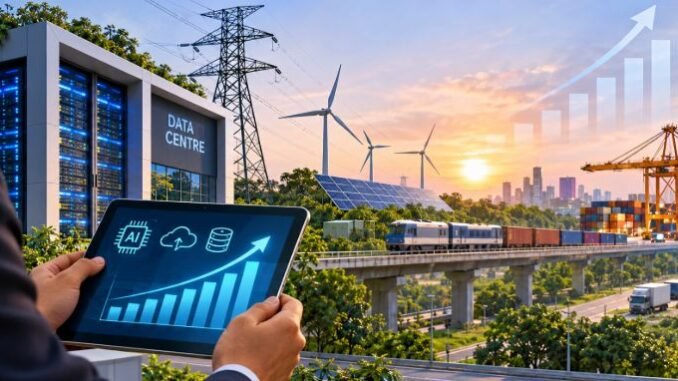
The way businesses invest is changing. As technology becomes part of almost every industry, investors are looking beyond software companies and digital products. They are increasingly putting money into the infrastructure that makes modern business possible, including data centres, power networks, transport systems and advanced manufacturing facilities.
The growing use of artificial intelligence, cloud computing and digital services is creating demand for reliable electricity, faster connectivity and stronger supply chains. This has brought infrastructure and technology closer together, making them two important areas of interest for businesses, governments and institutional investors.
What makes this shift important is that the growth of one sector increasingly depends on the other. A company may develop advanced AI solutions, but those systems still need powerful computers, data centres and a steady supply of electricity to operate. This connection is opening new opportunities for investment across the global economy.
Infrastructure Investment Gains Momentum
The demand for modern infrastructure is increasing across countries and industries. According to McKinsey, the world will require around $106 trillion in cumulative infrastructure investment through 2040. At the same time, global foreign direct investment reached $1.6 trillion in 2025, rising 6% from the previous year, supported by major projects in digital infrastructure, semiconductors and energy.
These developments show why infrastructure is receiving greater attention from investors. Roads, ports, railways, electricity networks and communication systems are essential for economic activity. As countries work to modernise these facilities, businesses are finding opportunities to participate in large-scale projects.
For investors, infrastructure can also offer long-term business potential. Many assets provide essential services and operate over several decades. Some projects generate revenue through long-term contracts or regulated arrangements, although their returns depend on operating costs, financing and government policies.
AI Growth Creates New Demand for Data Centres and Energy
Artificial intelligence is becoming a major reason behind the growing demand for digital infrastructure. Businesses are adopting AI to improve productivity, automate routine tasks and develop new services. However, these technologies require significant computing power and storage capacity.
This has increased demand for data centres, which provide the facilities needed to run AI systems and digital platforms. These centres also require reliable electricity, cooling systems and advanced network connections.
As a result, investment opportunities are spreading beyond technology developers. Energy companies, data centre operators, equipment suppliers and infrastructure developers are also benefiting from the growing need to support digital expansion.
The increasing connection between AI and energy is particularly important. As data centres consume more electricity, businesses and investors are paying greater attention to power generation, renewable energy and modern electricity grids.
Businesses Are Rethinking Supply Chains
Recent global disruptions have encouraged companies to take a closer look at their supply chains. Many businesses now want to reduce their dependence on a limited number of suppliers and improve their ability to manufacture and distribute products.
This is creating demand for warehouses, industrial parks, ports, roads and rail networks. Companies are also exploring local manufacturing and alternative sourcing options to make their operations more resilient.
India is part of this changing investment environment. Government initiatives such as PM GatiShakti, along with public infrastructure spending and asset monetisation programmes, are supporting infrastructure development and encouraging private sector participation.
Better transport and logistics facilities can help businesses move goods more efficiently, reduce delays and reach new markets. This makes infrastructure development important not only for investors but also for manufacturers, exporters and smaller businesses.
Technology Is Changing How Infrastructure Works
Technology is playing an increasingly important role in improving traditional infrastructure. Businesses are using artificial intelligence, automation and data analytics to manage assets, monitor performance and identify maintenance requirements.
For example, predictive maintenance systems can help companies detect equipment problems before they lead to costly breakdowns. Digital monitoring can also improve the management of power plants, transport networks and industrial facilities.
These changes can help businesses save money, reduce downtime and make better use of existing assets. They also create opportunities for technology companies that provide software, monitoring systems and automation solutions to infrastructure operators.
For investors, this combination offers a different way to look at the market. Instead of focusing only on technology companies or traditional infrastructure businesses, they can consider companies bringing both together.
Challenges That Investors Cannot Ignore
Although infrastructure and technology are attracting significant interest, investing in these sectors is not without challenges.
Large infrastructure projects require substantial funding and can take years to complete. Delays in construction, land acquisition, regulatory approvals and electricity connections can increase costs and affect expected returns.
Technology investments also involve uncertainty. New developments can quickly make existing products or systems less competitive. High valuations, changing customer demand and unclear paths to profitability can create additional risks.
Geopolitical tensions, trade restrictions and changes in government policies can further affect investment decisions. Businesses and investors therefore need to look carefully at project costs, market demand, financial strength and long-term business potential before committing capital.
Conclusion
The growing interest in infrastructure and technology reflects a simple change in the way the modern economy operates. Businesses need more than digital tools to grow; they also need reliable electricity, efficient transport, strong communication networks and modern industrial facilities.
This is bringing new investment opportunities across energy, data centres, manufacturing, logistics and digital services. While challenges such as high costs, project delays and changing regulations remain, the demand for these essential systems continues to shape business investment decisions.
For companies, the shift creates opportunities to expand operations, improve efficiency and develop new services. For investors, it offers a chance to participate in the sectors supporting future economic growth. As technology and infrastructure become increasingly connected, their combined role in attracting business capital is likely to remain significant.
