
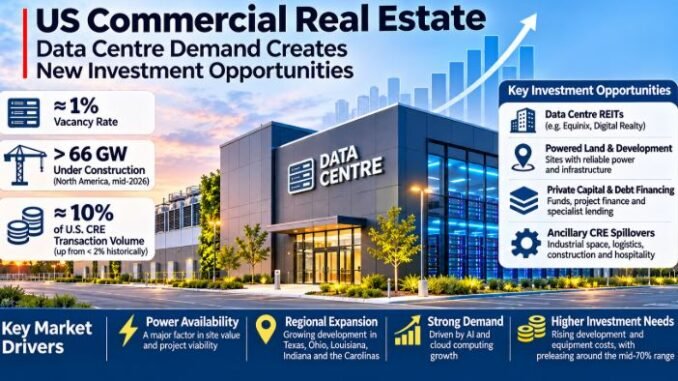
The rapid growth of artificial intelligence (AI), cloud computing and digital services is driving a major shift in the US commercial real estate market. Data centres are attracting increasing attention from property developers, institutional investors and financial companies as demand for computing capacity continues to rise.
With data centre vacancy estimated at around 1% and more than 66 GW of capacity under construction across North America by mid-2026, the sector is experiencing strong demand and significant development activity. Data centres are also becoming a larger part of commercial property investment, accounting for nearly 10% of US commercial real estate transaction volumes, compared with less than 2% historically, according to the market figures supplied.
For investors, this growth represents an opportunity to participate in a property sector increasingly connected to the digital economy. However, success will depend on more than securing land or constructing buildings. Access to electricity, reliable infrastructure, suitable locations and long-term tenant demand are becoming essential factors in determining a project’s commercial potential.
Power availability is shaping investment decisions
Electricity has become one of the most important considerations in data centre development. Unlike conventional commercial properties, these facilities are assessed largely by their power capacity rather than their floor space.
The growing use of AI is increasing the amount of computing power required by businesses. This is encouraging operators to seek facilities capable of supporting high-density workloads, advanced cooling systems and continuous operations.
However, securing sufficient electricity is becoming a major challenge. Grid connection delays, limited transmission capacity and lengthy utility approval processes can affect development schedules and increase costs.
As a result, land with existing power connections or a realistic route to securing additional capacity is becoming more attractive to developers. Some projects are also considering on-site energy generation and battery storage to improve reliability and reduce dependence on constrained grid infrastructure.
For commercial property investors, this is changing how potential sites are evaluated. A location with suitable land but insufficient power may be less commercially attractive than a site with established infrastructure and a clear development pathway.
Regional markets are gaining investor attention
The expansion of data centre development is creating opportunities beyond traditional technology markets.
Developers are increasingly considering locations where land availability, electricity supply and infrastructure can support large-scale projects. Markets across Texas, Ohio, Louisiana, Indiana and the Carolinas are attracting interest, alongside established Sun Belt locations.
This expansion is creating new possibilities for regional commercial property markets. Data centre projects require more than the main facility. They also generate demand for construction services, industrial space, equipment storage, logistics, maintenance and specialist suppliers.
Local businesses may benefit from these requirements, while landowners and developers could find opportunities in areas experiencing new infrastructure investment.
The commercial impact can extend to hospitality and accommodation businesses as construction teams, technical specialists and service providers operate around major development sites. However, the scale of these benefits will vary according to the size and duration of individual projects.
Investment opportunities across the property sector
The growing data centre market offers several investment routes, depending on the investor’s capital, risk appetite and preferred level of involvement.
Publicly listed real estate investment trusts, including Equinix and Digital Realty, provide exposure to established data centre operators and their property portfolios. Private investment platforms and specialist funds offer additional access to operating facilities and development projects.
Land acquisition is another area attracting attention. Investors and developers are looking for sites with suitable planning conditions, reliable electricity access and the potential to accommodate large-scale facilities. Build-to-suit developments, designed around the requirements of major occupiers, can also provide opportunities where tenant demand is established.
Financing is becoming an important part of the market’s expansion. Private investment funds, construction lending, project finance and specialist debt structures can help support the capital requirements of new facilities. These opportunities are relevant to institutional investors, lenders and financial businesses seeking exposure to digital infrastructure.
The wider commercial property market may also benefit through demand for industrial facilities, logistics space and supporting services. This creates opportunities for businesses that supply, maintain or operate infrastructure around data centre developments.
Development costs and operational risks remain important
Despite strong demand, data centre development involves significant financial and operational challenges.
Facilities require specialised electrical systems, cooling technology, backup power, security and advanced building infrastructure. These requirements can increase construction costs and make project delivery more complex than conventional commercial property development.
Planning approval, electricity supply and access to skilled labour can also affect delivery timelines. In some locations, concerns about energy consumption, water use and pressure on local infrastructure may create additional challenges for developers.
Preleasing can help reduce investment uncertainty by securing occupiers before a facility is completed. However, investors must still consider tenant financial strength, lease terms, construction costs and the ability to deliver the required technical specifications.
For developers, careful site selection and infrastructure planning will be essential. For investors, due diligence should extend beyond projected rental income to include power availability, financing costs, operating expenses and long-term asset competitiveness.
Data centres are creating a wider commercial property opportunity
The expansion of AI and cloud computing is positioning data centres as an increasingly important part of the US commercial real estate market. Their growth is creating opportunities across property development, land investment, financing and supporting business services.
The sector’s influence is also spreading into regional markets, where new projects can stimulate demand for industrial space, construction services, logistics and accommodation.
For investors, the opportunity lies in identifying locations and projects where electricity supply, infrastructure and tenant demand are aligned. Developers that can secure these fundamentals may be better positioned to attract occupiers and investment capital.
As demand for digital infrastructure continues to grow, data centres are likely to remain an important area of commercial real estate activity. The businesses best placed to benefit will be those that combine sound property decisions with a clear understanding of the energy, technology and financial requirements behind the sector.
