
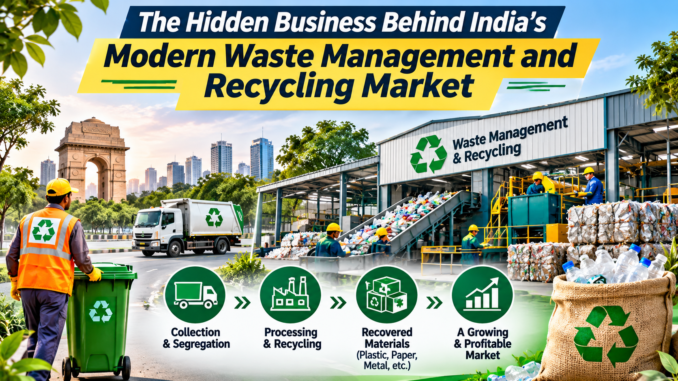
Nov 25: India’s waste management industry is gradually emerging as a significant business opportunity, driven by urbanisation, industrial growth, changing consumption patterns and increasing demand for sustainable solutions. What was once viewed primarily as a municipal responsibility is now attracting entrepreneurs, investors, technology companies and manufacturers looking to turn discarded materials into valuable resources.
From plastic packaging and electronic waste to used batteries and construction debris, the country’s growing waste volumes are creating demand for organised collection, recycling and processing facilities. Behind this activity is an expanding business ecosystem involving waste aggregators, recycling companies, logistics providers, equipment manufacturers and technology startups.
The shift is also changing how businesses view waste. Instead of treating discarded materials as something that simply needs to be disposed of, companies are exploring ways to recover, reuse and generate value from them. This is creating new opportunities within India’s expanding circular economy.
India’s Growing Waste Management Industry
India’s waste management requirements are increasing alongside its expanding cities, manufacturing activity and consumer markets. The growth of e-commerce, packaged goods, electronic products and infrastructure projects is adding to the volume and variety of waste generated across the country.
According to the Ministry of Environment, Forest and Climate Change, India generated approximately 1,85,195 tonnes of municipal solid waste per day during 2023–24. Around 1,79,479 tonnes were collected daily, while approximately 1,14,110 tonnes were processed or treated.
These figures highlight the scale of the challenge, but they also point to considerable business opportunities. Efficient collection, segregation and processing infrastructure will be essential to managing the country’s growing waste burden.
For companies entering this sector, the opportunity is no longer limited to municipal contracts. Businesses can also serve residential communities, shopping centres, hotels, manufacturing facilities, offices and other commercial establishments.
Where the Business Opportunities Exist in India’s Recycling Market
India’s recycling industry consists of several specialised segments, each offering different opportunities depending on the type of waste, processing technology and demand for recovered materials.
Plastic Waste Recycling: Turning Discarded Packaging into Raw Materials
Plastic recycling is one of the most established opportunities within the waste management sector. Packaging materials, plastic containers and discarded household products generate a continuous supply of recyclable waste.
Recycling companies collect, sort and process suitable plastic materials into reusable granules and other industrial inputs. Manufacturers can use these recovered materials in selected applications, including packaging, household products and construction-related goods.
The growing emphasis on responsible packaging and plastic waste management is encouraging businesses to invest in sorting facilities, washing units and recycling machinery.
For entrepreneurs, opportunities exist in collection networks, plastic aggregation, processing facilities and supplying recycled materials to manufacturers. However, profitability depends on the quality of collected plastic, processing costs and demand from end users.
Electronic Waste Recycling: Recovering Value from Old Devices
The increasing use of smartphones, computers, televisions and household appliances is creating a growing electronic waste management requirement.
Discarded electronic products contain materials such as copper, aluminium and other recoverable metals. Recovering these materials requires specialised equipment, trained workers and appropriate environmental safeguards.
India’s e-waste management industry is gradually moving towards a more organised structure, supported by regulatory requirements and the expansion of authorised recycling facilities.
Companies can participate in several stages of this business, including electronic waste collection, refurbishment, dismantling and material recovery.
Corporate offices, IT companies, educational institutions and electronics manufacturers also represent potential customers for organised e-waste collection and recycling services.
Battery Recycling: A New Opportunity in the Electric Mobility Market
The growth of electric vehicles and battery-powered products is bringing battery recycling into greater focus.
Lithium-ion batteries used in electric vehicles, electronic devices and energy storage systems require specialised end-of-life management. Recycling these batteries can help recover valuable materials and reduce dependence on newly extracted resources.
This is creating opportunities in battery collection, safe transportation, dismantling and material recovery.
For businesses, the segment requires considerable technical expertise, investment and compliance with safety and environmental requirements. However, as electric mobility and energy storage adoption expand, battery recycling could become an increasingly important part of India’s industrial supply chain.
Organic Waste Management: From Food Waste to Valuable Resources
Organic waste generated by hotels, restaurants, residential communities, wholesale markets and food processing businesses can support several business models.
Instead of sending biodegradable waste to landfills, specialised companies can process it into compost and biogas. These products can support agricultural activities, energy generation and other commercial applications.
Decentralised composting facilities and biogas plants offer opportunities for businesses serving commercial establishments and residential communities. Such solutions can help reduce the volume of waste sent to landfills while generating useful products.
The commercial potential of this segment is also highlighted in a May 2026 report by the Council on Energy, Environment and Water (CEEW), titled Organic Waste Circular Economy for Viksit Bharat: Jobs, Investment, and Emissions Pathways to 2047.
The report estimates that India’s organic waste sector could unlock a market opportunity of USD 61.5 billion and attract USD 30.2 billion in cumulative capital investment by 2047 under its ambitious green transition scenario. It also identifies the potential for significant employment generation through composting, biomethanation and other organic waste processing activities.
These projections highlight the opportunities available to businesses involved in waste collection, biogas production, compost manufacturing and processing infrastructure. However, realising this potential will depend on reliable waste supplies, commercially viable operations, investment and stronger market linkages.
Construction Waste Recycling: Supporting India’s Infrastructure Growth
India’s expanding real estate and infrastructure sectors are generating significant quantities of construction and demolition waste.
Concrete, bricks, metals and other discarded construction materials can be collected, sorted and processed for reuse.
Recycled aggregates, for instance, can be used in certain construction applications when they meet the required technical specifications.
This creates opportunities for companies specialising in construction waste transportation, processing facilities and the supply of recovered materials.
As urban redevelopment and infrastructure projects continue, organised construction waste management could become an important part of sustainable urban development.
How Extended Producer Responsibility Is Creating New Business Opportunities
Extended Producer Responsibility (EPR) is becoming an important factor in the development of India’s recycling industry.
Under EPR regulations, producers, importers and brand owners have responsibilities for managing specified categories of waste. These requirements encourage businesses to work with authorised recyclers and establish more organised collection and recycling arrangements.
India’s EPR framework covers several waste categories, including plastic packaging, electronic waste, batteries, used tyres and used oil.
This is creating opportunities for recycling companies, waste collection agencies and service providers offering compliance and tracking solutions.
Government information released in 2026 reported 4,574 registered recyclers across different waste streams as of March 2026. The cumulative waste processed across these categories was reported at 417.57 lakh metric tonnes.
The growing number of registered recyclers reflects the expansion of the organised recycling ecosystem and the increasing importance of regulatory compliance.
For businesses, EPR is also creating demand for reliable recycling partnerships, waste documentation and traceability systems.
How Technology Is Changing the Waste Management Business
Technology is helping waste management companies address some of their biggest operational challenges, particularly in collection, segregation, transportation and material recovery.
Artificial intelligence, automated sorting systems and digital tracking platforms are becoming increasingly relevant to modern recycling operations.
For example, automated sorting equipment can help identify different recyclable materials, while digital platforms can connect waste generators with collection agencies and authorised recycling facilities.
Some emerging business opportunities include:
- AI-powered waste identification and segregation.
- Digital platforms connecting waste generators and recyclers.
- Smart waste collection and transportation systems.
- Automated recycling plant operations.
- Digital waste tracking and EPR compliance solutions.
- Technology for recovering reusable materials from complex waste streams.
For startups, these areas offer opportunities to develop specialised solutions for municipalities, manufacturers and recycling businesses.
The Informal Sector Remains Important to India’s Recycling Economy
Despite the growth of organised recycling facilities, India’s waste management industry continues to depend on informal waste collectors, scrap dealers and local aggregators.
These workers play an important role in recovering recyclable materials from households, markets, offices and commercial establishments. Their collection networks help move valuable materials into the recycling supply chain.
However, informal workers often face challenges such as irregular income, inadequate safety equipment and limited access to formal recycling infrastructure.
Greater collaboration between organised recycling companies and informal waste collectors could improve material collection while creating more stable working arrangements.
For recycling businesses, these networks are also important because access to a consistent supply of properly segregated waste directly affects operating efficiency.
Why Businesses Are Looking at Recycling as a Commercial Opportunity
The growing interest in recycling is not driven by environmental concerns alone. Businesses are also recognising its potential to support manufacturing, resource efficiency and supply chain management.
Several factors are contributing to this shift.
Demand for recycled raw materials: Manufacturers are exploring suitable recycled plastics, metals, paper and other recovered materials as alternative production inputs.
Regulatory requirements: EPR obligations are encouraging companies to establish formal waste management partnerships.
Corporate sustainability goals: Businesses are paying greater attention to resource consumption, waste reduction and responsible sourcing.
Industrial demand: Recycling companies can build commercial relationships with manufacturers seeking recovered materials.
Circular economy models: Companies are exploring ways to reduce waste and extend the useful life of products and materials.
These developments are creating opportunities for businesses that can provide reliable collection, processing and material recovery services.
Challenges Facing India’s Waste Management and Recycling Industry
Despite its growth potential, India’s waste management sector faces several challenges that businesses need to consider.
Poor segregation at source remains a major issue. When recyclable and non-recyclable materials are mixed, sorting becomes more expensive and the quality of recovered materials can decline.
Infrastructure is another concern. Setting up recycling facilities requires investment in machinery, land, transportation, trained personnel and regulatory compliance. Smaller companies may find it difficult to manage these costs while maintaining competitive pricing.
The economics of recycling can also change with fluctuations in commodity prices. When virgin materials become cheaper, some manufacturers may have less incentive to purchase recycled alternatives.
Additionally, electronic waste and battery recycling require specialised technology and safety measures. Companies entering these segments need to develop the necessary technical capabilities rather than relying only on collection networks.
Improving waste segregation, strengthening infrastructure and creating reliable demand for recycled materials will be important for the industry’s long-term development.
What Lies Ahead for India’s Waste Management Market?
India’s waste management industry is gradually moving towards a more organised business model, with recycling, technology, manufacturing and resource recovery becoming increasingly interconnected.
The government’s focus on urban sanitation, circular economy initiatives and producer responsibility is creating opportunities for investment in waste processing infrastructure.
Battery recycling, electronic waste recovery, plastic recycling, organic waste processing and construction waste management are among the segments that could attract greater business interest.
Startups may also find opportunities in digital waste management platforms, automated sorting technologies and solutions that connect fragmented collection networks with organised recycling facilities.
However, long-term growth will depend on more than increasing the number of recycling plants. Businesses will need consistent waste supplies, efficient processing capabilities, access to buyers and financially sustainable operating models.
Companies that can combine technology, operational efficiency and responsible resource management are likely to play an important role in the industry’s development.
Conclusion
The business behind India’s modern waste management industry extends far beyond waste collection and disposal. It includes a growing network of recycling companies, manufacturers, logistics providers, technology startups and resource recovery businesses.
As regulations evolve and industries look for more sustainable ways to source materials, waste is becoming an increasingly important part of India’s economic and manufacturing ecosystem.
For entrepreneurs and investors, the opportunity lies in building efficient systems that can turn discarded materials into valuable resources. With the right infrastructure, technology and business models, India’s recycling industry could become an important contributor to the country’s circular economy, industrial development and sustainable growth.
