

Ireland is embracing artificial intelligence (AI) to improve healthcare delivery, support medical professionals and make health services more efficient. From assisting doctors with medical assessments to reducing administrative workloads, AI is creating new opportunities to improve the speed and quality of patient care.
As healthcare services face growing demand, workforce pressures and increasing administrative responsibilities, technology is becoming an important part of the solution. AI can help healthcare professionals process information faster, identify patterns in medical data and make better-informed decisions. The objective is not to replace doctors or nurses, but to give them better tools to deliver effective and timely care.
Ireland’s national AI for Care 2026–2030 strategy reflects this growing focus on responsible AI adoption across clinical services, hospital operations, medical research and public health.
AI Adoption Is Growing Among Irish Doctors
Artificial intelligence is gradually becoming part of everyday medical practice in Ireland. A survey conducted by EY and the Royal College of Physicians of Ireland in 2026 found that 58% of surveyed doctors had used AI in clinical practice during the previous year. More than one in five reported using it daily.
This growing interest reflects the potential of AI to simplify complex tasks and help doctors manage increasing workloads. Medical professionals can use AI tools to summarise patient histories, organise clinical information, prepare consultation notes and explore possible diagnoses.
These applications can make information easier to review and reduce the time spent on repetitive work. However, AI-generated outputs still require professional assessment to ensure that decisions are accurate and appropriate for individual patients.
Faster Diagnosis Through Medical Imaging
One of the most promising applications of AI in healthcare is medical imaging. Hospitals often process large volumes of scans and diagnostic images, making timely assessment an important priority.
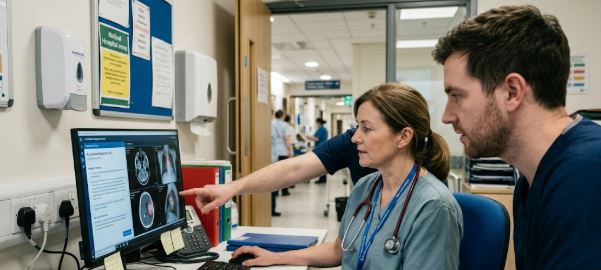
AI-powered systems can help identify patterns in X-rays, CT scans and other medical images. They can highlight areas that may require closer examination and help clinicians prioritise cases that need urgent attention.
In time-sensitive conditions such as stroke, faster assessment can be particularly important. AI-supported decision-making tools may help medical teams review relevant information more efficiently and coordinate the next steps in patient care.
These technologies are designed to support, rather than replace, clinical expertise. Doctors must assess AI-generated findings alongside symptoms, medical history and other diagnostic evidence before determining an appropriate course of action.
Reducing Administrative Work for Healthcare Professionals
Administrative responsibilities can take up a considerable portion of a doctor’s working day. Preparing clinical notes, reviewing patient records and managing documentation are necessary tasks, but they can limit the time available for direct patient care.
AI-powered documentation tools can help prepare consultation summaries, organise medical information and reduce repetitive data-entry work. More advanced systems can assist with summarising lengthy records, allowing healthcare professionals to locate relevant information more quickly.
A 2026 survey of Irish doctors found that 80% saw potential for AI to improve documentation, while 76% identified opportunities to increase efficiency.
For hospitals and healthcare providers, these applications could help streamline workflows and reduce some of the administrative pressure on staff. However, AI-generated notes must be checked carefully to avoid inaccuracies or missing details in patient records.
When used appropriately, these tools can give healthcare professionals more time to focus on patients, explain treatment options and coordinate care.
Supporting Personalised Patient Care
Every patient has different medical needs, treatment requirements and personal circumstances. AI can help doctors review relevant information from medical histories, test results and other clinical records to identify patterns that may support more personalised care.
For example, AI systems can assist in comparing clinical information, identifying potential risk factors and organising evidence for further assessment. In public health, data analysis can help identify disease patterns and support decisions about where healthcare resources may be needed most.
These capabilities could improve coordination between healthcare teams and support more informed treatment decisions.
However, AI recommendations must be evaluated carefully. Systems trained on incomplete or unrepresentative data may produce unreliable results for certain patient groups. Healthcare providers must therefore assess accuracy, fairness and suitability before introducing AI into clinical workflows.
Technology can strengthen medical decision-making, but effective patient care still depends on professional judgement, communication and an understanding of each individual’s needs.
Ireland’s National Strategy Supports Healthcare Innovation
Ireland’s AI for Care 2026–2030 strategy provides a framework for exploring how artificial intelligence can be introduced across the health and social care system. It places emphasis on clinical applications, operational improvements, research and the responsible use of technology.
The strategy creates opportunities for healthcare providers, technology companies and research institutions to work together on solutions that address practical challenges.
Ireland’s established pharmaceutical, medical technology and life sciences industries also provide a strong foundation for innovation. Collaboration between clinicians, researchers and technology developers can help new AI applications move from development to testing and, where appropriate, wider adoption.
For businesses, potential opportunities include diagnostic software, digital health platforms, clinical documentation tools and technologies that support medical research.
However, successful adoption will require more than developing innovative products. Companies must demonstrate meaningful benefits, meet applicable regulatory requirements and ensure that their solutions integrate effectively with existing healthcare systems.
Data Protection and Patient Safety Remain Priorities
The growing use of AI also raises important questions about privacy, accuracy and accountability. Healthcare systems handle sensitive personal information, making secure data management essential.
The 2026 survey of Irish doctors found that 65% were concerned about increased data-breach risks associated with AI, while 59% expressed concern about over-reliance on the technology. A substantial 93% said they needed further training and support to use AI effectively.
These findings highlight the importance of preparing healthcare professionals for the changes that AI brings.
Hospitals and medical organisations need clear policies on how AI tools are used, how patient information is protected and how outputs are reviewed. Staff training is equally important, helping professionals understand both the capabilities and limitations of these systems.
AI applications used in clinical settings must also undergo appropriate evaluation and comply with relevant data protection and healthcare regulations. Maintaining human oversight is essential, particularly when technology influences diagnosis or treatment decisions.
The Road Ahead for Healthcare AI in Ireland
Artificial intelligence has the potential to make healthcare in Ireland more efficient by helping doctors assess information faster, reducing administrative workloads and supporting better-coordinated services.
The country’s national strategy and growing interest among medical professionals provide a foundation for further development. However, the long-term success of healthcare AI will depend on its ability to deliver practical improvements without compromising patient safety or trust.
Investment in digital infrastructure, staff training, secure data systems and clinical evaluation will be essential as adoption expands. Healthcare providers must also measure whether AI tools genuinely improve efficiency, reduce delays and support better patient experiences.
Ultimately, the value of AI will be measured not by how advanced the technology appears, but by how effectively it helps people receive appropriate care. By combining technological innovation with medical expertise and responsible implementation, Ireland can strengthen its healthcare system and create new opportunities for sustainable growth in digital health.
