
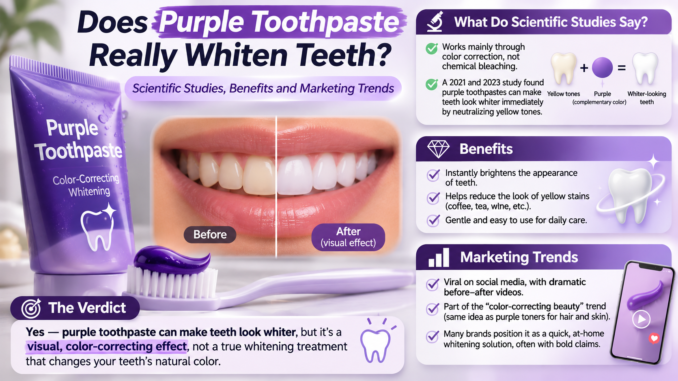
Nov 13: Does purple toothpaste really whiten teeth, or does it simply make them look brighter for a short time? The question has gained attention as colour-correcting toothpaste becomes a popular product in the oral-care and beauty markets.
Promoted through social media videos, influencer recommendations and eye-catching product demonstrations, purple toothpaste is being positioned as a convenient way to achieve a brighter-looking smile. Its appeal lies in a simple idea: using purple pigments to reduce the appearance of yellow tones on teeth.
However, there is an important difference between making teeth appear whiter and actually changing their colour. Scientific research into optical whitening ingredients offers some insight into how these products work, but it does not establish that every purple toothpaste delivers the same results.
What Is Purple Toothpaste and How Does It Work?
Purple toothpaste uses colour correction to make yellowish teeth appear brighter. Purple and yellow sit opposite each other on the colour wheel. When purple pigments are applied to a yellowish surface, they can visually neutralise some of the yellow tones.
This is known as an optical whitening effect. Rather than chemically bleaching the teeth, the pigments influence how their colour is perceived.
The concept is similar to purple shampoos used to reduce yellow tones in blonde or grey hair and colour-correcting products used in cosmetics.
Some purple toothpastes also contain polishing ingredients, such as silica, which help remove surface stains through brushing. This is a separate process from colour correction.
The distinction matters because the optical effect is generally temporary. It does not necessarily remove deeper stains or permanently change the natural shade of teeth.
Does Purple Toothpaste Really Whiten Teeth? What Scientific Studies Reveal
Research into colour-correcting toothpaste has largely examined blue covarine, a pigment used in certain whitening formulations. Blue covarine and purple toothpaste are related through the principle of optical colour correction, but they are not identical. Research on blue-covarine formulations should therefore be interpreted as relevant evidence, not direct proof that every purple toothpaste works equally well.
Several clinical studies help explain what consumers can realistically expect.
Efficacy of Whitening Toothpaste Containing Blue Covarine: A Double-Blind Controlled Randomized Clinical Trial (2021)
Published in the Journal of Esthetic and Restorative Dentistry, this clinical trial involved 75 participants. Researchers compared conventional toothpaste, blue-covarine whitening toothpaste and a 10% carbamide peroxide whitening treatment.
The findings did not show a significant whitening advantage for blue-covarine toothpaste over conventional toothpaste. The carbamide peroxide treatment produced greater whitening.
This suggests that colour-correcting toothpaste should not be considered equivalent to a conventional bleaching treatment.
The Whitening Effect of Single Brushing with Blue-Covarine Containing Toothpaste—A Randomized Controlled Trial (2021)
Published in the Journal of Dentistry, this study examined whether a single brushing session with blue-covarine toothpaste could produce an immediate whitening effect.
The researchers did not find a significant improvement compared with the control toothpaste. The findings indicate that an immediate whitening benefit is not guaranteed across all blue-covarine formulations.
Effect of Blue Covarine Toothpastes on Tooth Colour: A Randomised Crossover Study (2025)
Published in the International Dental Journal, this study involved 66 participants and examined three blue-covarine toothpaste formulations.
The researchers reported improvements in measured tooth whiteness and reductions in yellowness immediately after brushing compared with the control toothpaste.
However, the study focused on the immediate effect of a single brushing session. It did not establish whether the improvement would last over an extended period or whether all purple toothpaste products would produce similar results.
The authors’ affiliations with Unilever Oral Care are also relevant when assessing the research and its commercial context.
Blue Covarine in Toothpaste: A Comprehensive Review and Meta Analysis of Efficacy, Safety, and Potential Effects (2026)
This systematic review and meta-analysis, published in the International Journal of Dental Hygiene, examined available research on blue-covarine toothpaste.
The review reported improvements in tooth colour and perceived brightness across the studies it analysed. However, differences in study methods and relatively small sample sizes were among the limitations.
The review’s literature search covered studies published up to March 25, 2023. It therefore did not include the 2025 randomised crossover study discussed above.
Overall, the research suggests that optical pigments may improve the appearance of tooth colour under certain conditions. However, results vary across formulations and studies. More research is needed to establish how long these effects last and how individual products perform.
Purple Toothpaste vs Traditional Whitening Toothpaste: Understanding the Difference
Although many toothpaste products are marketed as whitening solutions, they do not all work in the same way. Understanding the difference can help consumers make better purchasing decisions.
Purple toothpaste and optical colour correction: These products use pigments to reduce the visual appearance of yellow tones. They may offer an immediate cosmetic effect, but this does not necessarily mean that stains have been removed or the underlying tooth colour has changed.
Whitening toothpaste and surface-stain removal: Conventional whitening toothpastes generally use polishing and cleaning ingredients to remove or reduce surface stains caused by tea, coffee, food and other everyday habits. Their results depend on the formulation and how consistently the product is used.
Peroxide-based whitening and chemical bleaching: Products containing hydrogen peroxide or carbamide peroxide work differently. These ingredients chemically bleach tooth discolouration and can produce a more substantial change in tooth shade. Their effectiveness depends on concentration, application time and the treatment method.
The key distinction is between improving the appearance of teeth, removing external stains and chemically changing tooth colour. These are three different outcomes, even though they may all be promoted under the broad term of teeth whitening.
How Oral-Care Brands Are Marketing Purple Toothpaste
The growing interest in purple toothpaste is also a marketing story. Oral-care companies are finding new ways to connect everyday hygiene products with beauty, grooming and personal appearance.
Influencer Marketing Makes the Product Easy to Demonstrate
Purple toothpaste has an advantage in short-form video marketing: it is visually distinctive and easy to explain.
Creators can demonstrate the product, introduce the colour-wheel concept and show how colour correction is intended to work. Before-and-after videos, beauty tutorials and product reviews give brands several ways to present the product to potential buyers.
Celebrity associations and influencer partnerships can extend this reach to consumers who may not normally follow developments in oral care.
For brands, the opportunity lies in combining product education with engaging visual content. However, demonstrations should accurately represent the temporary nature of the optical effect.
Oral Care Is Becoming Part of the Beauty Market
Consumers are increasingly familiar with products that promise visible improvements in personal appearance. Purple toothpaste fits into this behaviour by borrowing ideas from skincare, haircare and cosmetics.
Terms such as colour correction, instant brightness and beauty routines help position oral-care products beyond their traditional hygiene category.
This shift gives manufacturers an opportunity to reach consumers who are interested in personal grooming and appearance-focused products, while encouraging retailers to expand their oral-beauty selections.
What Should Consumers Know Before Buying Purple Toothpaste?
Purple toothpaste may appeal to people looking for a temporary brighter-looking smile. However, consumers should understand the product’s actual purpose before purchasing it.
A few factors are worth considering:
- Check the whitening claims: Find out whether the product offers temporary colour correction, surface-stain removal or chemical whitening.
- Understand the ingredients: Look at the role of pigments, polishing agents and any bleaching ingredients.
- Keep expectations realistic: The optical effect may fade after brushing and should not be confused with permanent whitening.
- Maintain regular oral hygiene: Colour-correcting toothpaste does not replace brushing properly, flossing or routine dental check-ups.
- Seek professional advice for persistent discolouration: Tooth discolouration can have different causes, and a dentist can recommend an appropriate treatment.
People with sensitive teeth, enamel concerns or existing dental problems should consult a dentist before starting a whitening treatment.
Business Opportunities in the Growing Oral Beauty Market
The rise of purple toothpaste demonstrates how product innovation and changing consumer expectations can create opportunities in an established market.
For oral-care manufacturers, colour-correcting formulations offer a way to differentiate products in a crowded toothpaste category. Distinctive packaging, accessible explanations of colour science and beauty-focused positioning can help products attract attention both online and in retail stores.
Premium positioning is another opportunity. Consumers who are interested in skincare, haircare and personal grooming may be willing to explore specialised oral-care products that promise a visible cosmetic benefit. E-commerce platforms can support this demand through product demonstrations, customer reviews and educational content.
The trend also creates opportunities for marketing agencies. Brands can use influencer partnerships, short-form videos, educational campaigns and targeted social media advertising to explain the science behind their products and reach relevant audiences.
However, long-term success will depend on more than attractive packaging or viral campaigns. Clear product claims, credible evidence and realistic demonstrations are essential to building consumer trust. Brands that explain the difference between temporary colour correction and actual tooth whitening are better positioned to establish lasting credibility.
The Final Verdict: Is Purple Toothpaste Worth Trying?
Purple toothpaste can make teeth appear brighter by reducing the visual effect of yellow tones. For consumers looking for a temporary cosmetic improvement, it may be worth considering.
However, it should not be mistaken for a permanent whitening treatment. Research on blue-covarine toothpaste shows that optical effects can vary across products and clinical studies. These findings also cannot automatically be applied to every purple toothpaste formulation.
The wider significance of this trend lies in how oral care is becoming part of the beauty and personal-care market. Colour science, product differentiation and social media marketing are giving traditional hygiene products a new commercial identity.
For consumers, the best approach is to understand what a product actually does rather than relying only on its whitening claims. For brands, the opportunity is to combine innovation with transparent communication and evidence-based marketing.
