

Cannes, May 15 : Eros Innovation presented AI in Asia at Cannes Next, the official innovation track of the Marché du Film Festival de Cannes, on 14 May 2026. The three-hour programme at the Village Innovation, Pantiero, followed by a reception, brought together over 200 studio leaders, sovereign funds, government representatives, filmmakers, and technology companies to discuss sovereign AI, AI-native storytelling, and the future of film financing.
The programme focused on the idea that Asia is building the infrastructure for AI-native culture through sovereign and rights-aware AI systems. Eros Innovation’s Large Cultural Models launched at the IndiaAI Summit in New Delhi by the Ministry of Electronics and Information Technology (MeitY), Government of India, as a sovereign AI initiative and trained on 1.5 trillion rights-cleared cultural tokens, formed the technological foundation of the discussions. The platform launches globally as Eros Universe in June 2026.
“We came to Cannes not to talk about what AI is doing to the entertainment industry, but to show what happens when AI is built from inside culture rather than on top of it. The industry once embraced VFX because it expanded human creativity rather than replacing it. We believe Cultural Intelligence is the natural next evolution AI built responsibly to enhance creator value, protect identity, and unlock entirely new forms of storytelling for the global entertainment industry.”, said Kishore Lulla, Founder, Eros Innovation.
The programme opened with a keynote by Kishore Lulla, followed by a fireside conversation with Joerg Bachmaier, CEO of Studio Babelsberg, on how AI is changing large-scale film production while preserving human creative decision-making.
The first panel, Sovereign AI vs Platform AI – Who Owns Culture?, examined the development of sovereign AI systems outside dominant US and Chinese platform ecosystems. Speakers included Paul Trillo of Asteria Films, Alex Serdiuk of Respeecher, and Ridhima Lulla of Eros Innovation, with moderation by Anssi Komulainen of the Finnish Innovation Fund Sitra. Discussions focused on AI-native filmmaking, consent-based voice AI, cultural datasets, governance frameworks, and creator identity protection systems.
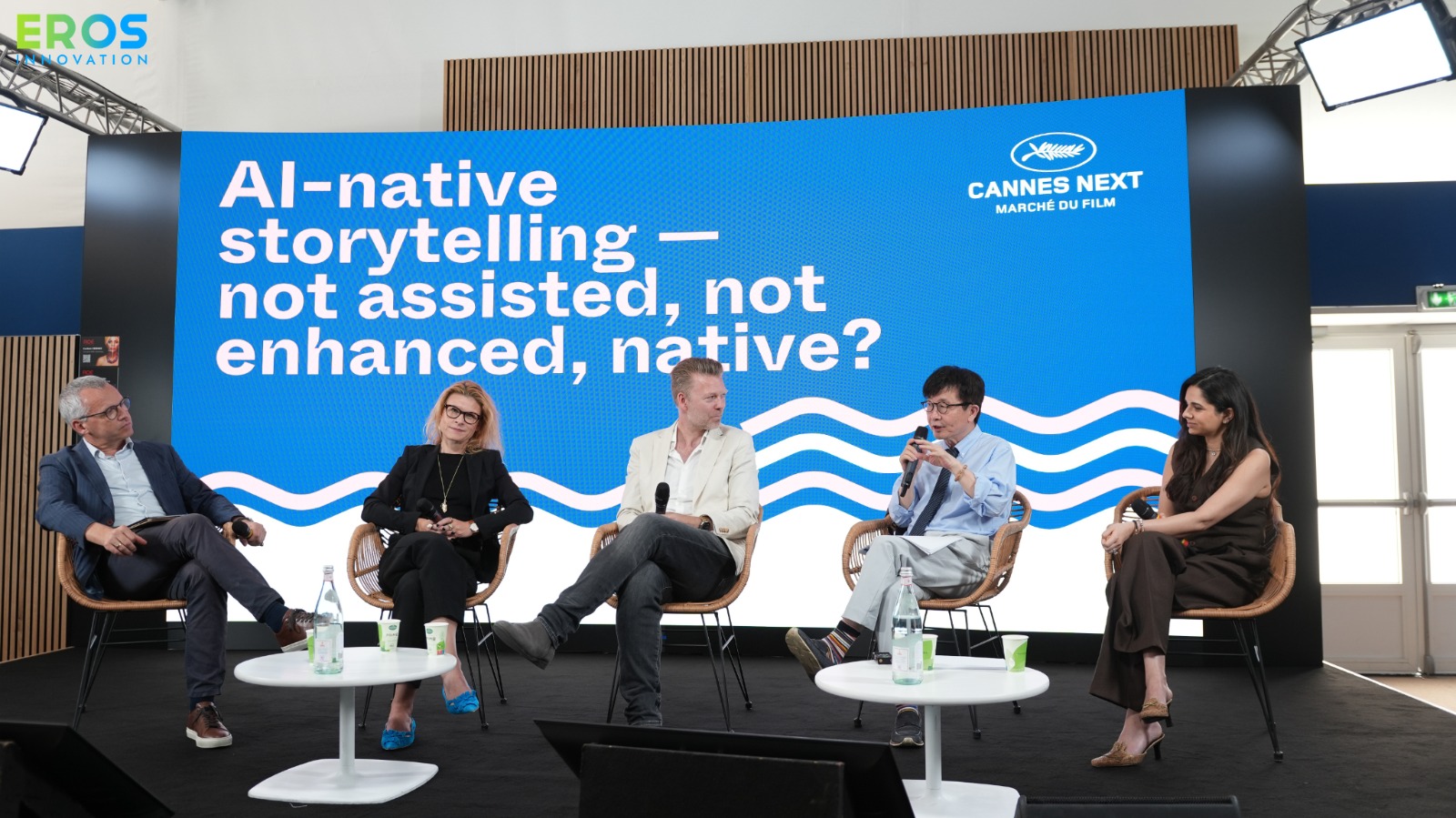
The second panel, AI-Native Storytelling – Not Assisted, Not Enhanced, Native, explored the shift from AI-assisted production to AI-native storytelling. Christina Caspers-Röhmer of Trixter (Cinesite Group), Shin Chul of BIFAN, Ridhima Lulla, and VFX supervisor Martin Madsen discussed AI-native character systems, evolving VFX workflows, and the growing AI filmmaking ecosystem in Asia. The session was moderated by Mikael Windelin.
The final panel, The Future of Film Financing in the AI Era, focused on how AI-driven cost compression and new financing structures are reshaping film funding and ownership models. Speakers included Marc Iserlis of Republic and filmmaker Miguel Faus, whose debut feature Calladita became the first blockchain-crowdfunded film. The discussion, moderated by Piyush Bhatia of Eros Innovation, also referenced Eros Innovation’s own film securitization model.