
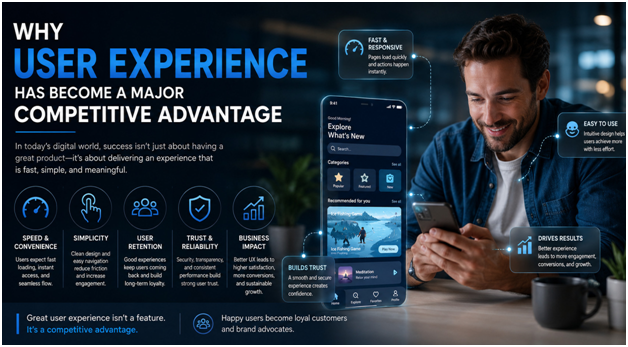

Not long ago, businesses mostly competed on price, product variety, or marketing budgets. Those things still matter, of course, but they are no longer enough on their own. In many industries today, the actual experience people have while using a platform can determine whether they stay loyal or leave within minutes.
User expectations changed faster than many companies expected.
People became used to digital products that feel smooth, fast, and easy to navigate. They expect apps to open instantly, websites to work properly on mobile devices, and interfaces to feel intuitive without needing explanations. Even small frustrations — slow loading times, cluttered menus, or confusing layouts — can push users toward competitors surprisingly quickly.
That shift has quietly turned user experience into one of the biggest competitive advantages modern businesses can have.
Convenience Shapes Decisions
Consumers now interact with dozens of digital platforms every single day. Shopping, banking, entertainment, communication, transportation, and even healthcare increasingly happen through screens.
As a result, people naturally compare every digital experience to the best one they’ve recently had.
If one app allows users to complete something in seconds, patience for slower alternatives disappears. Businesses that remove friction usually keep users engaged longer because convenience itself became valuable.
This is especially visible on smartphones, where people expect everything to feel immediate. Mobile-first behavior forced companies to rethink how they design interfaces, simplify navigation, and reduce unnecessary steps.
Simpler Often Wins
Interestingly, the most successful digital products are not always the ones with the most features.
In many cases, users prefer platforms that feel clear and uncomplicated. Clean layouts, faster loading speeds, and predictable navigation often matter more than endless customization options.
That trend appears across industries. Streaming services simplified interfaces. Banking apps reduced steps for payments. Food delivery platforms optimized ordering flows. Even entertainment-focused platforms increasingly prioritize quick access and responsiveness over visual complexity.
Some casual mobile games have adapted to this behavior as well. Games like Ice Fishing Game https://ice-fishing.in, for example, keep users engaged partly because the experience feels lightweight and straightforward on mobile devices. Players don’t need long tutorials or complicated systems to start interacting with the platform immediately.
That simplicity is not accidental anymore. It’s strategic.
Attention Became Harder to Keep
One of the biggest challenges businesses face today is simply maintaining user attention.
Digital competition is intense because companies are not only competing against direct rivals. They compete against everything else on a person’s phone at the same time. Social media, messaging apps, streaming platforms, news feeds, and mobile games all fight for limited attention spans.
That environment rewards products that feel fast and frictionless.
A slow interface or confusing user flow may not seem like a major problem internally, but users experience those delays emotionally. Frustration builds quickly online, especially when alternatives are only one tap away.
Businesses increasingly understand that retaining attention often depends less on advertising and more on reducing small moments of friction.
Trust Is Also Part of User Experience
User experience is not only about design. Trust matters too.
People pay attention to:
- transparent interfaces
- predictable navigation
- secure payment systems
- responsive support
- mobile reliability
When digital experiences feel unstable or overly complicated, trust drops almost immediately.
This is one reason many businesses now invest heavily in mobile optimization, infrastructure performance, and customer support systems instead of focusing entirely on visual redesigns.
The Companies That Adapt Faster Usually Win
Consumer expectations will probably continue evolving as technology becomes faster and more integrated into daily life.
Artificial intelligence, real-time personalization, and predictive interfaces are already changing how people interact with digital platforms. Users increasingly expect systems to anticipate their needs instead of forcing them to search through menus manually.
Companies that adapt to those expectations early usually gain an advantage because user habits tend to stick once convenience becomes normalized.
At this point, user experience is no longer just a design conversation.
For many businesses, it became one of the main factors influencing growth, engagement, and long-term customer retention.