

Chennai, Feb 27 : Policymakers, industry leaders, sustainability experts, academicians and technology innovators convened at Hall No. 4, New Halls, Chennai Trade Centre for the Water & Waste Sustainability Summit 2026: Driving Circular Economy Solutions, organized by PHD Chamber of Commerce and Industry (PHDCCI) and Water Today. The high-impact summit aimed to advance water stewardship, waste management reforms and circular economy implementation across India at a time when climate variability, rapid urbanisation and industrial growth were intensifying pressure on natural resources.
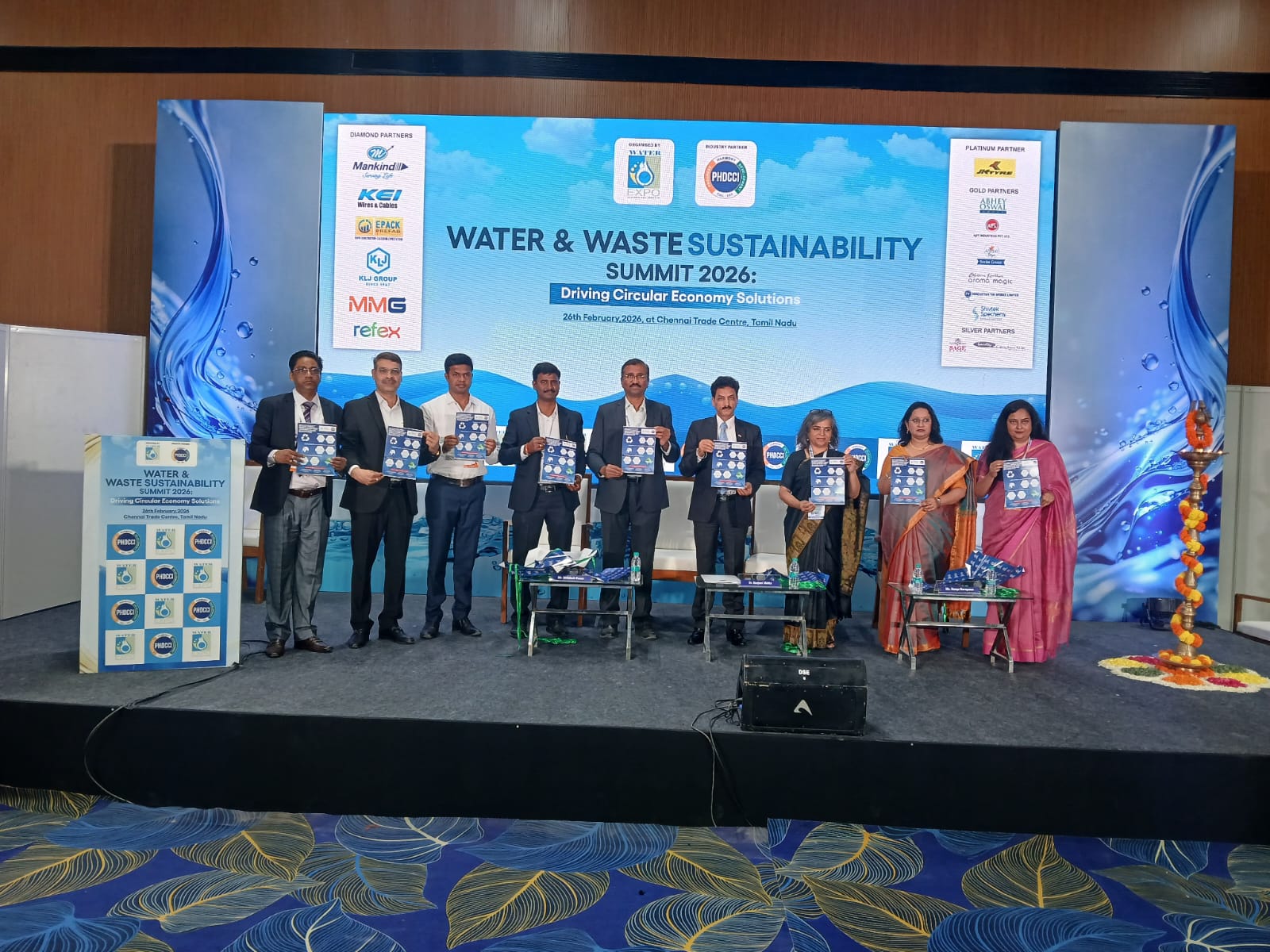
The summit focused on translating sustainability commitments into scalable, measurable action. Deliberations centred on policy alignment, innovative technologies, climate finance and collaborative frameworks that could enable industries and urban systems to transition toward resource efficiency, zero-waste models and sustainable water use.
The summit was virtually inaugurated by Shri Sumant Narain, Joint Secretary (National Water Mission), Ministry of Jal Shakti, Government of India, who delivered the keynote address outlining national priorities for integrated water resource management and conservation. The National Water Mission, under the National Action Plan on Climate Change, had set a clear target of achieving a 20 percent improvement in water-use efficiency across sectors. The mission was being implemented through regulatory reforms, water budgeting, data-driven monitoring and inter-sectoral convergence.
Government initiatives such as Jal Jeevan Mission, AMRUT 2.0 and Atal Bhujal Yojana reflected a strategic shift from supply augmentation to demand management, reuse and efficiency. A key policy priority was the mainstreaming of treated wastewater reuse in urban and industrial planning, integrating reuse mandates into contracts, by-laws and industrial approvals. Water audits, metering and disclosure mechanisms were expected to increasingly form part of compliance and ESG reporting frameworks.
PHDCCI’s Commitment to Measurable Impact
Dr. Ranjeet Mehta, CEO and Secretary General of PHD Chamber of Commerce and Industry, reiterated the Chamber’s commitment to sustainability, stating that water-use efficiency was both a national imperative and an industry responsibility.
PHDCCI committed to achieving at least a 20 percent aggregate improvement in water-use efficiency by 2028 across participating member industries. To translate this commitment into measurable action, the Chamber announced that it would conduct a minimum of 50 training workshops and webinars, develop sector-specific operational toolkits, establish a centralized digital platform for sharing best practices, and implement annual water-use efficiency assessments aligned with transparent benchmarking and sustainability reporting frameworks.
The inaugural ceremony also featured opening remarks by Ms. Ramya Narayan, Editor of Water Today Magazine, who stated that the summit aimed to catalyse actionable solutions that moved beyond dialogue to implementation. The summit was expected to generate strategic partnerships, promote investment in sustainable infrastructure, and reinforce India’s commitment to climate resilience and circular resource management.
Technical Sessions Drove Action
The summit’s technical sessions were structured to combine global perspectives with regional relevance.
The first session, chaired by Dr. Satish Mishra, Chief Sustainability Officer, Trident Group, explored global best practices in water management aligned with the Sustainable Development Goals (SDGs). Industry leaders from Grundfos, Tractors and Farm Equipment Limited (TAFE), JB Chemicals and Pharmaceuticals Ltd., Trident Group and Thermax Limited shared insights into integrating sustainability within industrial operations, alongside discussions on climate finance, green bonds and blended finance mechanisms.
The second session focused on circular economy pathways for water and waste management, highlighting reuse and recycling frameworks and resource recovery models. Experts from Mott MacDonald, TerraLive Envirotech Pvt Ltd, Ion Exchange India Limited and Tata Consultancy Services discussed operationalising circular systems through collaboration among governments, urban local bodies and corporate sustainability teams.
With a special emphasis on South India’s climate vulnerabilities, the third session examined water security, industrial water stewardship, zero liquid discharge systems, decentralized wastewater treatment and smart water management technologies. Representatives from AltTech Consortium, Rain Centre and Murugappa Water Technology and Solutions Pvt Ltd contributed to the dialogue.
Waste management and resource recovery formed the focus of the fourth session, covering integrated solid waste management, plastic and e-waste processing, waste-to-energy solutions, bio-methanation initiatives and construction and demolition waste recycling. Companies such as Earth Recycler Private Limited, Pyrogreen Energy Pvt. Ltd. and Kabadiwalla Connect showcased practical models for closing the resource loop.
The final session, led by Prof. Dr. P. Shanmugam of CSIR-Central Leather Research Institute, underscored the importance of industry–academia–government collaboration in advancing circular solutions. Academic leaders from Anna University, Vellore Institute of Technology Chennai, University of Madras and Pondicherry University deliberated on strengthening institutional partnerships to drive research, innovation and skill development.
Catalysing India’s Circular Transition
By bringing together stakeholders across policy, industry, finance and academia, the Water & Waste Sustainability Summit 2026 catalysed actionable solutions that extended beyond dialogue to implementation. As India accelerated efforts to secure its water future and reduce waste footprints, the Chennai summit stood out as a timely and strategic platform that advanced the country’s transition toward a sustainable and circular economy.