
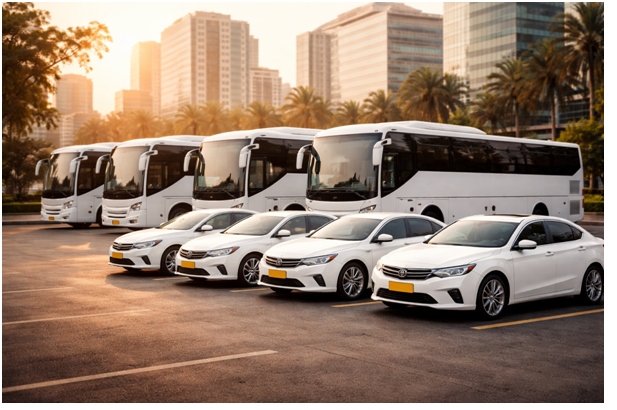

Corporate employee transportation in India is not a new concept. Companies across IT, BFSI, pharma, and manufacturing have relied on some form of cab arrangement or vendor-managed transport for years. What is changing is the weight it carries inside organizations. Transport that was once managed at the periphery, handled informally between HR and a local vendor, is increasingly being treated as a structured business function with direct implications for workforce reliability, safety compliance, and employee retention.
That shift is visible across major Indian business cities, from Bengaluru’s Outer Ring Road corridor to Mumbai’s BKC and Kolkata’s Salt Lake-New Town belt, and it reflects a broader rethinking of what employee experience actually costs when it is managed poorly.
The commute problem is a business problem
India’s urban workforce spends a significant portion of its working day in transit. In cities with high traffic density and uneven public transport coverage, a two-way commute can easily consume two to three hours per employee per day. The downstream effects on organizations are real: late arrivals, shift transition delays, fatigue-linked productivity dips, and elevated attrition among employees who weigh commute stress as a factor when evaluating job offers.
For industries running shift-based operations, such as BFSI, IT/ITeS, BPO, pharma, and manufacturing, these effects are not abstract. A delayed shift handover in a BPO affects SLAs. A late arrival in a pharma plant affects production schedules. The commute, in these contexts, is directly tied to operational continuity, and the cost of getting it wrong shows up in ways that are measurable but often misattributed.
Why structured transport is getting more strategic attention
The growing seriousness around employee transport is happening for several compounding reasons.
First, workforce expectations have risen. Employees, particularly in competitive hiring markets, factor in commute quality when choosing between employers. A structured, reliable transport system signals that an organization invests in employee experience, a distinction that carries real weight during hiring and retention conversations. Companies that previously got away with informal arrangements are finding that expectation gap harder to sustain.
Second, the true cost of informal arrangements has become clearer. Ad hoc cabs, inconsistent reimbursements, and unvetted local operators introduce hidden costs: administrative overhead, safety liability, and service unpredictability. Companies that have explored corporate vehicle leasing as a structured alternative report better cost control, cleaner billing cycles, and greater fleet flexibility compared to open-market dependency.
Third, safety has moved up the priority stack. With more organizations running 24/7 operations and employing a larger share of women in field and shift roles, the safety protocols around employee movement have come under sharper scrutiny. GPS-enabled fleets, monitored routes, trained chauffeurs, and live operational support are no longer seen as premium features. They are becoming standard expectations in enterprise transport contracts.
Kolkata as a case study in corporate mobility maturation
Kolkata’s evolution into a multi-sector business hub illustrates how this shift plays out at a city level. The city’s IT/ITeS activity is concentrated in Salt Lake Sector V and the expanding New Town Rajarhat corridor, while manufacturing and logistics operations extend across industrial zones toward Taratala and beyond.
Each of these zones presents distinct transport challenges that informal arrangements struggle to handle consistently. New Town Rajarhat, still developing its public infrastructure, relies heavily on private mobility. Salt Lake Sector V, with its high employee density, demands route-optimized solutions capable of handling peak-hour volume without service breakdowns. Industrial belts require shift-aligned scheduling with backup fleet support built in.
The response from companies operating across these zones has been a gradual but visible move toward structured transport partnerships with defined safety standards, centralized routing, and operational accountability, away from the patchwork of local vendor arrangements that characterized earlier years.
What a capable transport partner looks like
Not every transport provider is equipped to serve corporate requirements at scale. Organizations evaluating partners typically look for round-the-clock operational capability, GPS-enabled vehicle tracking, backup fleet availability, trained drivers with verified backgrounds, and the ability to manage multi-zone routing across a growing footprint.
Providers with pan-India experience and a dedicated corporate mobility practice tend to be better positioned to support organizations as they scale, expand to new office locations, or navigate the demands of a 24/7 operating model. The difference between a capable partner and a basic vendor becomes most visible not during routine operations, but during disruptions, when backup fleet response, rerouting capability, and communication speed determine whether employee movement holds or breaks down.
The broader direction
What is becoming clearer across Indian cities is that how employees travel to and from work is not separate from how well a business runs. Structured corporate mobility reduces friction, improves punctuality, strengthens safety, and signals to the workforce that the organization takes their daily experience seriously.
The companies expanding their transport infrastructure are not doing so because it is a new idea.They are doing so because the gap between informal arrangements and structured ones has become too visible to ignore, and the business case for closing that gap has grown stronger with every year of rising workforce expectations, tighter safety regulations, and more competitive hiring conditions. For organizations looking to build that foundation, investing in reliable employee transportation services in Kolkata and other major cities is increasingly where that conversation starts.